
Right of way at an intersection with no stop sign or signal: who goes first
Short answer: yield to any vehicle already in the intersection, then to whoever arrived first, and if you arrived together, the vehicle on your right goes first. That is the rule in every state. What changes is which half of it your handbook prints first, and that is what the exam question is built on. Below: the priority order as it actually applies, the official wording from four state sources, what to do when the lights are dead, and the unpaved-road rule almost nobody is taught.

The permit test question, and why three answers look right
The most common way this topic reaches you is a multiple-choice stem that reads roughly: at an intersection where there is no stop sign or traffic signal, drivers must yield to the vehicle that arrives first, vehicles approaching from the left, or vehicles approaching from the right. Two of those three are defensible depending on which sentence of the handbook you remember, which is why the category produces so many wrong answers.
Read the stem for one word: simultaneously, or at the same time. If it is there, the answer is the vehicle on the right. If it is absent, the answer is the vehicle that arrived first. The left-hand option is never correct in any US state. It sits in the answer list only because the real rule is written as a duty on the driver on the left, and a test taker who half-remembers that sentence reaches for the wrong word.

When we re-verified our own question bank against official state sources and corrected 28 answers, right-of-way scenarios accounted for more of those corrections than any other category, and this stem was the single worst offender. The reason turned out not to be the driving rule. It was the handbooks.
What the official sources actually say, word for word
We read the primary source for each state rather than a summary, and the framing genuinely differs. California opens with arrival order. New York states the yield-to-the-right duty with no arrival clause at all. Florida puts both in statute, in order. Arizona writes its version into the dark-signal section. Same behaviour, four different sentences to be tested on.
| State source | What it says | Leads with |
|---|---|---|
| California Driver Handbook | “The vehicle that arrives to the intersection first has the right-of-way.” On a tie, “give the right-of-way to the vehicle, pedestrian, or bicyclist on your right.” | Arrival order |
| New York Driver’s Manual, Chapter 5 | At intersections not controlled by signs or signals, “the driver on the left must yield the right-of-way to the driver on the right.” | Yield to the right |
| Florida Statute 316.121 | Yield to a vehicle “which has entered the intersection from a different highway”; on a tie, “the driver of the vehicle on the left shall yield the right-of-way to the vehicle on the right.” | Already in the intersection |
| Arizona Revised Statutes 28-645(C) | At an inoperative signal every driver “shall bring the vehicle to a complete stop before entering the intersection,” and “the driver of the vehicle on the left shall yield the right-of-way to the driver of the vehicle on the right.” | Stop first, then yield right |
Every competing guide for this query teaches the rule. None shows you that your exam’s wording is drawn from one specific handbook, which is the only reason the three answer choices feel interchangeable.
The priority order, in the sequence it actually applies
Right-of-way is not a single rule. It is a sequence, and each step only matters if the step above it did not settle the question. Work down the list and no scenario on a permit test can trap you.
- Anyone already in the intersection. Florida writes this as the first duty in 316.121, and New York states it plainly: a driver approaching an intersection must yield to traffic that is in the intersection. A car that is halfway through has the right-of-way even if it entered badly.
- Pedestrians and cyclists crossing. They outrank you whether or not the crosswalk is painted, and California names bicyclists in the same sentence as vehicles.
- Whoever arrived first. The California handbook makes this the headline rule for an intersection with no stop or yield signs.
- The vehicle on the right, when two of you arrive together. Stated as a duty on the driver on the left in New York, Florida and Arizona alike.
- The through road, at a T-intersection or where one road clearly ends.
- The paved road, when you are entering it from an unpaved one.
Note what sits at the top. Students who lose marks here almost always jump straight to step four, because the vehicle on the right is the part everybody remembers. Test writers know that, so their scenarios usually turn on step one or step three.
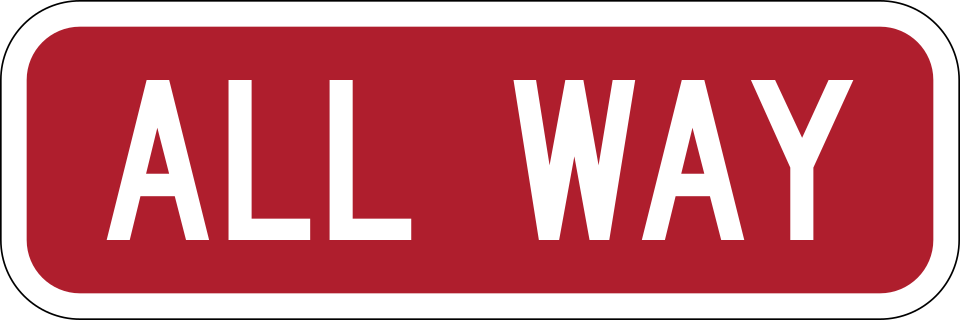
Where a sign is present the sequence is overridden before it starts. A stop sign or a yield sign assigns the duty directly, and the federal MUTCD Part 2B is what standardises those faces nationally. The ALL WAY plaque below a stop sign is the detail worth memorising: without it, the cross traffic may not be stopping at all.


When the traffic lights are out or flashing
A dark signal is the scenario drivers ask about most often and the one where state law really does diverge. Three official sources, three different mechanics, all reaching a safe outcome by slightly different routes.
| State source | What the driver must do | Tie-breaker |
|---|---|---|
| Arizona, ARS 28-645(C) | Complete stop before entering, then “may proceed with caution only when it is safe to do so.” | Driver on the left yields to the driver on the right, in statute. |
| California Driver Handbook | “Stop as if the intersection is controlled by STOP signs in all directions,” then proceed when safe. | Normal all-way-stop order applies. |
| Colorado, C.R.S. 42-4-612 | The rules for entering a through street from a stop sign apply, until an officer takes control or the signal returns to normal operation. | Minor road yields to the through road. Not symmetrical. |
Colorado is the one to look at twice, because it is the exception that most study guides get wrong. The common shorthand is that a dead signal becomes a four-way stop, and in California that shorthand is exactly right. Colorado does something different: it applies its stop-street rules, so the driver on the minor road yields to traffic on the through road rather than taking strict turns. Same stop, different order of departure.
A flashing signal is a separate case and is not malfunctioning. Flashing red carries the meaning of a stop sign, and flashing yellow means proceed with caution, which is why a flashing yellow light at an intersection never grants you the right-of-way by itself.
T-intersections and the through road
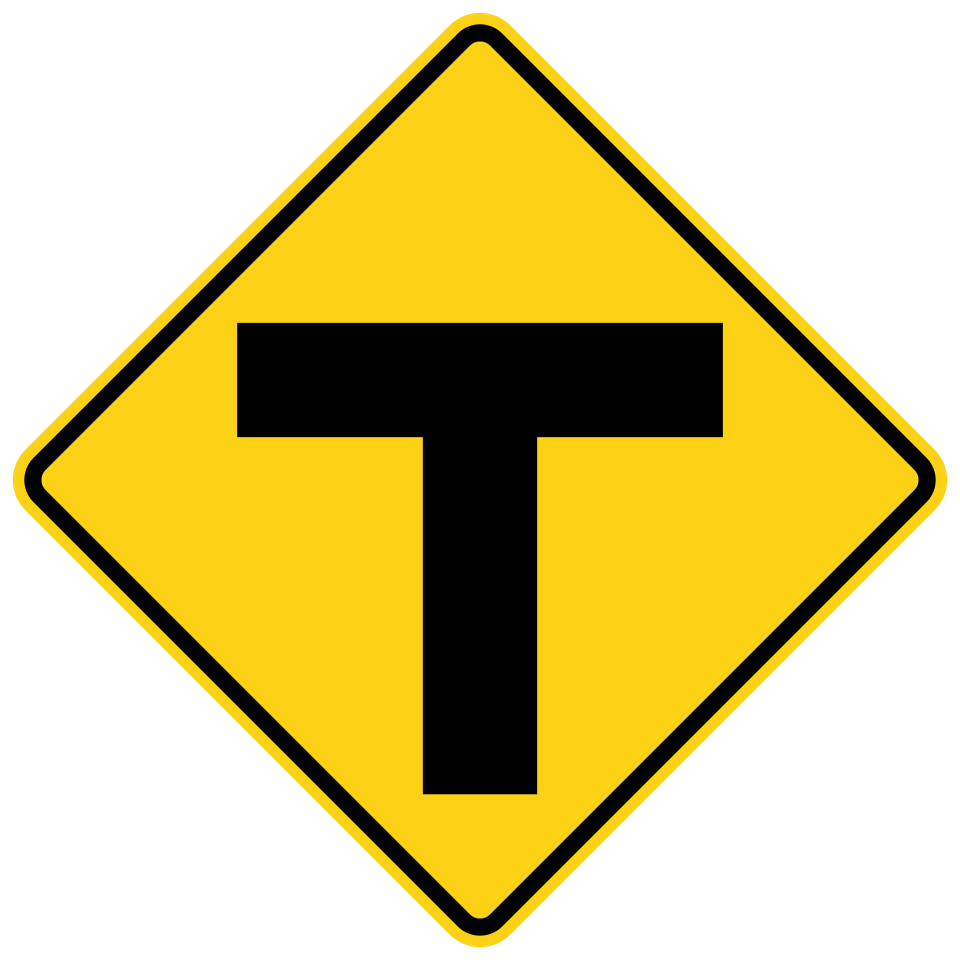
At a T-intersection the road that ends is the stem, and the driver on the stem yields. California states it directly: vehicles, bicyclists and pedestrians on the through road have the right-of-way. The duty does not depend on a sign being present, so an unsigned T still works this way, and the yellow W2-4 above is a warning that one is coming rather than a control device.
Two details decide the harder exam versions. A pedestrian crossing the through road outranks you regardless of road class, and a left turn off the stem crosses the near lane before merging into the far one, so you yield to both directions rather than only the one you are joining. The full geometry is on our T-intersection rules page.
The unpaved-road rule almost nobody is taught
This rule appears on state exams and in no major competing guide for this query. When you enter a paved road from an unpaved one with no sign or signal at that spot, you yield, even though nothing tells you to and even though you may have arrived first.
Florida writes it twice in the same statute. Under section 316.121(3), a driver entering or crossing a state-maintained road from a paved or unpaved road where no official traffic control device applies “shall yield the right-of-way to all vehicles approaching on the state-maintained road or highway.” Subsection (4) repeats the duty for an unpaved road meeting a paved county or city road. The logic is surface and road class, not arrival order, and it quietly overrides the vehicle-on-the-right rule you were about to apply.
The same statute answers the penalty question that circulates with this topic. Florida classes a violation of 316.121 as “a noncriminal traffic infraction, punishable as a moving violation as provided in chapter 318.” There is no national thousand-dollar fine or automatic suspension for failing to yield. Penalties are set per state and escalate when the failure causes a crash, so treat any dollar figure quoted without a state name as unreliable.
How to search an intersection before you enter it
Knowing the priority order does not help if you have not seen the other car. The searching habit driver educators teach, and that the harder exam questions are built around, is a sequence rather than a glance.
- Left first. Traffic from your left reaches your path before traffic from your right, because it crosses the near lane. This is the single most useful ordering detail on this page and it is why questions about where to look first score the left answer.
- Then ahead, through the intersection, for oncoming vehicles preparing to turn across you and for anything blocking your exit. New York’s manual tells drivers to wait until traffic ahead clears so they do not block the intersection.
- Then right, which is both the direction that can legally take priority from you on a tie and the last one to reach your path.
- Then left again before you commit, because the gap you measured a second ago has closed by the time you finish the other two checks.
Cover the brake as you approach rather than holding speed to the limit line. Most state codes require you to yield at an uncontrolled intersection rather than stop, and yielding means arriving at a speed from which you could stop. That is a decision about your speed well before the junction, not one you make at it.
The mistake that costs the most marks
Two cars reach a four-way stop at the same moment, facing each other, and both are signalling left. Most students answer that the two drivers turn in front of each other, because that is the manoeuvre they have watched adults perform. The scored answer is the right-of-way sequence: the drivers are opposite each other rather than at right angles, so neither is on the other’s right in the sense the rule means, and the exam wants the driver who arrived first, or mutual yielding and a clear communication if they truly arrived together.
A second trap is treating right-of-way as something you hold. No state code grants it. Every sentence quoted on this page is written as a duty to yield, and that is deliberate: the rules say when to give way, never when to take it. Read each answer option looking for the one that describes giving way, and this category stops being the hard one.
Sample questions on right of way at intersections
Four practice questions on this topic, written from the sources quoted above. Tap to reveal the answer.
Question 1: At an intersection with no stop sign, yield sign or traffic signal, who must yield?
- The vehicle approaching from the left yields
- The vehicle approaching from the right yields
- Neither, both vehicles must come to a complete stop
Correct: The vehicle approaching from the left yields
Why: When arrival order does not settle it, the duty falls on the driver on the left. New York’s manual and Florida Statute 316.121(2) use nearly identical wording. Neither requires a stop at an uncontrolled intersection.
Question 2: A traffic signal is completely dark because of a power failure. How do you proceed?
- Proceed through the intersection without slowing, since no signal applies
- Wait at the intersection until the signal starts working
- Stop before entering, then proceed when it is safe
Correct: Stop before entering, then proceed when it is safe
Why: Arizona Revised Statutes 28-645(C) requires a complete stop, then permits a driver to proceed with caution only when it is safe. California’s handbook reaches the same place by telling drivers to stop as if stop signs faced every direction.
Question 3: You are turning from a dirt road onto a paved county road with no signs. Who yields?
- You yield to traffic on the paved road
- Traffic on the paved road yields to you if you arrived first
- Whichever vehicle is on the right has the right-of-way
Correct: You yield to traffic on the paved road
Why: Road surface and class override arrival order. Florida Statute 316.121(4) requires a driver entering a paved county or city road from an unpaved road, where no traffic control device applies, to yield to all approaching vehicles.
Question 4: A pedestrian steps into an unmarked crossing as you reach an uncontrolled intersection.
- The pedestrian must wait, because the crosswalk is not painted
- You yield to the pedestrian
- You have the right-of-way if you arrived at the intersection first
Correct: You yield to the pedestrian
Why: Pedestrians sit above vehicles in the sequence, and an unmarked crossing at an intersection still counts as a crosswalk in most state codes. California’s handbook names pedestrians and bicyclists in the same yielding sentence as vehicles.
Practice right of way at intersections in your state
This topic is tested across all 50 states, and because the wording comes from your own handbook, practising on your state’s question set is what makes the difference. Popular state pages that include right-of-way questions: Texas permit test practice, Pennsylvania permit test, Ohio permit test, Georgia permit test and North Carolina permit test. Or browse all 50 states plus DC. For the wider rule set beyond intersections, see our right-of-way rules guide, and for the signs that override the sequence entirely, the road sign guides.
FAQ
At an intersection with no stop sign or traffic signal, who do drivers yield to?
Yield to any vehicle that is already in the intersection, then to whichever vehicle got there first. If two of you arrive at the same moment, the driver on the left yields and the vehicle on your right goes first. Most state exams score the arrival-order answer as correct, so read the stem carefully: it usually says the vehicles arrive at the same time, which is what makes the vehicle on the right the answer.
Who has priority at an intersection with out-of-order traffic lights?
Treat a dark or out-of-order signal as a stop, then apply the normal right-of-way order. Arizona puts both halves in statute: every driver stops, and the driver on the left yields to the driver on the right. California tells drivers to stop as if the intersection had stop signs in all directions. Colorado instead applies its stop-street rules, so the minor road yields to the through road rather than taking strict turns.
Who goes first at a four-way uncontrolled intersection?
The first vehicle to arrive goes first. When two arrive together, the vehicle on the right has the right-of-way. When all four arrive together, which almost never happens outside an exam question, drivers yield to the right in turn and the intersection clears counterclockwise.
What makes an intersection uncontrolled?
No stop signs, no yield signs, no traffic signal and nobody directing traffic. Pavement markings alone do not control an intersection. A yellow Cross Road sign (W2-1) warns you that one is coming, but it is a warning sign, not a control device, so it does not change who yields.
Do you have to stop at an uncontrolled intersection?
Not usually. Most state codes require you to yield rather than stop, so you slow to a speed that lets you stop if someone is coming. The exception is a dark or malfunctioning signal, where states such as Arizona require a complete stop before you enter.
At a T-intersection, who has the right of way?
Traffic on the through road, the one that continues straight through, has the right-of-way. The driver on the stem of the T yields to it, and also yields to pedestrians crossing the through road, whether or not the crosswalk is painted.
Are right-of-way rules at intersections the same in every state?
The driving behaviour is nearly identical everywhere, but the official wording is not. California’s handbook leads with first-to-arrive and uses the vehicle on the right only to break ties. New York’s manual states the yield-to-the-right rule with no arrival clause at all. The wording matters only because your exam questions are written from your own state’s handbook.
Practice right of way and 13 other test categories
DMV Ready covers every category on your state’s permit test. 4,000 questions, all 50 states plus DC, free to start.