
Yellow diamond warning signs: what each shape and symbol means
A yellow diamond with black symbols is a warning sign: it tells you a hazard is coming, not what the law requires of you right now. The federal rulebook is blunt about the design. Warning signs “shall be diamond-shaped (square with one diagonal vertical) with a black legend and border on a yellow background,” per Section 2C.02 of the Manual on Uniform Traffic Control Devices. That is where most permit-test questions on this topic start and stop. Below are the codes, the posting distances in feet, the colour exception most study guides get wrong, and the sign pairs people mix up.
Checked against the MUTCD 11th Edition (December 2023) on 4 October 2026.

What a yellow diamond actually tells you
Warning signs do not regulate. They forecast. A regulatory sign carries a rule you can be ticketed for breaking; a warning sign in yellow carries a hazard you are expected to read and adjust for. That split is the single most reliable way to answer a sign-category question you have never seen before: black or red on white means law, yellow with black symbols means caution, orange means a temporary work zone.
Shape carries the same information as colour, and the diamond shape is not quite absolute. Section 2C.02 of the FHWA Manual on Uniform Traffic Control Devices, 11th Edition, the 58-page chapter we read for this guide, sets the diamond as the standard, then allows an exception in the next paragraph: a warning sign larger than the oversized size in Table 2C-1 “may be diamond-shaped or may be rectangular or square in shape,” typically for overhead installations. Size follows road type as well. The minimum for a diamond facing traffic on a multi-lane road posted above 35 mph is 36 by 36 inches, against 30 by 30 on a single-lane road, which is why the same curve warning looks bigger on a four-lane highway.
Searches for this phrase also surface workplace hazard labels, the ANSI Z535 family bolted to machinery and wet floors. Those sit under a separate standard, and nothing below applies to them. Everything here is roadway signing under the MUTCD.
The warning signs that carry most of the test questions
Every state writes its own exam, but the federal set of traffic warning signs is the same everywhere, so the same dozen codes do most of the work. We built our warning-sign question set by reading state handbooks against the MUTCD rather than copying other practice apps, and re-verifying every answer against official sources made us correct 28 of them. Alignment signs were the worst offenders: Turn, Curve, Reverse Curve and Winding Road differ by one arrow stroke.
| MUTCD code | Official name | What it warns about | Where people lose the point |
|---|---|---|---|
| W1-1 | Turn | A sharp turn | Advisory speed 30 mph or less |
| W1-2 | Curve | One curve ahead | The default alignment sign |
| W1-3 | Reverse Turn | Two sharp turns, opposite directions | Confused with Winding Road |
| W1-4 | Reverse Curve | Two gentle curves, opposite directions | Exactly two, never three |
| W1-5 | Winding Road | Three or more curves | S-arrow means a series |
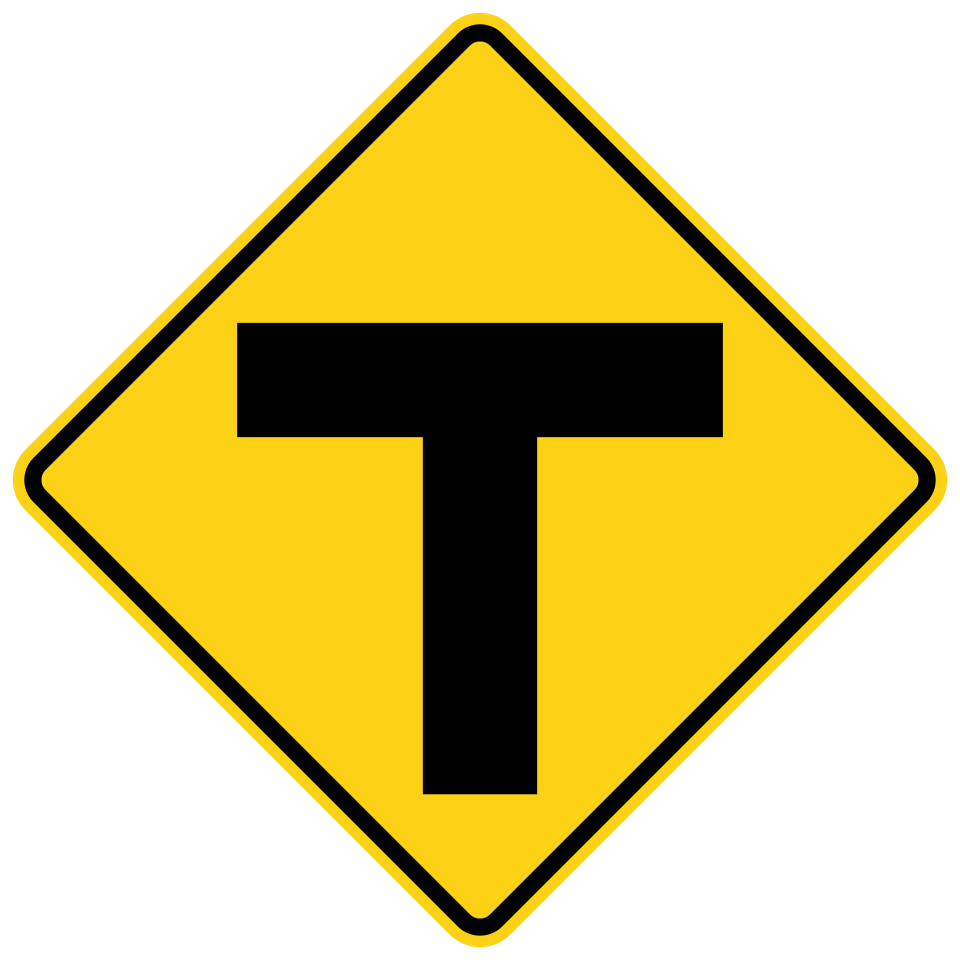
| W2-4 | Intersection Warning (T symbol) | Your road ends at a cross street | Read as Dead End |
| W3-1 | Stop Ahead | A stop sign you cannot see yet | Stop Ahead signs warn early |
| W4-1 | Merge | Traffic may enter your lane | Confused with Yield |
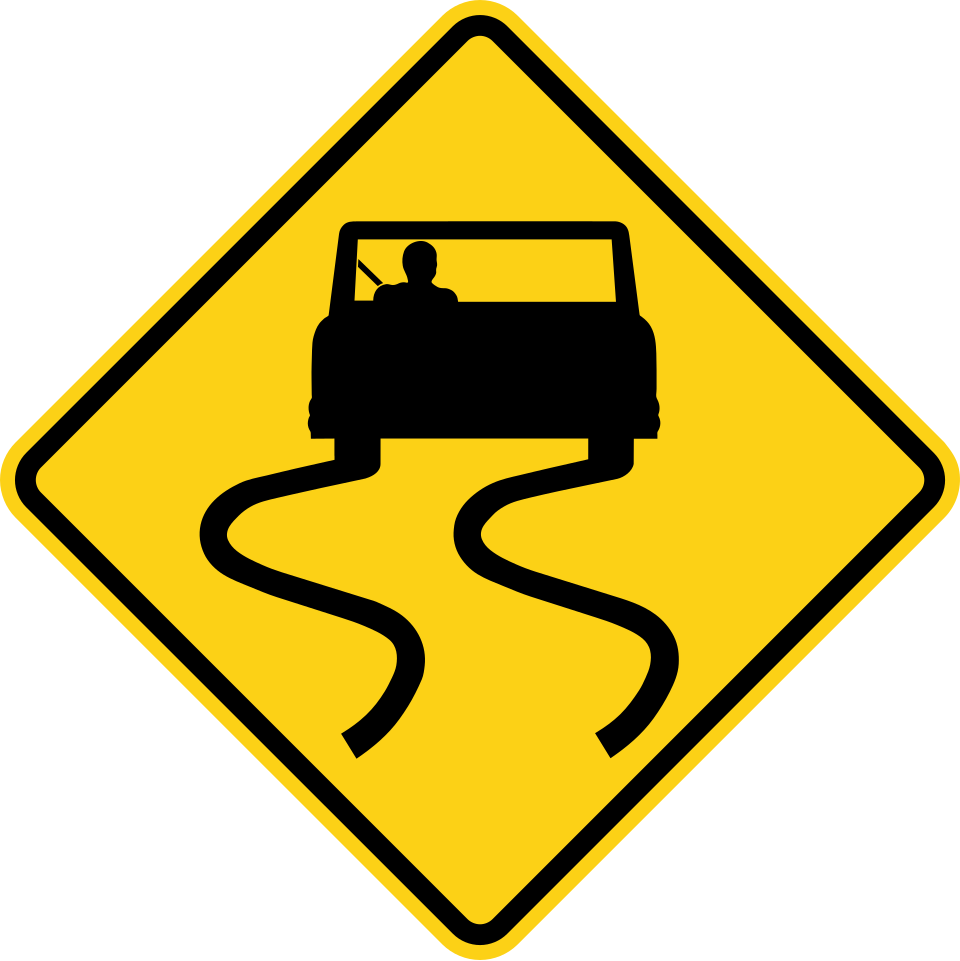
| W8-5 | Slippery When Wet | Surface unusually slick in rain | Read as gravel or unpaved |
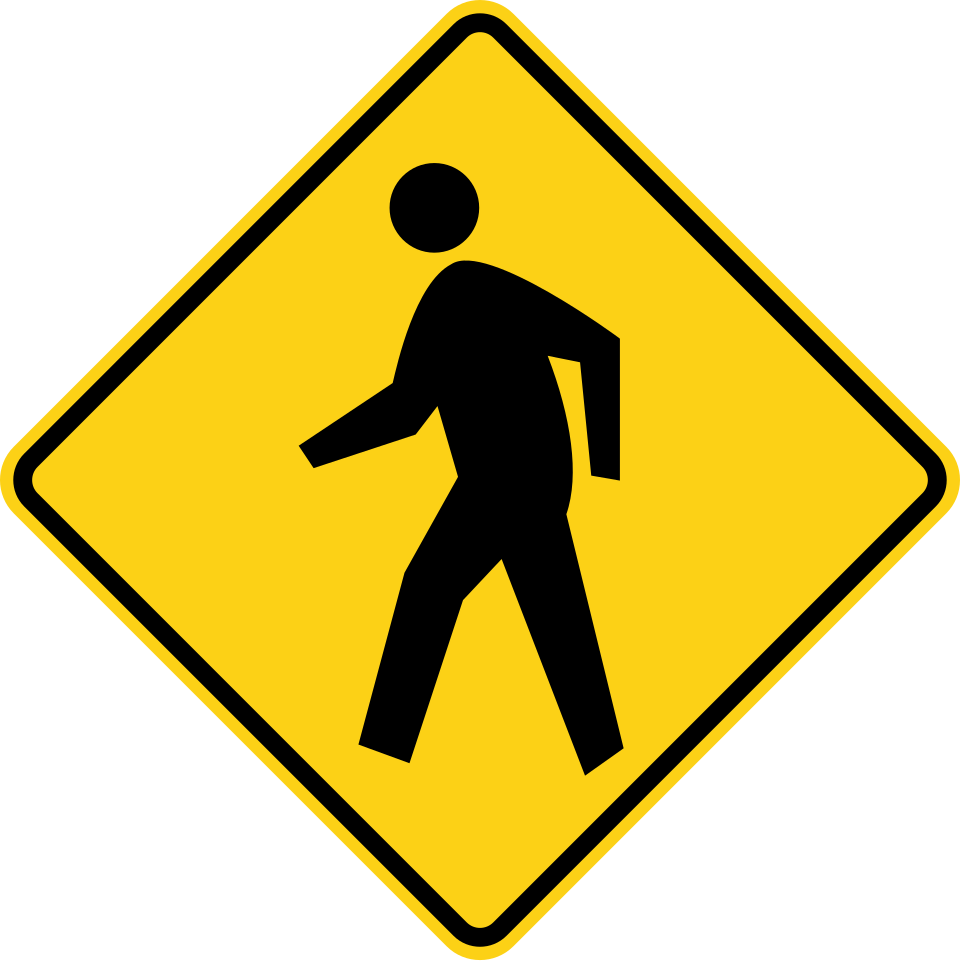
| W11-2 | Pedestrian Crossing | A marked crosswalk ahead | Mistaken for school crossing |
| W11-3 | Deer Crossing | Animals cross here regularly | Distractors suggest honking |
| W14-1 | DEAD END | The road has no outlet | A word sign, not a symbol |


The Turn and Curve pair has a numeric rule behind it, which turns a coin flip into an answer. MUTCD guidance says a Turn (W1-1) sign should be used instead of a Curve (W1-2) sign in advance of a horizontal curve with an advisory speed of 30 mph or less. Thirty is the hinge: above it, the gentle arrow; at or below it, the right angle.

Counting is the other trap in that family. Reverse Turn (W1-3) and Reverse Curve (W1-4) both mean exactly two changes of direction, while Winding Road (W1-5) means three or more.
Animal warnings work differently from the rest, and study material rarely says so. The MUTCD treats conditions not tied to a specific location, Deer Crossing among them, as placeable wherever engineering judgment puts them, so there is no advance distance to compute. The hazard is the whole stretch, and it is not trivial: IIHS fatality data counts 210 deaths in collisions with animals in 2024, against 7,979 in collisions with fixed objects.
Yellow or fluorescent yellow-green: the colour split study guides miss
Ask ten practice apps what colour a warning sign is and ten say yellow. The manual is more specific, and the difference is testable. Warning signs about schools and school buses, and their supplemental plaques, shall carry a black legend and border on a fluorescent yellow-green background: a Standard, which in MUTCD language means mandatory. Pedestrian, bicyclist and playground warnings sit one notch down and may use either colour.
| Sign group | Required background | Status in the manual |
|---|---|---|
| Most hazards: curves, intersections, surface, merges | Yellow background, black legend and black border | Standard (2C.02 para 1) |
| School area and school bus warnings, and their plaques | Fluorescent yellow-green | Standard, mandatory (2C.02 para 9) |
| Pedestrian, bicyclist, playground warnings and plaques | Yellow or fluorescent yellow-green | Option, agency choice (2C.02 para 8) |
| Any supplemental plaque | Must match the sign it supplements | Standard (Figure 2C-16 note) |
| Temporary work zone warnings | Orange | Set by the temporary traffic control part |
So a school zone sign in bright lime-green is not a faded yellow sign or a local quirk; it is the federal standard, and the pentagon school-crossing sign (S1-1) uses the same colour. Our pedestrian crossing sign guide covers the half-and-half case, where the identical W11-2 symbol ships legally in either background. Note also that the US uses the diamond while most of the world uses a red-bordered triangle, so a yellow triangle in a question is testing a non-US convention that state exams rarely touch.
How far ahead the sign is posted, in feet
Warning signs are not placed by habit. Table 2C-3 of the MUTCD sets advance distances built from perception-reaction time, a deceleration rate and an assumed legibility distance. On a road posted at 55 mph, a Merge or Lane Ends sign goes roughly 990 feet ahead of the convergence point, because that manoeuvre is modelled with 14 seconds of decision time in heavy traffic. A Stop Ahead sign on the same road goes about 495 feet out, modelled on stopping sight distance with 2.5 seconds of reaction.
| Posted or 85th-percentile speed | Speed reduction and lane change in heavy traffic (Merge, Lane Ends) | Potential stop (Stop Ahead, Yield Ahead, Signal Ahead, Intersection) |
|---|---|---|
| 25 mph | 325 ft | 155 ft |
| 30 mph | 460 ft | 200 ft |
| 35 mph | 565 ft | 250 ft |
| 40 mph | 670 ft | 305 ft |
| 45 mph | 775 ft | 360 ft |
| 50 mph | 885 ft | 425 ft |
| 55 mph | 990 ft | 495 ft |
| 60 mph | 1,100 ft | 570 ft |
| 65 mph | 1,200 ft | 645 ft |
| 70 mph | 1,250 ft | 730 ft |
Two things fall out of that table for the road, not just the test. The sign is calibrated to the speed limit, so travelling well above it leaves less margin than the engineer allowed. And signs with a legend under six inches or over four words get another 100 feet, so word signs sit further out by design.
Below about 35 mph the table stops giving numbers for alignment warnings and defers to site conditions: such a sign may be placed anywhere from the point of curvature up to 100 feet in advance of the curve. Spacing that feels arbitrary on a slow residential street genuinely is a judgment call.
Advisory speed plaques are a recommendation with a legal edge
The small yellow square under a warning sign is an Advisory Speed plaque, code W13-1P, and it behaves differently from the white speed limit sign. Three rules from Section 2C.59 are worth holding on to: the displayed speed must be a multiple of 5 mph, the plaque cannot stand alone and only supplements an advance warning sign, and outside emergencies the number comes from an engineering study.

Whether you can be ticketed for exceeding it is what students actually ask, and the answer is state-specific with a consistent shape. California states it plainly in the Caltrans manual for setting speed limits: “A driver may be cited for exceeding the posted advisory speed if they encounter, or create, a problem when exceeding the advisory speed,” and “a driver may not be cited solely for exceeding the posted value of an advisory speed sign.” The advisory number is not the charge. The basic speed law, which says you may never drive faster than is safe for conditions, is. Taking a 35 mph advisory curve at 55 and sliding across the centre line is a basic speed law case the plaque helps prove.
California permit test practice questions tend to probe that recommendation-versus-law line, while Pennsylvania permit test practice and New York permit test practice lean on symbol recognition. The New York State driver’s manual chapter on traffic control is a short read on the category if your own handbook is thin on it.
Common test traps, and the one mistake that costs the most points
Symbol confusion is the whole game. Questions show you a sign with no context and no road around it, which strips out every cue you would actually use while driving. Four pairs account for most of the damage.
- Curve versus Winding Road. One bend is W1-2, three or more is W1-5, two in opposite directions is W1-4. Count the arrow strokes.
- T intersection versus Dead End. A black T (W2-4) means your road ends at a cross street. DEAD END (W14-1) means no outlet. Our T-intersection rules guide covers the right-of-way part.
- Merge versus Yield. Merge (W4-1) warns traffic may enter your lane. A yield sign is regulatory and assigns right of way; warning signs never do.
- Diamond sign versus diamond pavement marking. A diamond painted in a travel lane marks a high-occupancy vehicle lane, which is pavement marking territory.
The costliest single mistake is subtler: treating a warning sign as an instruction. Picture a Signal Ahead sign on a 45 mph arterial, posted about 360 feet before the light. Read as “stop here” it causes early braking and a rear-end hit. Read as “a signal exists, cover the brake, expect red” it arrives prepared. Exam questions mirror that distinction constantly, and the wrong answer is usually the one that turns a forecast into a command.
Colour questions carry a second layer: where both “yellow” and “fluorescent yellow-green” are offered and the sign involves a school, green wins, because it is a Standard not an Option. Our guide to what each warning sign colour means lays out the rest of the system, and work zone signs covers the orange family.
Sample questions on warning signs
Here are 4 practice questions on this topic. Tap to reveal the answer.
Question 1: A yellow diamond sign shows an arrow that curves left, then right. What does it mean?
- Two curves in opposite directions
- Three or more curves ahead
- A sharp turn with an advisory speed of 30 mph or less
Correct: Three or more curves ahead
Why: The S-shaped arrow is Winding Road, MUTCD code W1-5, used for three or more changes in horizontal alignment. Exactly two is a Reverse Curve (W1-4) or Reverse Turn (W1-3).
Question 2: What action should you take when you see a diamond-shaped Merge warning sign ahead?
- Be ready to change your speed and lane so other drivers can merge safely
- Move to the left lane immediately
- Speed up to prevent other vehicles from merging
Correct: Be ready to change your speed and lane so other drivers can merge safely
Why: The Merge sign (W4-1) warns that lanes from two roadways converge and traffic may move into yours. On a 55 mph road it sits roughly 990 feet before the merge point.
Question 3: A warning sign about a school crossing must have which background colour?
- Yellow
- Fluorescent yellow-green
- Either yellow or fluorescent yellow-green
Correct: Fluorescent yellow-green
Why: MUTCD Section 2C.02 makes this a Standard: school and school bus warning signs and their plaques shall use a black legend and border on fluorescent yellow-green. Pedestrian, bicyclist and playground warnings may use either colour.
Question 4: You see a yellow diamond with a deer symbol. What should you do?
- Honk your horn continuously to scare away animals
- Be alert and slow down if you see deer or other wildlife
- Maintain your current speed, since animals avoid vehicles
Correct: Be alert and slow down if you see deer or other wildlife
Why: Deer Crossing (W11-3) marks a stretch where animals cross regularly, not a single point, so the MUTCD sets no fixed advance distance. Scan the shoulders and expect more than one animal.
Practice warning signs in your state
This topic is heavily tested across all 50 states. Popular state pages with warning-sign questions include California, Pennsylvania, New York, Massachusetts and Washington. Or browse all 50 states plus DC.
Learn the categories before the individual pictures. Yellow diamond means a hazard is coming, white rectangle means a law applies, orange means temporary work, fluorescent yellow-green means children are involved. Get those four right and an unfamiliar symbol becomes a good guess rather than a blank. Then drill the look-alike pairs, because that is where the points go. Run a timed set of warning-sign questions for your own state in DMV Ready, which uses the same exam format your DMV does, and work the misses until the arrow strokes read instantly. Our road sign guides cover every other category in this depth.
FAQ
What does the yellow warning sign mean?
A yellow sign with black symbols or letters warns that a hazard or a change in conditions is ahead: a curve, an intersection, a crosswalk, a slick surface, animals, or merging traffic. It does not impose a rule. Under MUTCD Section 2C.02 the standard design is a diamond with a black legend and border on a yellow background.
Why are warning signs yellow?
Yellow is the MUTCD-assigned colour for general warning, and it holds its contrast against both daylight and headlight illumination better than most alternatives. The colour code is systematic: yellow for warning, white for regulatory, orange for temporary traffic control, fluorescent yellow-green for school and pedestrian-related warnings.
What are 7 examples of a warning sign?
Curve (W1-2), Winding Road (W1-5), Stop Ahead (W3-1), Merge (W4-1), Slippery When Wet (W8-5), Pedestrian Crossing (W11-2) and Deer Crossing (W11-3). All seven use the yellow diamond, and all seven appear regularly on state permit exams.
Are warning signs always diamond-shaped?
Almost always, and the exception is written into the manual. A warning sign larger than the oversized size listed in MUTCD Table 2C-1 may be rectangular or square instead, which is typical for overhead installations. On the test, treat diamond as the answer unless the question is specifically about oversized or overhead signs.
Can I get a ticket for exceeding an advisory speed?
Not for the number alone in most states. California’s Caltrans guidance says a driver may not be cited solely for exceeding the posted value of an advisory speed sign, but may be cited if exceeding it creates a problem, under the basic speed law. Check your own state’s wording, since enforcement language varies.
How often do warning signs appear on the DMV permit test?
They show up on virtually every state’s permit test. Expect at least 1-3 questions on warning signs on a 25-question exam, and more on longer exams. Sign recognition is usually one of the largest single categories on the written test.
Are warning signs the same in every state?
The shapes, colours and codes are federally standardised through the MUTCD, so a Curve sign in Oregon matches a Curve sign in Georgia. What varies is the state layer on top: advisory speeds, enforcement wording, fines, and which signs a given handbook chooses to feature.
Practice warning signs and 13 other topics
DMV Ready covers every category on your state’s permit test. 4,000 questions, all 50 states + DC, free to start.