DMV Vision Test Requirements: What to Expect by State
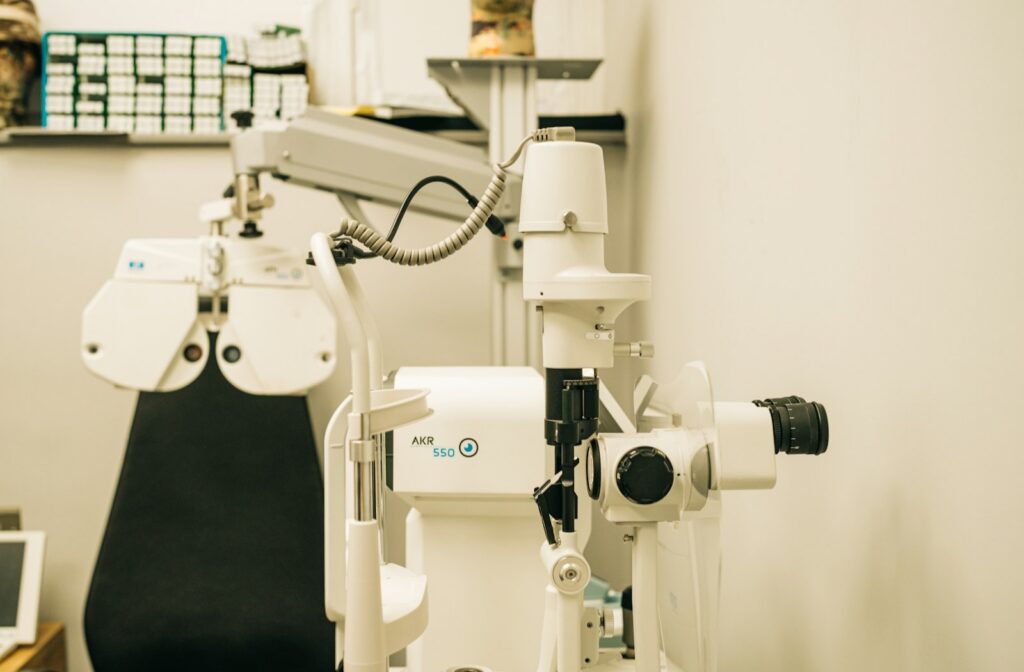
Almost every driver license counter in the country hides the same small machine: a viewer you press your forehead against and read a line of letters. That is the DMV vision test, and for most people it takes under a minute. The bar you need to clear is usually 20/40 visual acuity in at least one eye, with or without glasses or contacts. Miss that line and you are not denied a license on the spot. You get referred to an eye doctor who can document your vision on a state form and, in many cases, send you back with a corrective-lens restriction instead of a rejection. This guide breaks down what the screening checks, the exact standard in five large states including Florida’s 20/70 floor and Georgia’s 140-degree field rule, what the referral process looks like, and how to walk in ready to pass.
What the DMV vision test actually checks
At the license counter, the screening is not a full eye exam. An examiner is testing three things, and most states only score the first one for a standard license.
Visual acuity comes first: how sharply you see detail at 20 feet. You read progressively smaller rows of letters on a Snellen-style chart, either projected on a wall or built into a tabletop viewer. The examiner notes the smallest row you can read cleanly with both eyes, then sometimes one eye at a time.
Peripheral vision comes next, the width of what you can see without moving your eyes. Some states fold this into the machine test by flashing lights at the edges of the viewer and asking when you notice them. Others skip it entirely for non-commercial drivers, which is why the federal 70-degree horizontal-meridian rule under 49 CFR 391.41 only kicks in for commercial applicants.
Color recognition is the third check, the ability to tell a red signal from a green or amber one. Standard licenses rarely test this directly, but it is a hard requirement for commercial driving. If you want to study the rules that pair with these signals, our guide to what a stop sign legally requires and the yield sign rules drivers miss covers the road knowledge the same office tests on the written exam.
The 20/40 standard and what the numbers mean
Vision is written as a fraction like 20/40, and the numbers confuse people more than they should. The top number is the testing distance in feet, standardized at 20. The bottom number is the distance at which a person with typical vision could read that same line. So 20/40 means you read at 20 feet what an unimpaired eye reads at 40 feet. A lower second number is sharper vision: 20/20 is the reference point, and 20/15 is sharper still.
Most states set the unrestricted licensing threshold at 20/40. Clear that line and you drive without a vision restriction. Land below it and you typically still qualify, but with conditions: a corrective-lens code on your license, a daytime-only limit, or a referral for documentation. The screening allows correction, so if you read the chart while wearing your glasses or contacts and hit 20/40, you pass with a restriction noting you must wear them to drive.
This is also why the test matters for first-time applicants, not just renewals. If you are still working through how to get a learner’s permit, the vision screening happens the same visit you submit your permit documents and take the knowledge test, so a surprise at the eye machine can stall the whole appointment.
DMV vision requirements by state
The 20/40 figure is the national norm, but the exact thresholds, the field-of-vision rules, and what triggers a referral vary by state. The table below pulls the current standard directly from each state agency.
| State | Acuity for unrestricted license | Field of vision rule | Below standard |
|---|---|---|---|
| California | 20/40 with both eyes together; or 20/40 in one eye and at least 20/70 in the other | No numeric field standard in the screening | Referred to a vision specialist who completes form DL 62 |
| New York | 20/40 in either or both eyes, with or without correction | No numeric field requirement listed | Accepts a Vision Test Report (MV-619) from an eye doctor |
| Texas | 20/40 in each eye and both together for no restriction | Field assessed by specialist when referred | Below 20/40 unaided sends you to a specialist (form DL-63) |
| Florida | 20/40 in each eye for unrestricted; floor of 20/70 with documentation | Specialist documents field when vision is borderline | If one eye is 20/200 or worse, the other must be 20/40 (form 72010) |
| Georgia | 20/60 in one eye | At least a 140-degree field of vision required | Restriction or specialist retest depending on findings |
Two patterns stand out. Florida is more permissive on paper than its neighbors: a driver can license down to 20/70 if an eye doctor certifies the vision cannot be improved, according to the Florida Highway Safety and Motor Vehicles vision standards. Georgia takes the opposite trade: it accepts a softer 20/60 acuity but is one of the few states that writes an explicit 140-degree field-of-vision requirement into the rule, per the Georgia Department of Driver Services. California, by contrast, sets a two-part acuity rule (20/40 with both eyes, or 20/40 in one paired with 20/70 in the other) and no numeric field test in its screening, as the California DMV vision conditions page spells out.
What happens if you do not pass
Failing the screening almost never ends with a flat denial. It moves you onto a documentation track, and the exact paperwork has a name in every state.
In California the examiner refers you to a vision specialist who must complete a Report of Vision Examination (DL 62) before any license is issued. New York lets your physician, ophthalmologist, optometrist, optician, or even a registered nurse complete a Vision Test Report (MV-619), which the office accepts in place of the counter screening. Texas routes sub-20/40 unaided results to an eye specialist who fills out form DL-63, and Florida uses its Report of Eye Examination (form 72010) for borderline cases below the 20/40 line.
Once your eye doctor confirms you can be corrected to the standard, the license usually comes back with a restriction code rather than a rejection. New York spells these out clearly on its vision requirements and restrictions page: a B code means you must wear corrective lenses to drive, a TELESCOPIC LENSES restriction covers drivers using bioptic systems, and a DAYLIGHT DRIVING ONLY restriction applies when night vision is impaired. Drive without the lenses your B code requires and you are operating outside your license, the same as driving on an expired one.
The mistake almost everyone makes
The single most common error is assuming the standard is “20/40 everywhere, glasses optional.” A driver renewing in Florida reads online that 20/40 is the rule, leaves the glasses at home, reads 20/60 at the counter, and panics, when in fact Florida licenses that vision with form 72010 documentation down to 20/70. A different driver clears 20/40 in California with both eyes but has 20/100 in one eye and assumes that fails, when California’s rule explicitly allows 20/40 in one eye paired with 20/70 in the other.
A simple fix prevents both: wear the exact correction you drive with to the test, every time. If you passed three years ago wearing contacts, do not show up in old backup glasses with a weaker prescription. The examiner records whatever you read on test day, and a borderline result with the wrong eyewear is what sends people onto the referral track they did not need.
Commercial and federal standards are stricter
If you are testing for a commercial license, the rules change and they are federal, not state. Under the Federal Motor Carrier Safety Administration standard in 49 CFR 391.41, an interstate commercial driver needs distant visual acuity of at least 20/40 in each eye separately and 20/40 with both eyes together, a field of vision of at least 70 degrees in the horizontal meridian in each eye, and the ability to recognize the standard colors of traffic signals: red, green, and amber.
Two differences matter. A standard license in most states cares about your better eye, while 49 CFR 391.41 demands 20/40 in each eye on its own. And color recognition, which standard licensing rarely tests, is a pass-or-fail item for commercial drivers because it directly affects how you read signals and devices on the road.
How to walk in ready to pass
Vision screening rewards a little preparation. If your last eye exam was years ago and you have noticed yourself squinting at street signs, see an optometrist before your DMV appointment, not after a failed screening. An updated prescription is faster to get on your own schedule than a DMV referral loop that may require a DL 62, MV-619, DL-63, or 72010 depending on the state.
Bring and wear your current glasses or contacts, and bring the case so you can switch if needed. Rest your eyes the night before; fatigue measurably softens acuity at the margins. Many states also re-screen vision at renewal once you reach a certain age, so an older driver renewing for the first time in a decade should expect the machine even if earlier mail renewals skipped it. State by state details, including the renewal triggers, live on each state permit and license page. Knowing your state’s exact threshold before you arrive turns the eye machine from a gamble into a formality.
Frequently asked questions
Quick answers to the questions drivers ask most about the DMV vision test.
What is the minimum vision to pass the DMV eye test?
Most states require 20/40 in at least one eye, with or without corrective lenses, for an unrestricted license. A handful are more permissive: Florida licenses down to 20/70 with an eye doctor’s documentation on form 72010, and Georgia accepts 20/60 in one eye paired with a 140-degree field of vision.
Can you wear glasses or contacts for the DMV vision test?
Yes. The screening allows correction. If you reach 20/40 while wearing your glasses or contacts, you pass with a corrective-lens restriction on your license, which means you must wear them whenever you drive.
What happens if you fail the DMV vision test?
You are not denied on the spot. The DMV refers you to an eye doctor who documents your vision on a state form, such as California’s DL 62 or New York’s MV-619. If you can be corrected to standard, your license is usually issued with a restriction rather than refused.
Do you have to take a vision test to renew your license?
It depends on the state and often on your age. Many states require an in-person vision screening at renewal once a driver reaches a set age, even if younger drivers can renew online or by mail without one.
Is the DMV vision test the same in every state?
No. The 20/40 acuity standard is common, but field-of-vision rules, renewal triggers, and the threshold that forces a referral differ. Check your own state’s standard before your appointment rather than assuming the national norm applies.
Can you pass the DMV eye test with one good eye?
In most states, yes. New York and several others let you meet the standard in either or both eyes, and Florida allows a 20/200-or-worse eye as long as the other reaches 20/40. Commercial federal rules under 49 CFR 391.41 are stricter and require 20/40 in each eye.
Pass the vision test, then pass the knowledge test
The eye machine is the quick part of your DMV visit. Walk in wearing the correction you actually drive with, know your state’s exact threshold, and the screening becomes a thirty-second formality instead of a surprise. If your vision is borderline, see an optometrist first so you control the timeline instead of the referral process. The harder half of the appointment is the written exam, and that is where preparation pays off most. Drill real questions for your state with DMV Ready, from California and Texas to Florida and New York, and you clear both halves of the counter in one trip.