Road and Pavement Markings: A Complete Guide for the Permit Test
Most people studying for the permit test drill road signs and skip road markings entirely. That is a mistake. The lines, arrows, and colors painted on the pavement are tested on the written exam in almost every state, and they decide real things on the road: when you can pass, where you must stop, which lane is yours. This guide covers every marking you need to know, what each one means, and the handful that trip up first-time test-takers.
Yellow lines vs white lines: the one rule that explains most of them
Start here, because it unlocks half the questions. Yellow lines separate traffic moving in opposite directions. White lines separate traffic moving in the same direction.
If you see a yellow line to your left, oncoming traffic is on the other side of it. If you see white lines, every lane around you is heading the same way you are. Once that clicks, the rest is just solid-versus-broken.
Solid vs broken: when you can cross
The pattern of the line tells you whether crossing is allowed:
- Broken (dashed) line: crossing is permitted when it is safe. A broken yellow line means passing is allowed; a broken white line means you may change lanes.
- Solid line: crossing is discouraged or prohibited. A solid yellow line means passing is not allowed on your side; a solid white line discourages lane changes (common approaching intersections).
Double lines: the combinations that get tested
Double lines are where exam questions get specific. Read each side of the center separately - the line nearest you is the one that governs your move:
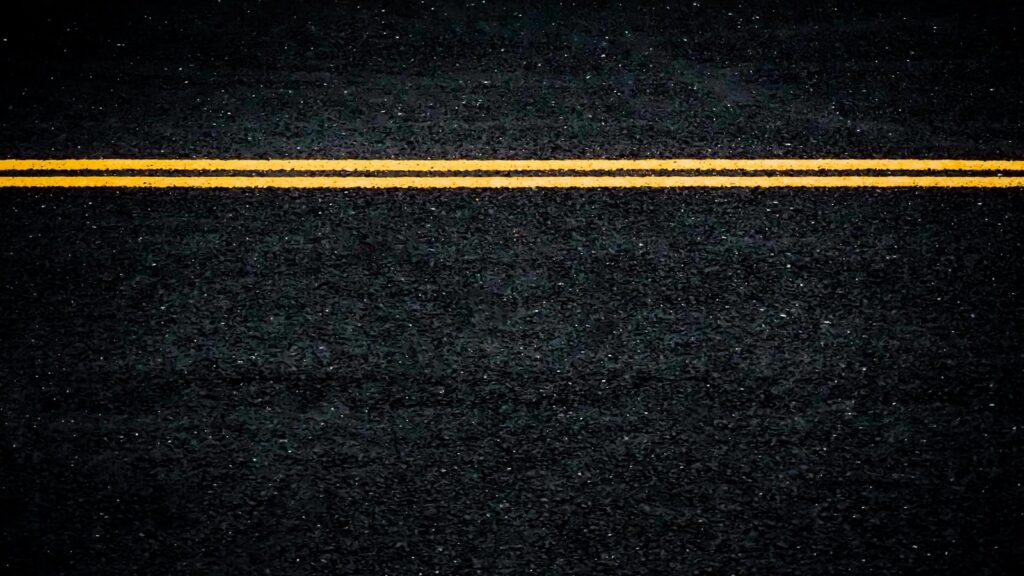
- Double solid yellow: no passing in either direction. Do not cross except to turn into or out of a driveway or alley where permitted.
- Solid yellow + broken yellow: the side with the broken line may pass; the side with the solid line may not. If the solid line is on your side, stay put.
- Double solid white: lane changing is prohibited. Common between a through lane and an exit or HOV lane.
Edge lines and shoulders
The outer lines mark the edge of the usable roadway. A solid white edge line runs along the right shoulder. A solid yellow edge line marks the left edge on divided highways and one-way roads. You should not drive across the edge line onto the shoulder except in an emergency or where signs allow it.
Stop lines, crosswalks, and yield lines
- Stop line: a solid white line across your lane at an intersection or signal. Stop behind it, not on it.
- Crosswalk: white markings (two parallel lines, or a ladder pattern) showing where pedestrians cross. Stop before the crosswalk and yield to anyone in it.
- Yield line (shark teeth): a row of solid white triangles pointing at you. It marks where you must yield or stop if needed, often at roundabouts and crosswalks.
Arrows, turn lanes, and the diamond
Painted symbols direct lane use:
- Turn arrows: a lane marked with a left or right arrow is for that movement only. A straight-plus-turn arrow allows either.
- Two-way left-turn lane: a center lane bordered by a solid and a broken yellow line on each side, used by both directions only for left turns. Never use it as a travel lane.
- Diamond symbol: marks a reserved lane - usually HOV (carpool) or bus. Use it only if you meet the posted requirement.
- Bike lane: a lane marked with a bicycle symbol and usually a solid white line. Do not drive or park in it except to make a permitted turn.
Curb colors (the bonus question)
Several states test painted curbs because they control parking: red means no stopping or parking, yellow means a short loading stop, white means a brief passenger pickup or drop-off, green means limited-time parking, and blue means accessible parking for permit holders only. Exact rules vary by state, so check your handbook.
How markings show up on the test
Expect questions in two forms: a plain-language question (“What does a solid yellow line on your side of the road mean?”) and an image-based one showing a stretch of road and asking what you may do. The yellow-versus-white and solid-versus-broken rules answer the large majority of them. Practice with questions in your own state’s exact format, since a few states word these differently.
Drill markings alongside signs in the free DMV permit test sample questions, review the full road signs and signals guide, and when you are ready for timed, state-matched practice, the DMV Ready app filters every question to your state.
FAQ
What is the difference between yellow and white road lines?
Yellow lines separate traffic moving in opposite directions. White lines separate lanes of traffic moving in the same direction. That single rule answers most marking questions on the permit test.
Can you cross a double yellow line?
No. A double solid yellow line means passing is prohibited in both directions. You may only cross it to turn into or out of a driveway or alley where local rules permit, never to pass another vehicle.
What does a broken white line mean?
A broken (dashed) white line separates lanes going the same direction and means you may change lanes when it is safe to do so.
What do the shark-teeth triangles painted on the road mean?
That is a yield line. The row of solid white triangles points toward approaching drivers and marks where you must slow and yield, or stop if necessary - commonly at roundabouts and mid-block crosswalks.


 Scan to get the app