What’s Actually on the DMV Permit Test in 2026?
The 2026 permit test isn’t dramatically different from the 2025 version - most state handbooks update incrementally - but a few categories have shifted weight. Below is what’s on the test, by content area, with the categories that have grown or shrunk recently.


The 14 categories every permit test draws from
Every state DMV’s question pool sorts into roughly the same 14 categories. The exact mix on your test varies, but the pool is consistent.
- Licensing & Permits - application rules, age requirements, restrictions. The largest single category in most states.
- Driving Laws - speeding, signaling, lane usage, the bulk of “what you must do” rules.
- Defensive Driving - following distance, stopping distance, hazard awareness.
- Vehicle Equipment - required equipment (lights, mirrors, brakes), inspection rules.
- Right of Way - uncontrolled intersections, 4-way stops, roundabouts, pedestrians, emergency vehicles.
- Driving Conditions - rain, fog, snow, night driving, reduced visibility.
- Traffic Signs - recognition by shape, color, and meaning.
- Alcohol & Drugs - BAC limits, zero-tolerance laws, implied consent, penalties.
- Traffic Signals - what each light means, flashing signals, pedestrian signals.
- Sharing the Road - bicycles, motorcycles, school buses, large trucks, pedestrians.
- Emergencies & Hazards - what to do if your brakes fail, you hydroplane, your tire blows.
- Road Markings - line types, colors, what’s legal to cross.
- Speed Limits - default limits, school zones, residential, highway.
- Parking Rules - distances from intersections, hydrants, crosswalks; parallel parking technique.
What’s heavier in 2026
A few categories have grown across multiple state handbooks in the past two years:
- Distracted driving / phone use. Almost every state added or expanded questions on hands-free laws, texting penalties, and “phone in cradle” rules. Penalties have gone up in most states.
- Pedestrian and cyclist right-of-way. Vulnerable-road-user laws have expanded. Oregon in particular gives pedestrians wide protection - questions on this come up more than average.
- Move-over laws (emergency vehicles). Most states require you to change lanes or slow down when passing stopped emergency vehicles, tow trucks, or roadside workers. Penalties have stiffened.
- School-bus rules. When you must stop, when you don’t have to (divided highways with median), and the penalty fines.
- Roundabout etiquette. More states are installing roundabouts; tests reflect that.
What’s lighter
A few topics have shrunk:
- Hand signals. Still on the test in most states, but the question count is smaller than it was a decade ago.
- Carburetor / engine mechanics. Mostly gone. The few remaining mechanical questions are about brakes, lights, and tires.
- Highway signs. Still tested, but the regulatory-sign emphasis has grown relative to highway/route signs.
Question format breakdown
Two formats dominate.
- Factual recall. “What does this sign mean?” “What’s the speed limit in a residential area unless otherwise posted?” “How many feet before a turn must you signal?” These are the easier wins - pure memorization from the handbook.
- Scenario judgment. “You’re approaching a yellow light. A pedestrian steps off the curb. What do you do?” These test understanding, not memorization.
The split is roughly 70/30 factual to scenario in most states. New York is unusual in being closer to 50/50.
State-specific variations
Beyond the universal pool, every state has its own rules. Examples:
- California‘s test draws heavily from right-of-way and alcohol sections; questions on the GDL provisional restrictions for under-18 drivers are common.
- Texas tests right-on-red exceptions, the state’s specific BAC rules for commercial drivers, and school-bus passing.
- Florida includes hurricane-evacuation route signage and water-related driving (flooded roads, etc.).
- New York‘s scenario format means you’re tested on judgment more than facts.
- Oregon emphasizes pedestrian right of way more than other states.
Test format by state (questions / pass mark)
Length and pass-mark vary widely. The shortest tests are 18-20 questions (Pennsylvania, New York, Vermont, Alaska); the longest are 50 (Florida, Indiana, Michigan, New Jersey, Nevada, Utah, Wisconsin). Pass marks range from 70% (NY, TX, MA, RI, NM, OK, DC) to 88% (Maryland).
For your state’s exact format, see the states directory. Each page has the question count, pass mark, minimum age, and 6 sample questions in the actual test format.
Sample question types - what you’ll actually see
To make this concrete, here are the types of questions that appear most often, with the format pattern.
Type 1: Sign recognition
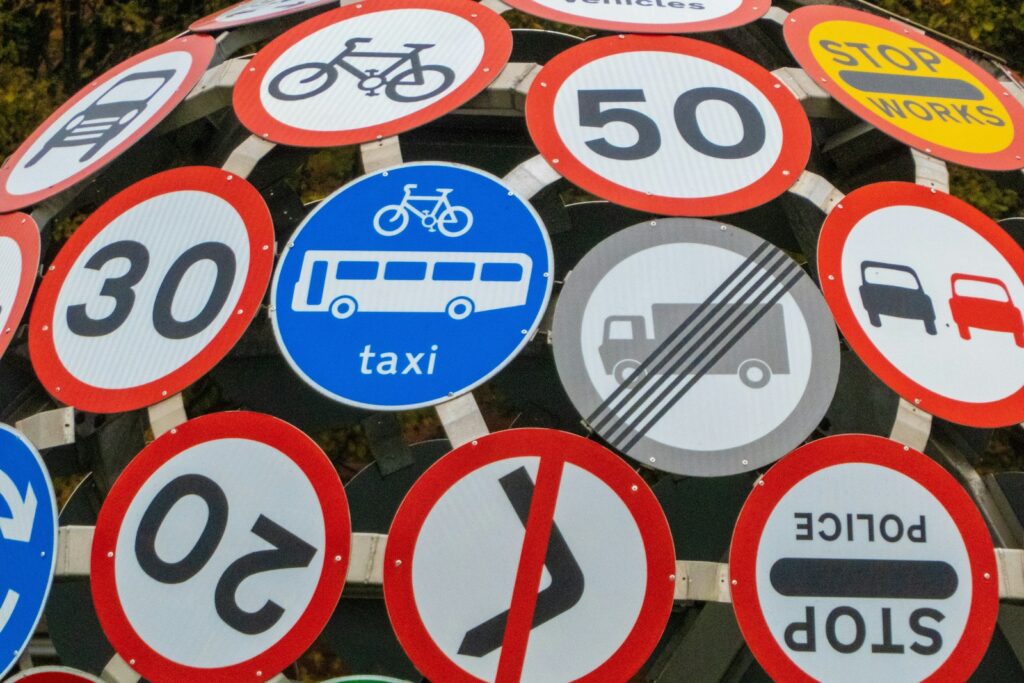
“What does this sign mean?” with an image and 3-4 options. Roughly 5-10 questions on most state tests. The shape and color carry meaning: yellow diamond is warning, red octagon is stop, blue square is services/info, brown is recreational, green is direction.
Type 2: Specific numerical rule
“How many feet before a turn must you signal?” “What’s the speed limit in a school zone when children are present?” These are pure handbook recall. The numbers vary by state - California requires 100 feet of signaling; some states are 200; some don’t specify a distance at all.
Type 3: Right-of-way scenario
“At a 4-way stop, who has the right of way?” or “An emergency vehicle approaches with sirens - what should you do?” These test understanding of the right-of-way framework.
Type 4: Procedural question
“What should you do if your brakes fail?” “What’s the proper way to handle a tire blowout?” The answer is usually the option that prioritizes safety and control over speed.
Type 5: State-specific rule
“In [your state], what is the BAC limit for drivers under 21?” or “When may you turn right on red in [your state]?” These reward state-specific study and punish generic prep.
App features that match the test format
For format-matched practice, look for:
- Practice exams that match your state’s count and pass mark. 46-question, 83% in California; 30 questions, 70% in Texas; 50 questions, 80% in Florida; 20 questions, 70% in New York.
- Topic-mode practice. Lets you drill one category (signs, right of way, alcohol) at a time.
- Wrong-answer review / smart-review mode. Surfaces the questions you’ve gotten wrong most often.
- Sign quiz. Image-only sign drills - pure recognition.
DMV Ready ships all of these. Whatever app you use, those four features are the minimum for serious prep.
FAQ
Has the permit test changed for 2026?
Not dramatically. State handbooks update on rolling schedules. The biggest 2024-2026 shifts are increased weight on distracted-driving rules, vulnerable-road-user laws (pedestrians, cyclists), and move-over laws for emergency vehicles. Core categories - signs, right of way, alcohol - are stable.
What’s the most heavily tested category?
Licensing & Permits and Driving Laws are the two largest categories in most state question pools, followed by Defensive Driving and Right of Way. Traffic Signs is consistently 20-30% of test questions.
Are there trick questions?
Not really. Permit tests are written to be straightforward - they’re testing whether you read the handbook, not whether you’re clever. Most “trick” perceptions come from people who didn’t study and assumed the answer was easy.
Content categories are derived from state DMV question pools and handbooks. For your state’s specific format, see the states directory or your state’s official site, e.g., dmv.ca.gov for California.
Practice by state and category in DMV Ready
All 50 states + DC. 4,000 questions. Free to start. No ads.