What a Flashing Yellow Light Means
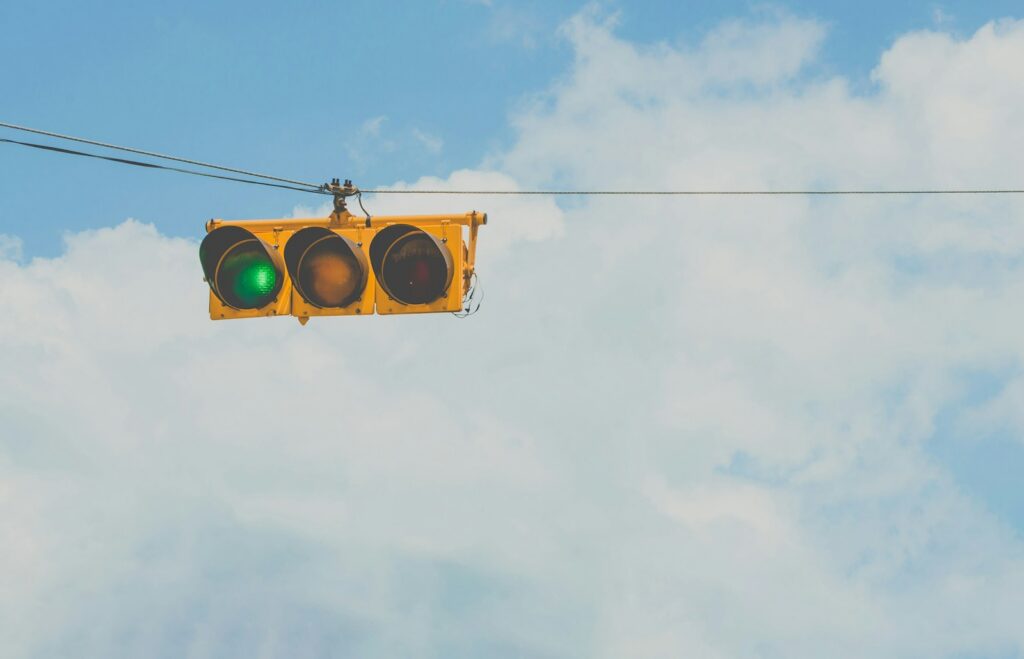
A flashing yellow light at an intersection means a driver may enter the intersection without stopping, but must yield first. That is the short answer, and it is the one the permit test wants. The longer answer is the one that actually keeps drivers out of a crash, because “flashing yellow” is not one signal in the federal rulebook. It is two. A flashing circular yellow and a flashing yellow arrow carry different permissions, different yield duties, and different test answers. The DMV Ready question bank treats them as separate items, and this is one of the few topics where the wording on page one of Google is thinner than the wording in the law.
What a flashing yellow light means under the federal rule
The controlling text is Section 4A.04 of the Manual on Uniform Traffic Control Devices, 11th Edition, published December 2023. Every state signal law traces back to it. Under 4A.04, traffic facing a flashing circular yellow “is permitted to cautiously enter the intersection to proceed straight through or turn right or left or make a U-turn,” unless lane-use signs, turn prohibitions, lane markings, roadway design, or separate turn signals say otherwise.
Read that list again. The federal rule does not just permit a driver to continue straight. It permits a right turn, a left turn, and a U-turn on a flashing yellow. Most quiz sites compress all of this into “proceed with caution,” which is true but tells a test-taker nothing about what the maneuver actually allows.
What the rule gives with one hand it limits with the other. The same section names exactly who a driver must yield to, and the list is specific rather than vague.
| Facing a flashing circular yellow | What MUTCD 4A.04 says |
|---|---|
| Do you stop? | No. Stopping is not required. |
| Movements allowed | Straight, right, left, U-turn, unless a sign, marking, or separate turn signal restricts it |
| Yield to pedestrians | Yes, any pedestrian lawfully within an associated crosswalk |
| Yield to vehicles | Yes, any vehicle lawfully within the intersection |
| Extra duty when turning left or U-turning | Yield to oncoming traffic close enough to be an immediate hazard |
That third row is the one drivers forget. Pedestrians facing any flashing yellow are permitted to cross, in a marked or unmarked crosswalk, under 4A.04. They are not required to wait for approaching traffic. A flashing yellow grants permission to move; it does not grant priority over someone already legally in the intersection or the crosswalk.
Flashing yellow light versus flashing yellow arrow
Here is the split almost nobody explains. A flashing circular yellow and a flashing yellow arrow are separate indications with separate rules under Section 4A.04, and mixing them up is how people get hit.
Under 4A.04, a driver facing a flashing yellow arrow may cautiously enter the intersection “only to make the movement indicated by such arrow.” The circular yellow opens the whole intersection. The arrow opens one movement and nothing else. Both carry the same yield duties: pedestrians in the crosswalk, vehicles already in the intersection, and oncoming traffic when turning left.
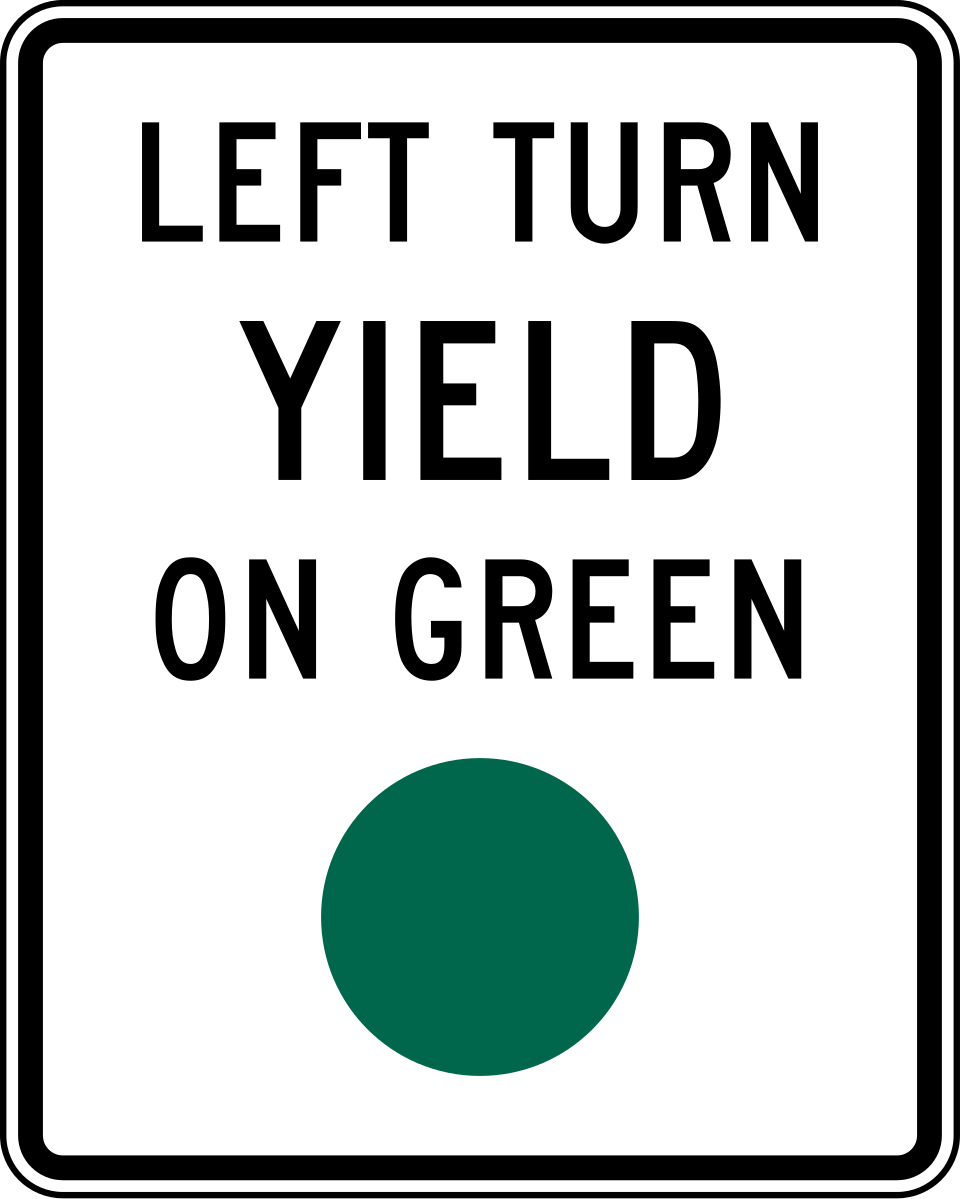
Practically, the flashing yellow arrow shows up in a left-turn lane during normal stop-and-go operation. It is telling the driver the same thing an unprotected green ball used to tell them: turn when there is a gap, and the gap is the driver’s problem to find. California’s driver handbook puts it plainly: “You can turn, but your turn is not protected from other traffic.”
The circular version is different in origin. It usually means the whole signal has dropped into flashing mode, either on a late-night schedule or because something failed. For the broader intersection rules that sit underneath all of this, the guide to right of way rules on the permit test covers the priority order these signals fall back on.
Why one direction gets yellow and the cross street gets red
When a signal enters flashing mode, the two directions do not get the same color, and the assignment is not random. Chapter 4G of the MUTCD says a flashing yellow “should be used for the major street and a flashing red signal indication should be used for the other approaches,” unless every approach flashes red.
So the flashing yellow is a statement about the road the driver is on. That road is the through route. The cross street is being made to stop, exactly as if it had a stop sign, which is why a flashing red is treated as a stop sign in every state handbook that documents the rule.
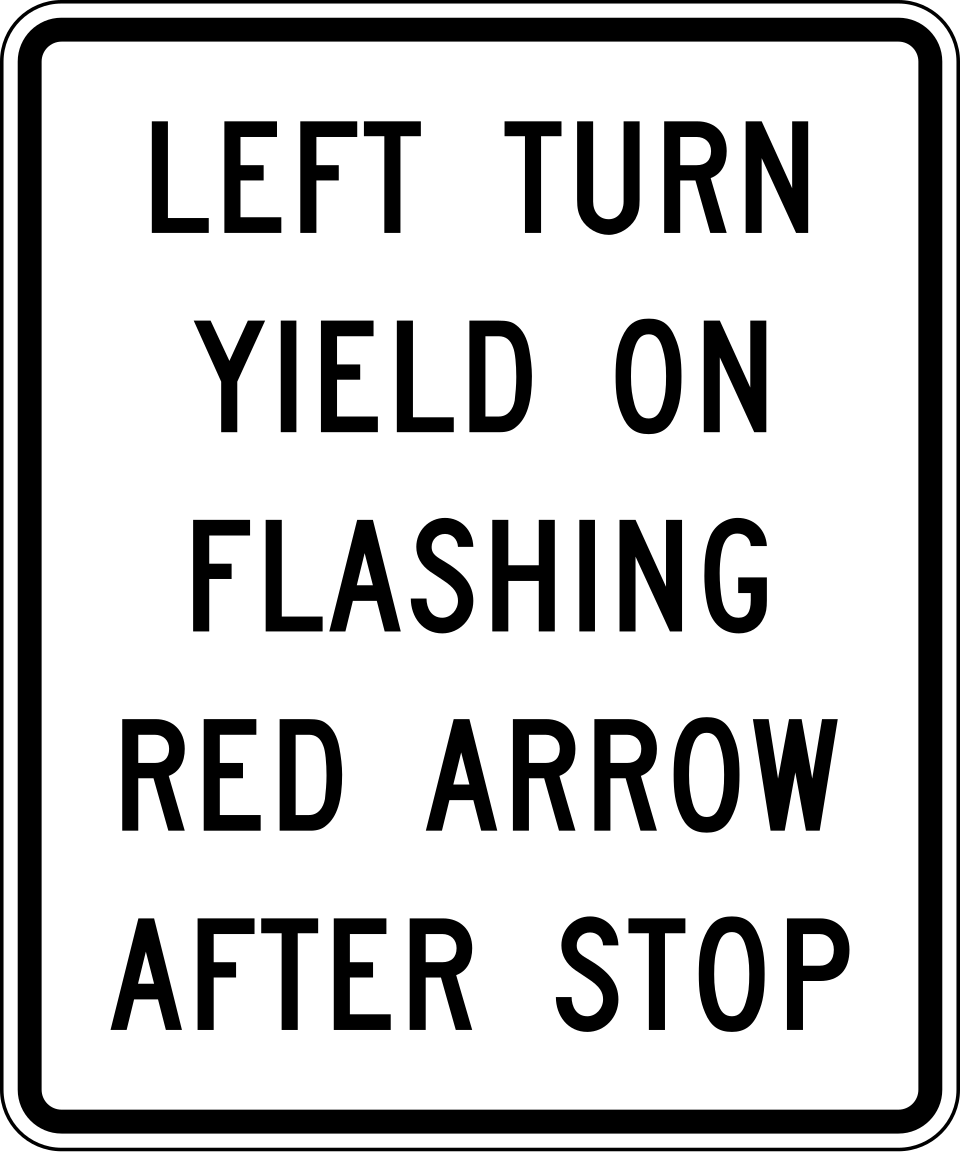
The red side has its own two-way split. A flashing circular red means stop, then proceed under stop-sign rules. A flashing red arrow means stop, then turn only in the direction the arrow points. Compare the four indications side by side and the logic gets easy to hold onto.
| Indication | Stop required? | Movements permitted |
|---|---|---|
| Flashing circular yellow | No | Straight, right, left, U-turn |
| Flashing yellow arrow | No | Only the arrow’s movement |
| Flashing circular red | Yes, full stop | Any movement, under stop-sign rules |
| Flashing red arrow | Yes, full stop | Only the arrow’s movement |
One more piece of trivia that turns up on tests: a flashing green has no meaning in the United States. MUTCD 4A.04 states it “shall not be used.” A driver who has seen one was probably in Canada, where it means something else entirely.
The common mistake: a dark signal is not a flashing yellow
Consider a driver approaching an intersection at 6 a.m. after an overnight storm. The signal heads are completely black, no colors at all. Treating it as a flashing yellow and rolling through at 20 mph invites a collision with a car coming from the right that made the same assumption.
Dark and flashing yellow are opposite instructions. A dark signal is not permission. In state after state, a signal displaying nothing is a four-way stop by law. Georgia’s Department of Driver Services says that if a signal “is not functioning at all at an intersection, all drivers must treat the intersection as if a stop sign is posted for all directions.” Here is how four states word the same rule.
| State | Flashing yellow | Signal completely dark |
|---|---|---|
| California | “A warning to proceed with caution. Slow down and be alert. You do not need to stop.” | Stop as if controlled by stop signs in all directions |
| Georgia | “Slow down and exercise caution before proceeding through the intersection.” | Treat as a stop sign posted for all directions |
| New York | “Drive with caution.” | Come to a stop as you would for a stop sign, then follow right-of-way rules |
| Michigan | Proceed with caution, no stop required | Stop, yield to vehicles in or approaching the intersection, exercise ordinary care |
Michigan is the useful one to look at closely because the duty is spelled out in statute rather than a handbook. MCL 257.649(4) covers any signal that “exhibits no colored lights or colored lighted arrows” or otherwise fails to clearly assign right of way, and imposes three obligations: stop at the stop line, yield to vehicles in or approaching the intersection, and exercise ordinary care crossing. Practicing in the state where the test will be administered is worth the effort here, so run through the Georgia permit test practice, California practice set, or Michigan questions and watch how the wording shifts. Every other state sits in the state-by-state practice directory.
What the signal is physically doing
Flashing operation is engineered, not improvised, and the specification is tighter than most drivers assume. MUTCD Chapter 4G requires the light source to flash between 50 and 60 times per minute, with each flash lit for at least half and at most two thirds of the cycle. That is why a flashing yellow reads as a steady pulse rather than a stutter.
Chapter 4G also requires every signal to carry a conflict monitor, formally a malfunction management unit, whose job is to drop the intersection into flashing mode the moment it detects conflicting indications. The flashing operation cannot be cancelled by switching off the controller. A signal that has failed safe is designed to sit there flashing until a technician arrives.
Two more details from the same chapter explain what a driver sees. During flashing mode, every green indication at the intersection goes dark and stays dark. And a green or flashing yellow can never jump straight to red without a steady yellow in between, which is why no driver ever gets trapped mid-intersection when a signal transitions.
Not every flashing yellow sits at an intersection, either. Section 4A.04 describes a fourth use, where a flashing circular yellow works as a beacon attached to another traffic control device. Mounted above a school zone sign, on a curve warning, or over a fire station exit, the beacon carries no independent instruction. It signals that the message on the device below it applies right now. A 20 mph school limit posted with a beacon is enforceable while the beacon flashes and not while it is dark, which is the whole point of wiring one to a bell schedule.
Two of the site’s guides sit directly on that boundary. The breakdown of the school zone sign and its MUTCD S1-1 code covers what the beacon is supplementing, and the wider catalogue in the road signs library shows which warning signs commonly carry one. Beacon or intersection, the yellow itself always means the same thing: information, not permission to stop paying attention.
Why flashing yellow arrows keep spreading
For decades the permissive left turn was signalled with a plain green ball, and it carried a defect engineers call the yellow trap. The through movement gets a yellow while the oncoming through movement keeps its green. A driver reads the near-side yellow as everyone’s yellow, assumes the oncoming lane is stopping, and turns across it.
Research done for the National Cooperative Highway Research Program identified the flashing yellow arrow as the best available replacement for the circular green in permissive left turns, partly because it is easy to program around the yellow trap. The Federal Highway Administration then measured what happened after installation. Its safety evaluation of flashing yellow arrows, FHWA-HRT-19-035, studied 307 treated intersections against 438 untreated reference sites in Oklahoma, Oregon, Nevada, and North Carolina.
| Site group | Left-turn crashes | Left-turn-into-oncoming crashes | Injury and fatal crashes |
|---|---|---|---|
| 136 four-leg intersections | 25 percent lower | 39 percent lower | 20 percent lower |
| 64 four-leg intersections | 38 percent lower | 49 percent lower | 22 percent lower |
| 12 four-leg intersections | 39 percent lower | 45 percent lower | 21 percent lower |
The finding that matters for a new driver is the one buried in the same report: left-turn crashes went up where a flashing yellow arrow replaced a fully protected green arrow. The arrow is safer than a green ball and less safe than a protected-only phase. A flashing yellow arrow hands the driver a judgment call that used to be made for them.
How this shows up on the permit test
Building DMV Ready meant reading all 50 state driver handbooks side by side, and signal questions are where the wording diverges most. Georgia says a driver “must slow down.” New York says “drive with caution.” California adds the sentence that settles the question outright: “You do not need to stop.” Same federal rule underneath, three different surfaces, and test writers pull from their own state’s phrasing.
When the DMV Ready question bank was re-verified against official state sources and 28 answers were corrected, signals and right of way accounted for a disproportionate share of the corrections. The pattern was consistent: third-party sources kept repeating a summary of the rule instead of the rule itself. Several still cite Section 4D.04 for flashing signal meanings, which was the correct citation under the 2009 manual. The 11th Edition moved that text to 4A.04 in December 2023.
Two habits will get a test-taker through nearly every version of this question. First, if the option says a driver must come to a complete stop at a flashing yellow, it is wrong in all 50 states. Second, if the option says the driver has the right of way, it is also wrong, because the yield duty to pedestrians and to vehicles already in the intersection never goes away. Work through the road signs practice test and the New York question set to see both traps in their natural habitat, and check the yield sign rules alongside them, since the reasoning is identical.
Frequently asked questions
The questions below come up constantly, both in the DMV Ready support inbox and in the search results for this topic. Short answers here; the sections above have the sourcing.
Do you have to stop at a flashing yellow light?
No. MUTCD 4A.04 permits a driver to enter the intersection without stopping, and no state handbook requires a stop. The driver still yields to pedestrians in the crosswalk and vehicles already in the intersection.
What is the difference between a flashing yellow light and a flashing yellow arrow?
A flashing circular yellow permits straight, right, left, and U-turn movements. A flashing yellow arrow permits only the movement the arrow shows. Yield duties are the same for both.
What do you do if a traffic light is completely dark?
Stop. A dark signal is treated as a four-way stop in California, Georgia, New York, Michigan, and most other states. Michigan puts the duty in statute at MCL 257.649(4).
Why is one direction flashing yellow and the other flashing red?
MUTCD Chapter 4G assigns flashing yellow to the major street and flashing red to the minor approaches. The flashing red side stops under stop-sign rules.
Can you turn left on a flashing yellow arrow?
Yes, after yielding to oncoming traffic and to pedestrians in the crosswalk. The turn is permitted but unprotected, which is exactly what the flashing arrow communicates.
Is a flashing yellow light the same as a yield sign?
The duty is similar but the scope differs. A yield sign governs one approach permanently. A flashing yellow is a signal state that can change back to normal stop-and-go operation.
Practice the version the state will actually ask
Flashing signals are a small slice of the written test and an outsized slice of the questions people miss, because the intuitive answer and the legal answer pull apart. Anchor the two rules that hold everywhere: a flashing yellow never requires a stop, and it never grants right of way. Everything else is state phrasing on top of the same federal text. Open the practice set for the state where the exam will be taken, work the signals and right-of-way questions until the wording stops surprising, then go take it.


 Scan to get the app