School Zone Sign: Meaning and Rules
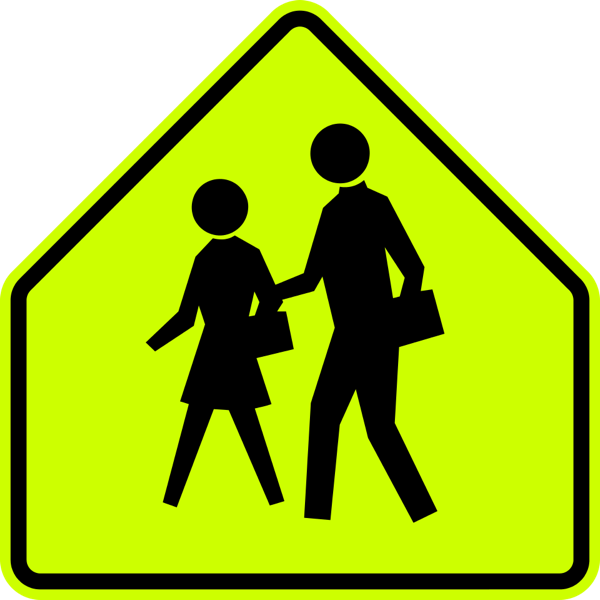
A school zone sign is the fluorescent yellow-green, five-sided (pentagon) warning sign showing two children walking, and it means one thing above all else: a school is close, kids may be crossing, and you need to be ready to slow to the posted school speed limit, commonly 15 to 25 mph when children are present. In the federal sign catalog it carries the code S1-1, and it is one of the few signs on the road that gets its own dedicated shape and color. This guide breaks down what the sign means, why it looks the way it does, the speed rules it triggers, and the exact mistakes that cost drivers tickets and cost kids their safety. For anyone studying for a permit test, this ranks among the highest-value signs to understand cold.
What a school zone sign actually tells you
The standard school warning sign, designated S1-1 in the federal Manual on Uniform Traffic Control Devices, does a simple job: it warns that you are entering a school area where children may be present. The current sign shows two walking figures on a fluorescent yellow-green pentagon with a black border. Per MUTCD Part 7 on traffic control for school areas, this single S1-1 pentagon serves four distinct roles: warning of a general school area, marking the beginning of a school zone, giving advance notice of a school crossing (paired with an AHEAD or distance plaque), and marking the crossing itself (paired with a downward diagonal arrow).
Building DMV Ready meant cross-checking all 50 state driver handbooks against the federal standard, and the pattern holds: every state teaches this sign as a warning that reduced-speed rules and a crosswalk lie ahead. What trips people up is not the meaning. It is what the sign does and does not control, which is where the next sections come in. A school zone sign never appears in isolation on the test either; it usually sits next to a speed sign, a crossing, or a set of pavement markings, so learning it as part of an assembly is the fastest way to answer the question correctly.
The four uses change what a driver should do. A general school-area warning tells you to expect buses and foot traffic. A zone-beginning sign marks where reduced-speed rules start. An advance-crossing sign, paired with an AHEAD or distance plaque, gives you room to slow before a specific crosswalk. A crossing sign with a downward diagonal arrow sits right at the crosswalk where children step off the curb. Same pentagon, four jobs, and the plaque underneath tells you which one you are reading.
Why the sign is a pentagon and glows yellow-green
Two design choices make this sign instantly recognizable, and both are deliberate. The shape is an upward-pointing pentagon, and in the U.S. sign system that five-sided outline is reserved exclusively for school warning and school crossing signs. No other traffic sign uses it. When a pentagon appears in your field of view, your brain is meant to think school before you even read the legend. That reserved-shape rule is the single most useful fact for a permit test, because it lets a driver identify the sign by silhouette alone.
The color is the second signal. Ordinary warning signs are standard yellow, but school signs use fluorescent yellow-green, a shade chosen because it holds unusually high visibility in the low light of dawn and dusk, which is exactly when kids walk to and from school. The federal standard is explicit: school warning signs “shall have a fluorescent yellow-green background with a black legend and border.” That bright green-yellow was phased in as the required color for school-area signs so drivers could tell a school warning apart from a generic hazard at a glance. It carries a different message from construction orange, which flags a work zone, and from the standard yellow diamond, which flags a general road hazard.
In the DMV Ready practice question bank, the school zone item drivers miss most often is not the meaning at all. It is people mistaking the fluorescent green-yellow for construction orange, or picking a diamond instead of the pentagon. Both errors come from studying the picture instead of the system. Learn the rule once, that a five-sided green-yellow sign means school and nothing else does, and the whole category of question becomes automatic. That is the kind of shortcut baked into the sign lessons because it survives both the exam and the road.
| Attribute | School zone sign (S1-1) | Why it matters |
|---|---|---|
| Shape | Upward-pointing pentagon | Reserved only for school signs; identify by silhouette |
| Color | Fluorescent yellow-green | High visibility at dawn and dusk when kids walk |
| Symbol | Two children walking | Distinguishes it from a lone-pedestrian crossing sign |
| Border and legend | Black | Federal MUTCD standard for all school-area signs |
The sign warns you, it does not set the speed limit
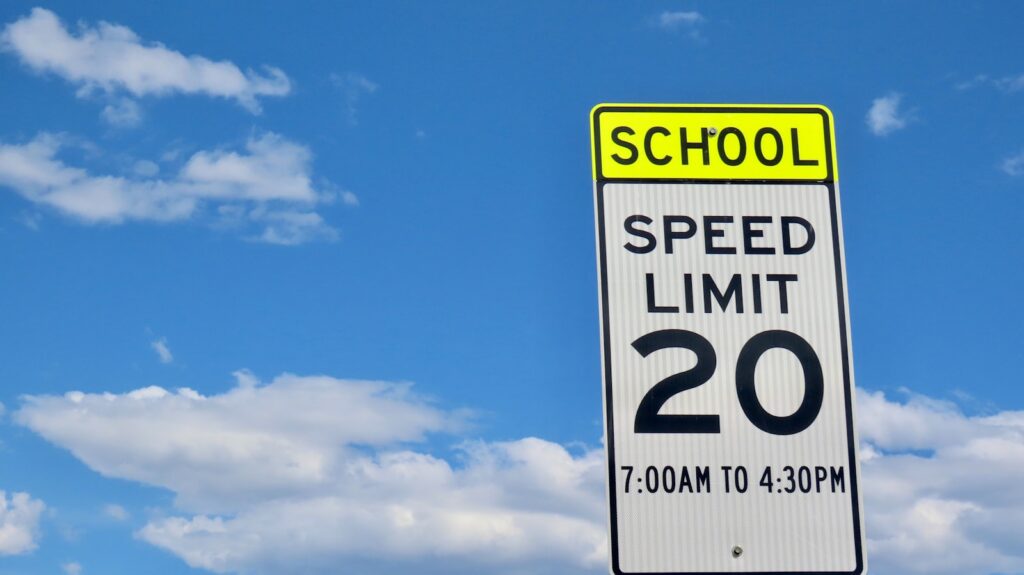
Here is the distinction that separates a confident driver from a ticketed one. The pentagon school sign is a warning. On its own it sets no speed limit. The number a driver must obey comes from a separate speed-limit sign, the rectangular white S5-1 sign that reads something like “SCHOOL SPEED LIMIT 20,” usually with a “WHEN FLASHING” or “WHEN CHILDREN ARE PRESENT” plaque beneath it. The federal manual requires the S1-1 pentagon to be installed in advance of that first S5-1 speed-limit assembly, so the warning always precedes the enforceable number.
Reading the assembly is the skill. A typical school zone gives you the pentagon first as a heads-up, then the rectangular S5-1 speed-limit sign that legally binds you, then a crossing sign at the crosswalk, and finally an END SCHOOL ZONE sign where normal limits resume. Miss the middle sign and a driver can be doing 35 in a 20 without realizing the warning pentagon two blocks back was the cue to slow. That is why DMV Ready teaches it as a sequence on the traffic sign study hub, and why test questions often hinge on what you do next, not just what it means.
School zone speed limits by state
School zone speed limits are set by state and local authorities, so the exact number lives on the posted S5-1 sign, not on the pentagon. Most fall into three tiers, and knowing the tiers helps a test-taker answer state-specific permit questions even when the precise figure varies by town. The California driver handbook sets 25 mph within 500 feet of a school when children are present, and lower where a 15 mph zone is posted. Florida, Illinois, and Ohio commonly post 20 mph zones, while some Pennsylvania and Arizona zones drop to 15 mph.
| Posted limit | Example states and zones | Typically applies |
|---|---|---|
| 15 mph | Pennsylvania; many marked zones in Arizona and parts of California | Posted hours or when children are present |
| 20 mph | Florida, Illinois, Ohio (typical posted zones) | School days during posted hours or when a beacon flashes |
| 25 mph | California within 500 ft (CVC 22352), plus many statewide defaults | When children are going to or leaving school |
Whichever tier applies, the reduced limit is rarely in effect all day. Most zones activate on school days only, during posted time windows (often roughly 30 minutes before and after class), or whenever the yellow beacons are flashing. Weekends and holidays usually revert to the normal street limit. Drivers can drill the exact numbers for their state on the DMV Ready California, Florida, and Texas practice tests, each built from that state’s current handbook.
Other school zone signs you will see nearby
The pentagon rarely travels alone. A full set of school zone signs works as a system, and the permit test often shows them as a group. A fluorescent yellow-green SCHOOL BUS STOP AHEAD sign (S3-1) warns that a school bus stop sits just past a hill or curve where waiting students are hidden. At the crossing, a guard may step out with a STOP or SLOW paddle that carries the same force as posted stop signs. Drivers may also see children crossing markings, a sign warning where children play near a playground, a marked drop off zone, and no parking signs that keep sightlines clear. All of these safety signs are made reflective so they stay readable at dawn and dusk.
Treat them as one child-safety system. When a school bus ahead flashes red and swings out its stop arm, drivers must stop in both directions on most roads. Bicycle riders and students on foot fill these streets at arrival and dismissal, so road safety and school safety here mean scanning low and wide, not just reading a number. Drilling these related traffic signs and road signs is exactly what the DMV Ready sign lessons are built for.
When children are present, doubled fines, and the mistakes drivers make
The phrase “when children are present” sounds vague, but many states give it a precise legal meaning. In California it means while children are going to or leaving school during school hours or the noon recess period, not simply whether a driver happens to see a child. Treat a marked zone as active any time kids could reasonably be around it, because the officer, not the driver, decides whether the condition was met.
Penalties are the other reason to take the pentagon seriously. Many states double the fine for speeding in a school zone. In Texas, school-zone speeding fines are doubled and can run past 400 dollars once court costs are added, and using a phone in an active school zone is separately restricted. New York and other states stack similar enhancements. State-by-state numbers behind these rules appear on the DMV Ready New York practice test and in the guide to speed limit rules for the permit test.
Common mistake: A new driver in Sacramento sees the fluorescent pentagon, assumes it is the speed limit, and keeps rolling at 35 mph because no child is visible on the sidewalk. Two hundred feet later a hidden radar unit clocks the car in the posted 25 mph zone during the morning arrival window. The pentagon was never the limit; the rectangular S5-1 sign the driver rolled past was, and “no kids in sight” is not the legal test under California’s going-to-or-leaving-school definition. The fine comes back doubled.
Why the limit drops to 20: the crash math
Low school-zone limits are not arbitrary caution. They track hard data on how vehicle speed decides whether a struck pedestrian lives. According to the National Highway Traffic Safety Administration, 7,080 pedestrians were killed in traffic crashes in 2024 and more than 71,000 were injured, which works out to one pedestrian death roughly every 74 minutes. Children are among the most vulnerable because they are small, hard to see between parked cars, and unpredictable near crosswalks.
Speed is the lever. Research from the AAA Foundation for Traffic Safety found that a pedestrian’s risk of severe injury or death climbs sharply with impact speed: the average risk of death is low near 20 mph but rises to roughly 50 percent by the low 40s in miles per hour. That gap is the whole argument for a 20 mph school zone instead of a 35 mph street. Slower speed also buys stopping distance and reaction time. A car doing 20 mph needs far less room to stop than one doing 35, and the extra fractions of a second let a driver react to a child who darts out from between parked cars. It also shrinks the kinetic energy in any collision, which is the physics behind why the same impact is survivable at one speed and fatal at another.
Right of way near crossings matters just as much as the speed number, because a driver who slows but fails to yield has solved only half the problem. That is why DMV Ready pairs this sign with lessons on the stop sign and other warning signs like the winding road sign and the slippery when wet sign, so slow down, scan, and yield becomes one habit.
Frequently asked questions
Quick answers to the school zone sign questions drivers and permit-test takers ask most.
The school zone sign is small on the page but heavy on consequences: identify the pentagon by shape and color, remember it only warns while a separate S5-1 sign sets the enforceable speed, and treat any marked zone as active when kids could be near. Get those three things right and every school-zone question on the exam becomes answerable, and the zones themselves become drivable at safe speeds. The fastest way to make it automatic is repetition on real questions, so practice the sign and its speed rules for your own state in the DMV Ready app and on the state practice tests, then move on to the rest of the state guides when you are ready.


 Scan to get the app