Winding Road Sign, Explained
A winding road sign is a yellow, diamond-shaped warning sign that tells you three or more curves are coming in a row, and the moment to slow down is now, before the first one. In the federal sign manual it carries the code W1-5, and states from Pennsylvania to New York describe it in nearly identical terms: several curves ahead, reduce speed. If you are studying for a permit test, this is an easy point once you know what separates it from the plain curve and turn signs, and what the small speed tab bolted underneath it is actually telling you. Below we break down exactly what the sign means, how it differs from its lookalikes, why it earns its own shape, and what to do the second you spot one.
What a winding road sign actually means
The short version comes straight from the handbook. According to Pennsylvania’s driver manual, the winding road sign “indicates there are three or more curves in a row on the road ahead.” The symbol is a black arrow that bends back and forth in an S shape on a yellow background, and like every warning sign it is diamond-shaped with black symbols on yellow.

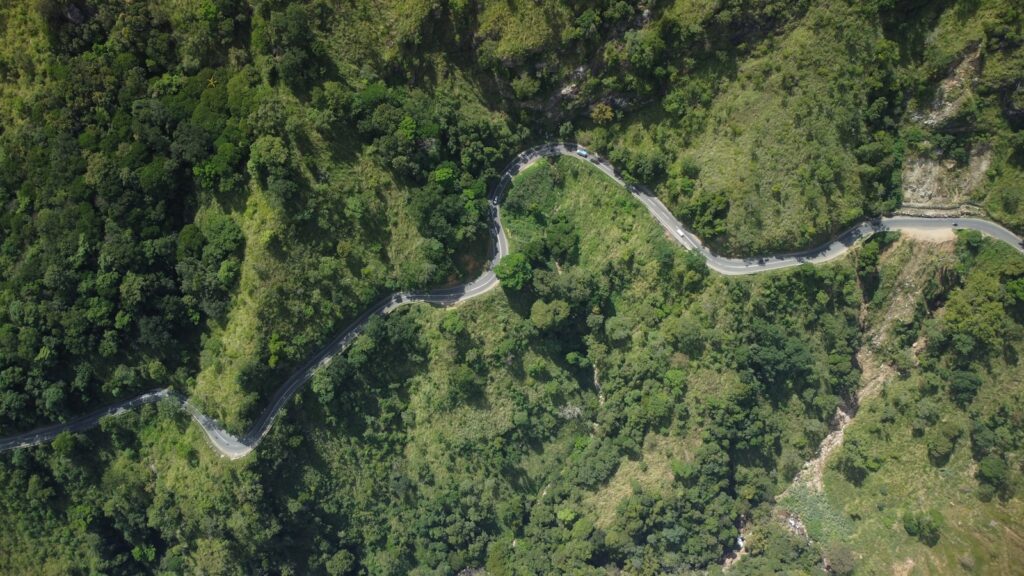
That yellow diamond is doing a specific job. Warning signs are posted before a hazard, not on top of it, so you have room to see what is ahead, decide how to respond, and shed speed if you need to. A winding road sign is telling you the pavement is about to start twisting and will keep twisting for a while, so the speed that felt fine on the straight will not feel fine in the third curve.
There is a federal rule behind when a road crew is even allowed to post one. The federal sign manual, MUTCD Section 2C, says a Winding Road (W1-5) sign may be used instead of a string of individual Turn or Curve signs “where there are three or more changes in roadway alignment each separated by a tangent distance of less than 600 feet.” In plain terms: at least three curves, each close enough to the next that a driver never really straightens out between them. A small distance plaque sometimes rides below the sign to tell you how far the winding stretch runs, so a “5 MILES” tab means settle in.
Winding road, curve, or turn: read the arrow


Here is the part the vendor pages and quick explainers skip. The five yellow curve signs are not random pictures. The arrow is a code, and the sharper it bends, the sharper the real curve. A Turn sign shows an arrow bent almost ninety degrees because it marks a sharp single curve, one the engineers measured at an advisory speed of 30 mph or less. A Curve sign shows a gentle bend because it marks an easier single curve rated above 30 mph. String two opposite bends together and you get the Reverse Turn or Reverse Curve. String three or more together and you get the Winding Road.
| Sign | MUTCD code | Arrow | What it warns | When it is used |
|---|---|---|---|---|
| Turn | W1-1 | Sharp near-square bend | One sharp curve | Single curve, advisory speed 30 mph or less |
| Curve | W1-2 | Gentle bend | One gradual curve | Single curve, advisory speed above 30 mph |
| Reverse Turn | W1-3 | Two sharp opposite bends | Sharp S-curve | Two sharp curves in opposite directions within 600 feet |
| Reverse Curve | W1-4 | Two gentle opposite bends | Gradual S-curve | Two gradual curves in opposite directions within 600 feet |
| Winding Road | W1-5 | Repeating S | Three or more curves in a row | Three or more alignment changes, each under 600 feet apart |
The arrow also points the way the first curve goes. If the top of the S leans left, the road bends left first; if it leans right, the road bends right first. Knowing that before you reach the pavement lets you set up your lane position early instead of reacting mid-corner. Pennsylvania spells out the follow-through for the single-curve versions: on a left curve you “slow down, stay in the center of your lane, and prepare to navigate through the left-bending curve,” and on a right curve you slow down and ride slightly right of center. The winding road sign is the same advice, repeated three or more times without a break.
The small speed tab is the number that counts
Plenty of winding road signs travel with a companion: a smaller yellow-and-black square hanging directly below with a number on it. That is the advisory speed plaque, coded W13-1P, and it is worth more attention than the big sign above it. As New York’s DMV manual puts it, “Sometimes a warning sign is joined with a yellow and black recommended speed sign. This indicates reduced speed is advised in that area.”

Do not treat that number as a loose suggestion. Under MUTCD Section 2C, the advisory speed is set by an engineering study, using a device that measures how hard a vehicle leans through the curve, and it is posted in 5 mph increments. It represents a comfortable, tested speed for the sharpest point of the stretch. A road agency is expected to add the tab whenever that safe curve speed runs 10 mph or more below the regular posted limit, which is exactly the gap that catches drivers off guard. So a 25 mph tab hanging under a road posted at 55 is not the sign being timid, it is the road telling you the sharpest curve was measured at less than half the speed you were just driving.
The distinction matters on the test and on the road. A white rectangular speed limit sign states a law you can be ticketed for breaking. The yellow advisory tab under a winding road sign is a recommendation, but it is the recommendation the pavement was actually measured for. If you want the full breakdown of how these two kinds of speed signs interact, our guide to speed limit rules on the permit test covers the regulatory side in detail.
Why one sign earns its own shape
Curves are dangerous out of proportion to how much road they cover, which is why the sign system treats them so carefully. Per the Federal Highway Administration’s curve safety research, curves carry roughly three times the crash rate of straight, tangent sections of the same road. When a curve crash turns fatal, 76 percent of the time it is a single vehicle that left the road and hit a fixed object or overturned, and the agency estimates that about 56 percent of those run-off-road curve fatalities are speed related. State-level numbers sharpen the picture even more: highway agencies have found that curves make up only around 10 percent of a road network yet account for a quarter to half of the severe run-off-road crashes on it, a disproportion no straight stretch comes close to.
| Curve safety figure | What the data shows |
|---|---|
| Crash rate on curves | About 3 times the rate of straight road sections |
| Fatal curve crashes that are single-vehicle run-off-road | 76 percent |
| Run-off-road curve fatalities that are speed related | About 56 percent |
| Share of roadway that is curves vs share of severe departure crashes | Curves near 10 percent of mileage, 25 to 50 percent of severe departure crashes in state data |
The physics behind those numbers is simple enough to feel from the passenger seat. A car wants to keep going straight, and a curve forces it to change direction, which loads the tires sideways. Add speed and the sideways demand climbs fast. Brake hard while you are already turning and the weight pitches forward and off the rear tires, which is how a routine bend turns into a slide. The winding road sign hands you the one thing that fixes all of that: time to get your braking done on the straight, before the road starts asking your tires for grip they may not have.
The common mistake: braking in the curve, not before it
Picture Devon, sixteen, driving a two-lane road in the hills outside Sacramento with a fresh permit. He passes a winding road sign with a 25 mph tab under it, glances at the first bend, decides it looks mild, and holds his speed through it. The second curve is tighter and arrives fast. Now he stabs the brake mid-corner, the nose dives, the rear tires go light, and the car pushes wide toward the outside edge and the guardrail.
The sign was never asking him to slow down in the third curve. It was asking him to shed speed before the first one, when the car was still straight and the tires were free to do only one job. The fix is a rhythm every experienced driver runs on instinct: brake on the approach, ease off as you enter, hold a steady speed through the bend, and accelerate gently as it opens back up. On a genuine winding stretch you repeat that rhythm curve after curve rather than treating the whole run as one problem. If you are prepping in a curve-heavy state, our California permit practice test, Texas permit practice test, and Florida permit practice test all drill the warning-sign actions the exam actually scores.
What the winding road sign is really asking on the permit test
Test questions about this sign come in two flavors, and both are gentle once you see the pattern. The first is recognition: a yellow, diamond-shaped sign means you are approaching a hazard or a spot with a special rule, full stop. The second is action: the right answer to “what should you do” is always to slow down and read what is ahead, never to speed up or hold your speed. The arrow shape is the tiebreaker that tells you how sharp the curves will be.
Building DMV Ready, we cross-checked how all fifty states word this sign in their driver handbooks. What surprised us is how little the wording moves. Pennsylvania calls it three or more curves in a row, New York files it with the rest of the yellow warning family, and the rest land in the same place. That consistency is the point: the exam is not checking whether you memorized a state-specific phrase, it is checking whether a yellow diamond reflexively reads as “slow down and look ahead.” Traffic Signs is one of the fourteen categories in our question bank, and the item people miss is rarely the sign’s name. It is the do-this-now action and the split between a warning sign (yellow) and a regulation (white). You can pressure-test both in our road signs practice test, and it is worth learning the winding road sign next to its diamond cousins like the slippery when wet sign and the broader family of yellow warning signs. The orange versions you meet in work zones follow the same read-and-react logic.
Where to see it and practice it
You will meet the winding road sign most on rural two-lane highways, mountain routes, and older roads that follow the land instead of cutting through it. On the permit test you will meet it as a yellow diamond with an S-shaped arrow and, often, a speed tab. Either way the response is the same, and the fastest way to make it automatic is to see the sign over and over with the correct action attached. Browse the full road sign library to study the warning family together, then run the sign drills built into the DMV Ready practice tests for your state from the state hub. A sign you can name in half a second on a screen is a sign you will already understand at 55 mph on a road you have never driven.


 Scan to get the app