Yield signs: when you must stop and when you don’t
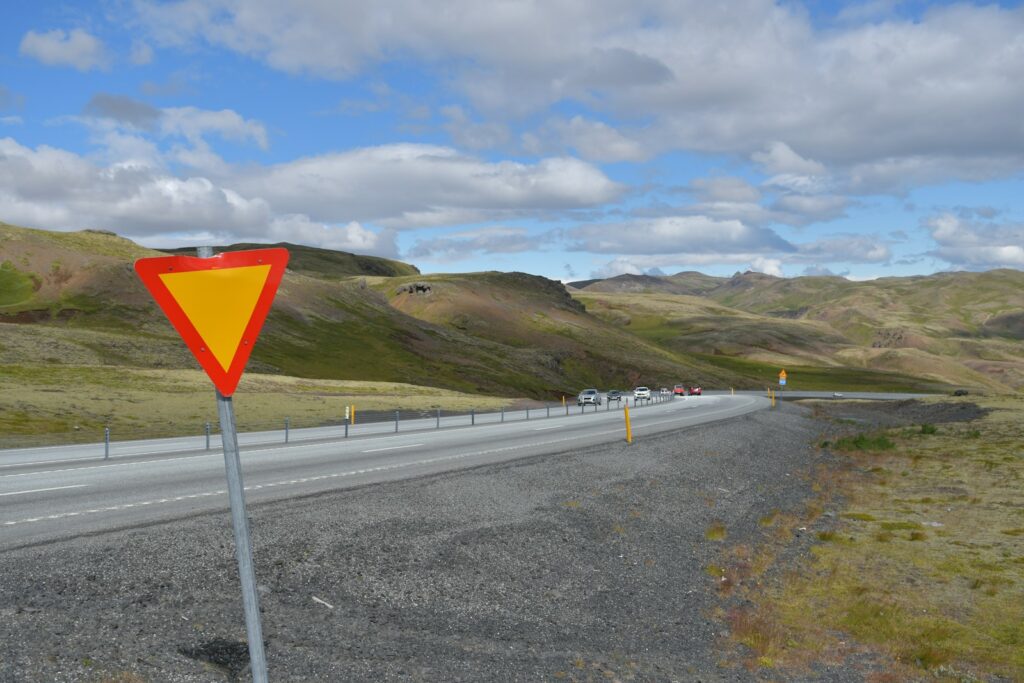
A red and white triangle pointing down. Less aggressive than a stop sign - you’re not required to stop unless traffic demands it - but the DMV permit test treats yield situations as some of the trickiest material on the exam.

Where you’ll see yield signs
Highway on-ramps where merging traffic must give way to vehicles already on the highway. Roundabout entrances. Some T-intersections where one street is clearly subordinate.
What to do
Slow down enough to see if you need to stop. If oncoming or cross traffic has the right of way and there’s not a safe gap, stop and wait. If the way is clear, you can proceed without a full stop.
Common test traps
The biggest test trap: ‘yield’ doesn’t mean ‘always stop.’ If you stop at a yield sign with no traffic present, you’ve slowed unnecessarily and could get rear-ended. The other trap is yielding to pedestrians - that’s a separate yield obligation that applies even at green lights and unmarked crosswalks.
Sample questions on yield signs
Here are 4 practice questions on this topic. Tap to reveal the answer.
Question 1: When are you required to stop for children at a school crosswalk in Oregon?
- Only during school hours between 7 a.m. and 5 p.m.
- When children enter the crosswalk or when a school crossing guard signals you to do so
- Only when children are already halfway across the street
Correct: When children enter the crosswalk or when a school crossing guard signals you to do so
Why: In Oregon, you must stop and yield to children when they enter the crosswalk or if a school crossing guard signals you to do so. You must remain stopped until the children clear the crosswalk.
Question 2: What does a flashing yellow arrow mean for drivers wanting to turn left?
- Left turns are prohibited
- Left turns are permitted but you must yield to oncoming traffic and pedestrians
- You have a protected left turn with right of way
Correct: Left turns are permitted but you must yield to oncoming traffic and pedestrians
Why: ‘A flashing yellow arrow means left turns are permitted. Drivers may turn left but must yield to oncoming traffic and pedestrians, then proceed with caution.’
Question 3: When encountering construction vehicles working on the roadway, you must:
- Move into a traffic lane that is not next to the construction vehicles
- Slow down to 25 mph and proceed with caution
- Stop and wait until all construction activity ceases
Correct: Move into a traffic lane that is not next to the construction vehicles
Why: You must yield to construction vehicles and workers that are actually engaged in work on the roadway, and you must move into a traffic lane that is not next to the construction vehicles when you encounter one working on the road.
Question 4: When is it acceptable to drive on a sidewalk?
- When traffic is heavily congested
- During emergency situations only
- Only when crossing it to enter or exit a driveway or alley
Correct: Only when crossing it to enter or exit a driveway or alley
Why: You should not drive on a sidewalk, except to cross it to enter or exit a driveway or alley. When crossing, you must yield to all pedestrians.
Practice yield signs in your state
This topic is heavily tested across all 50 states. Here are some popular state pages that include yield signs practice questions: Texas permit test practice, Florida permit test practice, Georgia permit test practice, North Carolina permit test practice, Ohio permit test practice. Or browse all 50 states + DC.
FAQ
How often do yield signs appear on the DMV permit test?
They show up on virtually every state’s permit test. Expect at least 1-3 questions on yield signs on a 25-question exam, more on longer exams.
What’s the most common mistake on yield signs questions?
The biggest test trap: ‘yield’ doesn’t mean ‘always stop.
Are yield signs the same in every state?
Mostly yes - sign shapes and colors are federally standardized through the Manual on Uniform Traffic Control Devices (MUTCD). State-specific rules layer on top, especially for fines, lane rules, and time-of-day variations.
Where can I practice questions about yield signs?
DMV Ready includes practice questions on yield signs for every state. Same exam format as your real DMV test.
Practice yield signs and 13 other topics
DMV Ready covers every category on your state’s permit test. 4,000 questions, all 50 states + DC, free to start.