Slippery When Wet Road Sign, Explained

Yellow diamond. Black car with two curly skid lines trailing its rear wheels. That is the slippery when wet sign, and it carries a single message: the pavement ahead can lose grip when wet, icy, or slicked with oil. Before you reach the marked stretch, ease off the gas, leave more room behind the car in front, and skip any hard braking or sharp steering until you are past it. That is the whole answer. Know it cold, because this sign shows up on nearly every state permit test. Below sits the sign’s official meaning, its federal code, exactly what to do when it appears, and how wet roads actually put drivers into crashes.
What the slippery when wet sign means
Picture a black car from behind. Two wavy lines curl off its rear tires. Those squiggles carry the whole message: the tires have lost traction. A yellow diamond with a black symbol places this sign in the yellow warning sign family, which flags a hazard ahead and asks you to prepare. It does not command any specific action the way a red or white regulatory sign would. It warns.
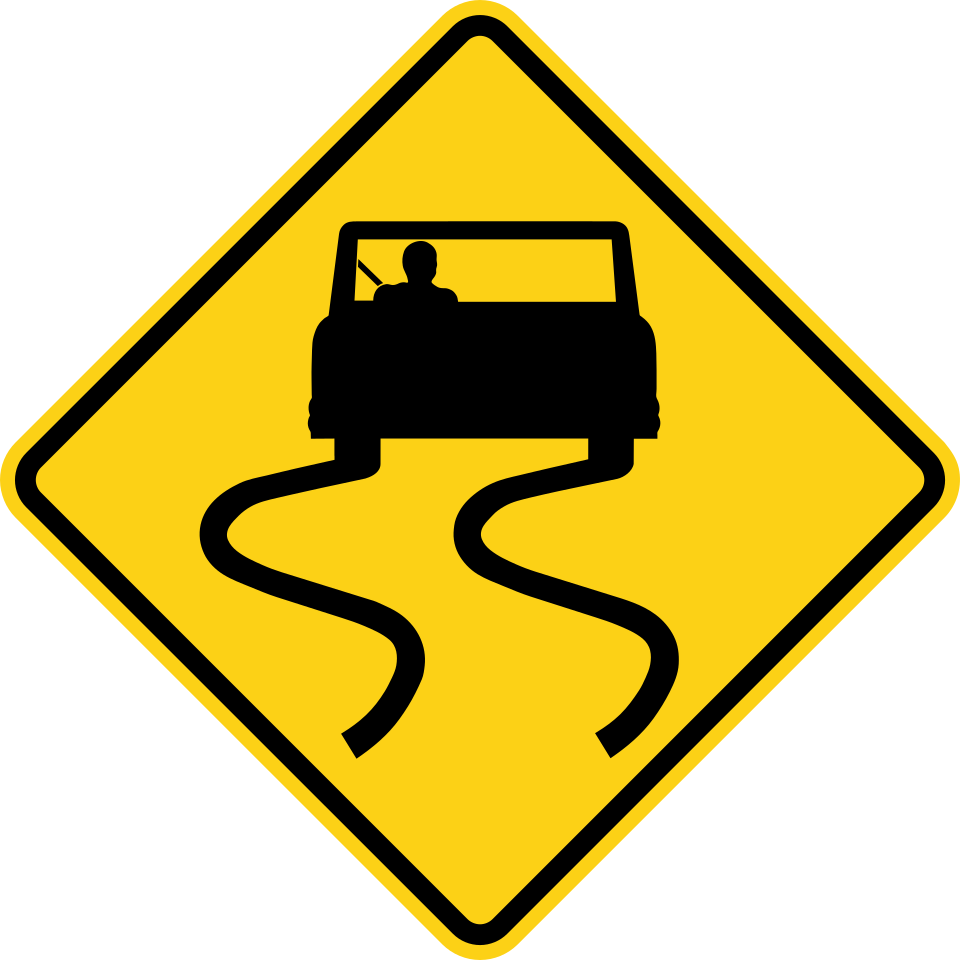
Federal rules assign this sign a code. The Manual on Uniform Traffic Control Devices, the national standard every state follows, catalogs it as sign W8-5, “Slippery When Wet.” Road crews can bolt a small supplemental plaque under the symbol to explain why a stretch loses grip: ICE, WHEN WET, STEEL DECK, or EXCESS OIL. Almost no permit-prep page mentions that plaque. It matters. EXCESS OIL under the sign is a very different warning from ICE, and it changes what you watch for.
DMV Ready cross-checked all 50 state driver handbooks, and the wording around this sign lands nearly identical across the board. What trips people up is not recognizing the picture. Rather, it is knowing that the correct answer to a slippery-road question is a driving action, not a definition. Judgment is what the sign tests.
Where you will see it, and why bridges matter
Crews post the W8-5 sign wherever a road predictably loses traction: sharp curves, freeway on-ramps and off-ramps, painted crosswalk zones, metal bridge decks, and long shaded stretches that never quite dry out. Bridges and overpasses get special attention. They freeze first and thaw last. Cold air moves both above and below the deck, so the surface chills faster than a road built on solid ground.
That is why a companion sign often appears on the approach to overpasses: “Bridge Ices Before Road” (MUTCD code W8-13). When the thermometer sits near freezing, a bridge can be glazed with ice while the road on either side is merely wet. A slippery-when-wet warning on a bridge approach is telling you the deck is the danger, not the open highway. Treat the whole span as a no-sudden-moves zone and it handles fine.
Some surfaces turn slick out of all proportion to the rain. Painted lane lines and crosswalk stripes. Steel bridge decks. Manhole covers. Polished patches where traffic sits at a red light. All of them shed water poorly and lose grip first. That is why the W8-5 sign sometimes carries a STEEL DECK plaque, and why a light drizzle on fresh paint can feel like ice. Watch your wheel placement across these surfaces, and try not to brake or turn while your tires are directly on top of them.
What to do when you see the sign
Reduce speed first. The California driver handbook tells drivers to cut speed by about one-third on wet roads. For a 60 mph highway, that means dropping to roughly 40. It also advises driving 5 to 10 mph under the posted limit in rain. Those are concrete targets. They beat the vague “slow down” printed on most sign pages.
Every other move follows from keeping the tires loaded evenly. Brake early and gently rather than stabbing the pedal. Steer with small, smooth inputs instead of jerking the wheel. Add following distance so a sudden stop never becomes necessary; a four second gap in the dry should stretch to six or more when the road is slick. Both hands on the wheel. Eyes far enough ahead to ease off the gas before a curve, not in the middle of one.
- Cut your speed by a third the moment the pavement looks wet, before you reach the marked curve or bridge.
- Brake and turn gently. Hard inputs are what break traction on a low-grip surface.
- Double your following gap so you never have to brake hard to avoid the car ahead.
- Read the plaque. ICE, STEEL DECK, or EXCESS OIL each tells you what the surface is doing.
Visibility matters as much as grip. Headlights on the moment the wipers go on, because most states now tie the two together by law, and low beams help other drivers spot a car through the spray. Clear the inside of the glass with the defroster before it fogs. Replace wiper blades that streak rather than wipe. A slick road you cannot see clearly is far more dangerous than one you can read a hundred feet ahead.
Why wet roads cause so many crashes
The numbers run larger than most new drivers expect. According to the Federal Highway Administration, about 745,000 weather-related crashes occur every year in the United States, and over 77 percent of them happen during rain or mist. Those crashes kill more than 3,800 people and injure over 268,000 every year. Wet pavement, not snow or ice, is the condition drivers meet most often.
Timing is one reason. Roads run at their most slippery in the first ten minutes of a rain, not during a downpour hours later. During a dry spell, oil, rubber dust, and grime build up on the surface; the first light rain lifts that film into a greasy layer before enough water arrives to wash it away. California’s handbook makes the point directly and warns that stopping distance climbs to two or three times normal on wet roads. A slippery-when-wet sign in the first minutes of a shower is the exact scenario it was built for.
| Wet-road fact | Figure | Source |
|---|---|---|
| Weather-related crashes per year (US) | ~745,000 | FHWA |
| Share of those during rain or mist | 77%+ | FHWA |
| People killed in weather crashes per year | 3,800+ | FHWA |
| Wet-road stopping distance vs dry | 2 to 3 times longer | CA DMV |
| When roads are most slippery | First 10 minutes of rain | CA DMV |
| Hydroplaning can begin at | ~35 mph | NHTSA data |
Hydroplaning: when your tires ride on water
Hydroplaning is the failure the slippery-when-wet sign is trying to prevent. It happens when a film of water builds up faster than the tires can channel it away, so the tread lifts off the road and the car rides on a thin layer of water. Steering, braking, acceleration: all of it stops working, because nothing is touching the pavement.
Speed is the biggest factor a driver controls. Tire tread moves water well up to about 35 mph, and above that the risk climbs sharply when standing water is present. Push past roughly 55 mph in deep water and the tires can lose contact entirely. Worn tread, low tire pressure, and heavier standing water all lower that threshold, which is why a slick stretch that felt fine yesterday can catch you today.
Feel the steering go light and the engine note rise? Do not panic. Do not slam the brakes. Ease off the gas, keep the wheel pointed straight, and let the car slow until the tires grip again. Braking hard or yanking the wheel while hydroplaning is what turns a scary moment into a spin. Slowing down before the water is always easier than recovering in it.
Risk drops long before the wet stretch arrives if the prep work is done. Tires do the work of clearing water, so tread depth is your first line of defense. The classic penny test, sticking a penny headfirst into a tread groove, flags a tire as worn when all of Lincoln’s head is visible, which is roughly 2/32 of an inch left. Keep your tires inflated to the pressure listed on the driver door jamb sticker, since underinflated tires channel water poorly and flex out of shape. Bald or soft tires can hydroplane at speeds where good ones still hold the road.
Standing water and flooded roads
A slippery-when-wet sign near a dip, underpass, or low creek crossing carries an extra warning after heavy rain: standing water. Here the advice changes from “slow down” to “do not enter.” The National Weather Service reports that just 6 inches of moving water can knock an adult off their feet, 12 inches can float most cars, and 2 feet can carry away SUVs and trucks. More than half of all flood-related drownings happen when someone drives into water.
Depth of water over a road is impossible to judge from the driver’s seat, and moving water hides how fast it is running. If a flooded low spot appears ahead, turn around and pick another route. No commute is worth a stalled engine in a rising current. The slippery-road sign got you to lift off the gas. The water tells you to stop.
Should an unavoidable shallow puddle run under the tires, dry the brakes on the far side. Water on the rotors and pads can cut stopping power for the first stop or two, so once clear, tap the pedal lightly a few times while moving slowly to build heat and squeeze out the film. Confirm the car stops normally before returning to speed. Wet brakes have surprised more than one driver at the bottom of a flooded dip who assumed the danger ended at the water’s edge.
How the slippery when wet sign appears on the permit test
On the exam this sign almost never asks “what shape is it.” It asks what to do. A typical question shows the diamond with the skid-mark car and offers choices like “speed up to get past the wet area,” “brake hard to test your traction,” “reduce speed and avoid sudden moves,” or “the sign only applies to trucks.” The right pick is always the calm one: slow down and steer smoothly.
Some states pair the sign with a winter twist. A question may show the same diamond near a bridge in freezing weather and ask what it means, and the answer ties back to ice forming on the deck before the road surrounding it. Other questions test the plaque directly, asking what EXCESS OIL or STEEL DECK beneath the symbol is warning about. The safe habit is to read the whole sign, plaque included, then pick the response that lowers speed and widens margin rather than the one that saves a few seconds.
Across the DMV Ready question bank, Traffic Signs is one of 14 topic categories, and diamond warning signs turn up as a common miss because they reward judgment over memorization. A driver who groups this sign with the other warning signs, and remembers that yellow means “get ready” while the skid lines mean “traction,” rarely gets it wrong. Studying the sign alongside related ones like work zone signs builds the pattern faster than drilling it in isolation.
Common mistake: waiting until the rain-slick overpass is already underneath the tires, then braking hard to scrub speed. Hard braking on a wet metal deck is exactly what breaks traction, and the car slides. The sign was pointing to a different move: shed speed before the bridge, gently, so no braking in the turn is ever needed.
Wet-weather judgment shows up across the written exam, so practicing the whole category, not just one sign, pays off. Drill signs and rules by state on the California, Texas, and Florida practice pages, or run a full road signs practice test. Pairing sign work with the guide to speed limit rules covers most of what wet-weather questions test.
Frequently asked questions
These are the slippery-when-wet questions drivers ask most, answered from official state handbooks and the federal sign standard so any exam framing is covered before the test starts.
Practice until the answer is automatic
The slippery when wet sign counts as one of the easiest points on the permit test to lock in, because the right move stays the same every time: cut speed, keep inputs smooth, add space. Understand why wet roads behave the way they do, and the exam question stops being a memory trick and becomes common sense. Drill the warning signs for your state, mix in the rules that go with them, and this diamond will register before the answer choices finish scrolling. Start with your state’s questions on the DMV Ready state practice pages and work the signs until they feel obvious.


 Scan to get the app