Slow Moving Vehicle Sign: What It Means
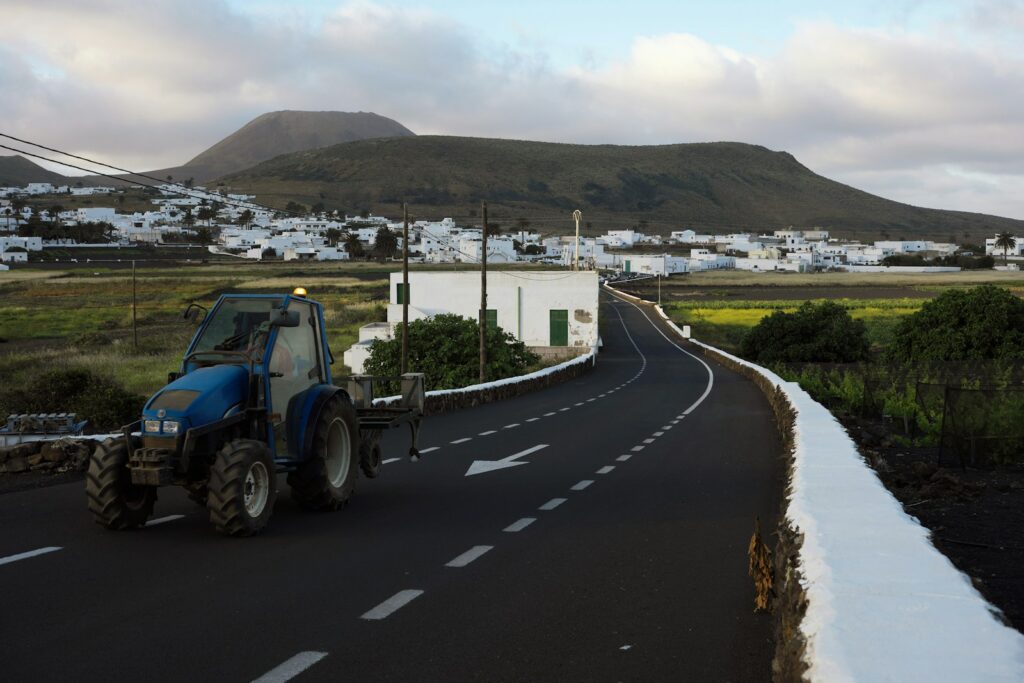
If you have spotted an orange triangle with a red border bolted to the back of a tractor, a road grader, or a horse-drawn buggy, you have seen the slow moving vehicle sign. It does not warn you about the road ahead. It identifies the vehicle carrying it as one built to travel at 25 mph or less, which means the gap between your bumper and theirs is closing far faster than it looks. That single distinction trips up more permit test takers than any other sign question we track. Below we cover what the emblem legally means under ANSI/ASAE S276, the three states where the 25 mph answer is wrong, the second emblem almost nobody teaches, and how the question is actually worded on the knowledge test.
The slow moving vehicle sign is equipment marking, not a road sign
Every other sign you study for the permit test comes from the Federal Highway Administration’s Manual on Uniform Traffic Control Devices. The slow moving vehicle emblem does not. It comes from an agricultural engineering standard, ANSI/ASAE S276, and it is written into federal workplace law at OSHA 1910.145(d)(10), which describes it as a “fluorescent yellow-orange triangle with a dark red reflective border” for “vehicles which by design move slowly (25 m.p.h. or less) on the public roads.”
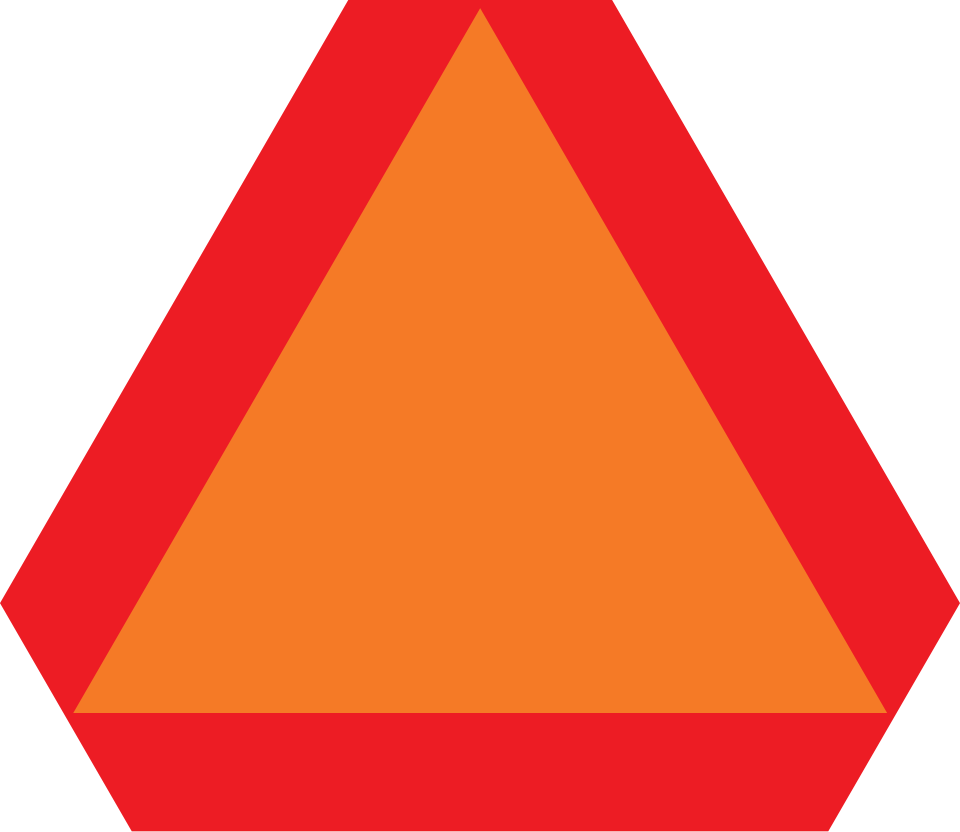
That origin explains the shape. Roadway signs use a fixed shape vocabulary, and no MUTCD sign is an equilateral triangle sitting point up. Agricultural engineer Ken Harkness designed the emblem at Ohio State University in 1962 precisely so it could not be mistaken for anything already on the road. Keeping those two systems straight is the whole skill:
| Shape | What it tells you | Example |
|---|---|---|
| Triangle, point up | A vehicle built for 25 mph or less is ahead of you | SMV emblem on a tractor |
| Diamond | A road condition is ahead | Curve, merge, pavement drop |
| Octagon | Full stop required | Stop sign |
| Pentagon | School zone or crossing | S1-1 school advance sign |
| Triangle, point down | Yield right of way | Yield sign |
The practical consequence: an SMV emblem never tells you to slow for a curve, a work zone, or a hazard in the roadway. It tells you a machine is occupying your lane at a fraction of your speed. If you want the full shape vocabulary, our guide to warning signs and what each shape means covers the MUTCD side, and the diamond shaped sign guide handles the shape this emblem is most often confused with.
The emblem does two different jobs, and one of them fades first
Here is the detail we could not find on a single page ranking for this term, and it is the one that matters most. The emblem is two signals stacked in one object. The 12-inch fluorescent orange center is the daytime signal, readable well past 1,000 feet in direct sunlight. The dark red border is retroreflective, so at night your headlights turn it into a hollow red triangle. Two signals, two lighting conditions.
Now pair that with the crash data. Ohio State University Extension reports that two out of three highway incidents involving slow moving vehicles are rear-end collisions, and 90% of them happen during daylight hours. The failure mode that actually kills people is the daytime one. Yet fluorescent orange pigment degrades under UV long before retroreflective sheeting stops returning light, which is why extension services recommend replacing an emblem every 2 to 3 years rather than waiting for it to stop shining at night. An emblem that still lights up in your high beams at midnight can be functionally invisible at noon.
Federal rules protect both signals. OSHA 1910.145(d)(10) prohibits altering the color film pattern or dimensions and prohibits adding advertising or other markings to the emblem. It also states plainly that the emblem is not a clearance marker for wide machinery and does not replace required lighting.
The 25 mph answer is wrong in at least three states
Practice quizzes teach a single number: 25 mph. That figure comes from the national ANSI/ASAE S276 standard and it holds in most of the country. It is not correct everywhere, and we verified the outliers by reading the statutes rather than trusting aggregator summaries.
| Authority | Speed threshold | Rear visibility required |
|---|---|---|
| ANSI/ASAE S276 and OSHA 1910.145 | 25 mph or less | 500 feet |
| California, Vehicle Code 24615 | 25 mph or less | 500 feet |
| Virginia, Code 46.2-1081 | Not in excess of 25 mph | 500 feet |
| Minnesota, Statute 169.522 | 35 mph or less | 600 feet |
| New York | Under 40 mph | 500 feet |
Minnesota Statute 169.522 sets its threshold at 35 mph and requires rear visibility from 600 feet, not the 500 feet used almost everywhere else. New York’s traffic safety guidance goes further and puts the emblem on all vehicles operating under 40 mph. So a driver studying for the Minnesota permit test or the New York permit test is looking at a road where the emblem can legally appear on equipment moving 10 to 15 mph faster than the national standard implies. In California, by contrast, Vehicle Code 24615 holds the line at 25 mph and adds a mounting spec: base down, between 3 and 5 feet from the ground.
The second emblem nobody teaches: the Speed Identification Symbol
Because modern farm equipment outruns the old 25 mph ceiling, the industry added a companion marking. The Speed Identification Symbol, standardized as ANSI/ASAE S584, is a separate emblem posted next to the SMV triangle on equipment designed to travel faster than 25 mph but under 40 mph. It displays the machine’s design top speed as a number.
New York requires it. State guidance states that Speed Identification Symbols must appear on vehicles traveling greater than 25 mph but less than 40 mph, mounted next to the emblem, and that each piece of agricultural equipment in a combination must display its own SMV emblem separately. If you see a triangle with a number badge beside it, that number is not a speed limit and it is not advisory. It is the machine’s ceiling, and it changes your following and passing math completely.
What to do when one appears in your lane
Run the arithmetic once and it stays with you. A car at 55 mph coming up on a tractor doing 15 mph closes at 40 mph, which is about 59 feet every second. A 400-foot gap, roughly a football field and a third, disappears in under 7 seconds. That is the entire window in which you must see the emblem, recognize it, judge the closing rate, and decide.
The stakes are not theoretical. Research on farm equipment crashes finds that the large majority involve a non-farm vehicle, and fatalities are several times more likely than in ordinary collisions, because a passenger car striking a steel implement absorbs nearly all the energy.
Common mistake: A driver heading home on a two-lane county road at dusk in late September spots the orange triangle a quarter mile ahead and reads it the way any diamond warning sign gets read: something up there, ease off eventually. Speed holds for another 4 seconds. By the time the accelerator lifts, only 150 feet remain and the closing rate is still 40 mph, and the combine ahead has drifted left toward an unmarked field entrance with no turn signal, because the operator is turning across the lane. Harvest season and planting season are exactly when this happens, and slow moving vehicles are most common on rural roads from late April through mid-October.
Three habits cover almost every version of this. Lift off the accelerator the moment you identify the emblem rather than waiting to judge the gap. Assume any slow moving vehicle may turn left into a field entrance or driveway that you cannot see, so never begin a pass as you approach one. And give wide equipment the full lane, since the emblem marks speed and says nothing about width. If a blowout or a shoulder drop complicates that, our guide on handling a tire blowout while driving covers the recovery steps.
Golf carts, buggies, and road machinery carry it too
The emblem is not farm-only. Minnesota Statute 169.522 explicitly covers animal-drawn vehicles, motorized golf carts on designated roadways, implements of husbandry, and all road construction machinery. Virginia requires golf carts operated on public roads to display one, while Colorado permits but does not require it on neighborhood electric vehicles. Low-speed vehicles are typically capped at 20 to 25 mph, which puts them squarely inside the emblem’s definition even though most drivers think of the triangle as a tractor marking.
Animal-drawn vehicles add a wrinkle worth knowing. Some conservative Amish groups object to the emblem on religious grounds, and states have written accommodations rather than exemptions. Minnesota allows a permit for an alternate emblem, a dull black triangle with a white reflective border, but a permit holder must still carry the standard red-orange emblem for use between sunset and sunrise and must affix at least 72 square inches of red reflective tape to the rear. New York’s approach relies on fluorescent tape strips. Rural drivers in Ohio, Pennsylvania, and Indiana should expect buggies marked either way.
Putting the emblem on your mailbox is illegal
This surprises people, and it is written into statute. Minnesota Statute 169.522 states that use of the emblem “is restricted to the slow-moving vehicles specified in subdivision 1 and its use on any other type of vehicle or stationary object on the highway is prohibited.” New York’s guidance says the same thing in plainer language: it is illegal to put SMV emblems on stationary objects such as mailboxes or driveway posts. Virginia Code 46.2-1081 restricts the emblem to statutory uses, though it carves out bicycles, mopeds, and motorized scooters so that displaying one there is not a violation.
The reasoning is signal dilution. The emblem works because it means exactly one thing. Every driveway marker and fence post wearing an orange triangle teaches drivers to stop reading it as “there is a machine in your lane doing 15 mph.” Mounting rules protect the same signal, and they vary more than you would expect.
| Requirement | Specification | Source |
|---|---|---|
| Orientation | Point up, perpendicular to travel | ANSI/ASAE S276 |
| Lateral position | Center, or as near left-center as practicable | ANSI/ASAE S276 |
| Height, general standard | 2 to 10 feet, measured to bottom edge | ANSI/ASAE S276 |
| Height, California | 3 to 5 feet, base down | Vehicle Code 24615 |
| Height, New York | 2 to 6 feet above the road | NY traffic safety guidance |
| Condition | Clean, undamaged, not faded | ANSI/ASAE S276 |
Buying a replacement, and when to do it
Slow moving vehicle signs are sold at farm supply retailers and hardware stores across the United States, and only one thing really matters: the product has to meet the current ANSI/ASAE S276 specification. Unbranded triangles are easy to find and easy to regret, because the fluorescent film is the part doing the daytime work, and its quality varies far more than the price tag suggests. Retailers stock these products alongside lighting kits and reflective tape, so look for an emblem made with diamond grade reflective sheeting on the border, which holds its return far longer than engineer-grade material.
Replace on a schedule rather than on appearance. Since the orange center fades before the red border stops reflecting, an emblem can still look convincing in your headlights long after it has lost the daylight signal that most of these crashes turn on. Extension programs put the practical service life at roughly 2 to 3 years of outdoor exposure. Road safety agencies treat a badly faded emblem as no emblem at all, and a driver approaching at 55 mph has no way to tell the difference until it is too late to matter.
How the question shows up on the permit test
Across the state handbooks we cross-check our question bank against, this topic appears in 3 reliable forms. The first asks what the orange triangle means, and the correct answer is a vehicle traveling at 25 mph or less, not a warning about the road. The second asks what you should do when you approach one, and the answer is slow down and prepare to follow rather than pass immediately. The third is a shape question that mixes the point-up triangle in with diamonds and pentagons.
The miss pattern in our own user data is consistent: people who lose this question almost always pick a road-condition answer, because every other triangle-adjacent shape they have studied describes the road rather than a vehicle. Anchoring on “this emblem describes a machine, not a road” fixes it in one pass, because the shape is telling us about the vehicle rather than the roadway. Work through the shape families in our road signs hub, then drill the mixed-shape sets in a full practice test. Two other markings people confuse with roadway signs are worth the same treatment: the wrong way sign and the crossings covered in our railroad crossing signs guide.
Frequently asked questions
These are the questions drivers actually search after seeing the emblem on a rural road.
Learning the slow moving vehicle emblem well is a small investment that pays twice. It removes one of the most commonly missed shape questions from your knowledge test, and it gives you a genuinely useful reflex on any rural two-lane road: orange triangle means lift off now, not eventually. Check your own state’s threshold before test day, since Minnesota sits at 35 mph under Statute 169.522 and New York extends to under 40 mph rather than the standard 25 mph figure. Then drill the sign-shape sets in DMV Ready until the triangle registers before you have finished reading the answer choices. Seven seconds is not much time to think it through on the road.


 Scan to get the app