Diamond Shaped Sign: What It Means
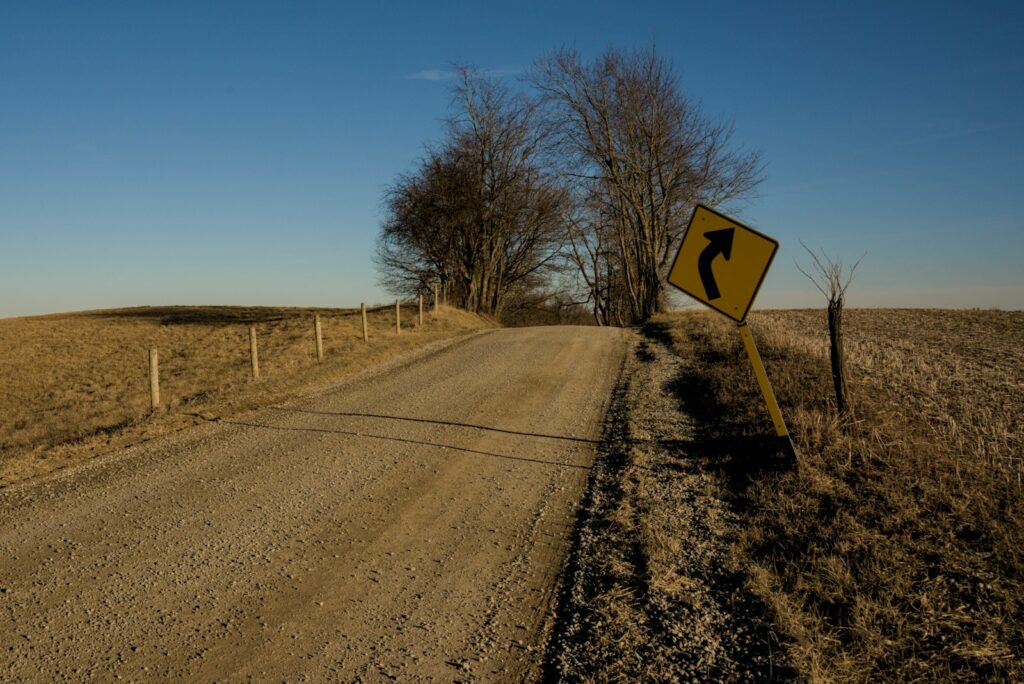
A diamond shaped sign means one thing on American roads: warning. The shape is the message. Before you read a word or decode a symbol, the outline itself has already told you that something ahead needs your attention, and federal rule reserves that outline for exactly that purpose. For anyone studying for a learner’s permit, that single association answers most of the sign-shape questions you will meet. What the exam rarely explains is the part that matters once you are driving: a diamond warns you, it does not order you, and the difference decides what happens if you ignore one.
What a diamond shaped sign means
The rule is short and it is federal. Section 2C.02 of the Manual on Uniform Traffic Control Devices, 11th Edition, published by the Federal Highway Administration in December 2023, states that “all warning signs shall be diamond-shaped (square with one diagonal vertical) with a black legend and border on a yellow background.”
Read that parenthetical again, because it is the precise definition most study guides skip. A diamond sign is not a stretched rhombus. It is a square, rotated so that one diagonal stands vertical. That is why a diamond sign is exactly as wide as it is tall, and why the points sit at twelve, three, six and nine o’clock.

The federal manual backs this up with a shape inventory. Table 2A-1, “Use of Sign Shapes,” assigns each outline to a sign family, and next to Diamond it lists a single entry: Warning Series. State handbooks say the same thing in plainer words. The Pennsylvania Driver’s Manual chapter on signs tells new drivers that warning signs “tell you about conditions on or near the road ahead,” that they are “posted before the condition, so you have time to see what is ahead,” and that they “are usually diamond-shaped with black symbols or words on a yellow background.”
Note the word “usually.” It is doing real work, and we come back to it below.
Why the shape carries the message before the words do
Shape is the fastest channel a sign has. At highway speed you resolve an outline against the sky several seconds before you can read a legend, so the federal manual treats shape as information in its own right and rations it carefully. Table 2A-1 marks certain shapes with a footnote reading “This shape shall be limited exclusively to the sign(s) indicated.” An octagon is only ever a stop. A downward-pointing equilateral triangle is only ever a yield. Those outlines are spent, permanently, on one message each.
The diamond is different in an instructive way. It is not reserved for one sign; it is reserved for one whole category. That is a deliberate trade. Warnings are open-ended, since there is no fixed list of hazards a road can present, so the manual assigns the category an outline and lets the symbol inside carry the specifics. You learn one shape and you have learned a hundred signs.
The manual protects that silhouette aggressively. Section 2A.05 states that “modifications to sign shapes, such as cutting off the left and right points of a diamond, shall not be allowed.” A highway agency running short of lateral clearance may not simply trim the sign to fit. The outline is the message, and a clipped diamond is a degraded message.
A diamond warns you. It does not order you.
Here is the distinction that costs new drivers points on the test and money on the road. Warning signs and regulatory signs do different legal jobs. A regulatory sign, typically a white or black-and-white rectangle, states a law you must obey. A diamond describes a condition ahead and leaves the response to your judgment.
The clearest illustration is the advisory speed plaque. Pennsylvania’s manual notes that this sign “may be used with any diamond-shaped warning sign,” and gives the standard example: the highest speed you should travel around a sharp left curve ahead is 25 mph.


That 25 is not the speed limit. The posted limit lives on a white regulatory sign and may well still read 55. The advisory number is an engineering recommendation for that specific curve. Ignoring it is not automatically “speeding.”
New drivers often draw the wrong conclusion from that, which is that advisory speeds are optional. They are not, in the way that counts. Every state has a basic-speed rule requiring you to drive at a speed that is reasonable for actual conditions, and an advisory plaque is documented evidence of what the road engineer determined those conditions to be. Take the curve at 55 and lose it, and the advisory sign becomes the first exhibit in the case that you were driving too fast for conditions, regardless of the number on the regulatory sign.
So the diamond is not toothless. It simply works through a different mechanism: it establishes what a reasonable driver should have known.
The four colors a diamond can wear
Yellow is the default, but it is not the only option, and the color changes what kind of hazard you are being warned about.
Yellow with a black legend is the general case set by Section 2C.02: curves, hills, intersections, surface conditions, merges. These are the yellow warning signs that make up most of the category.
Fluorescent yellow-green is the vulnerable-road-user color, and the manual splits it into an option and a requirement. For pedestrians, bicyclists and playgrounds, Section 2C.02 says these signs “may have a black legend and border on a yellow or fluorescent yellow-green background.” For schools it is mandatory: signs “regarding conditions associated with school buses and schools and their related supplemental plaques shall have a black legend and border on a fluorescent yellow-green background.” That distinctive yellow-green is engineered to sit outside the color range of everything else on the roadside, which is precisely why a school zone sign registers differently from an ordinary curve warning.
Orange means people are working. As Pennsylvania’s manual puts it, work zone signs “are normally diamond-shaped, like warning signs, but they are orange with black lettering instead of yellow with black lettering,” identifying areas “where workers or equipment may be on or near the roadway.” Same shape, same job, different urgency, and in most states a different fine schedule.
Fluorescent pink is the rarest of the four and the one most likely to appear on a test as a trick option. It is reserved for incident management: crashes, spills and other unplanned emergency situations. If you see a pink diamond, something has gone wrong up ahead within the last few hours.
The diamond signs most likely to be on your test
Permit exams draw from a predictable core. These are the diamonds worth recognizing on sight, with their federal designations:
- Turn (W1-1) and Curve (W1-2) - a sharp turn versus a gentler bend. The arrow shape distinguishes them.
- Winding road (W1-5) - three or more changes in direction. See our full guide to the winding road sign.
- Cross road (W2-1) - an intersection ahead, drawn as a plus sign.
- Stop ahead (W3-1) and Signal ahead (W3-3) - a traffic control you cannot yet see, often over a crest or around a bend.
- Divided highway (W6-1) - the roadway splits around a median.
- Bump (W8-1) and Dip (W8-2) - vertical surface changes.
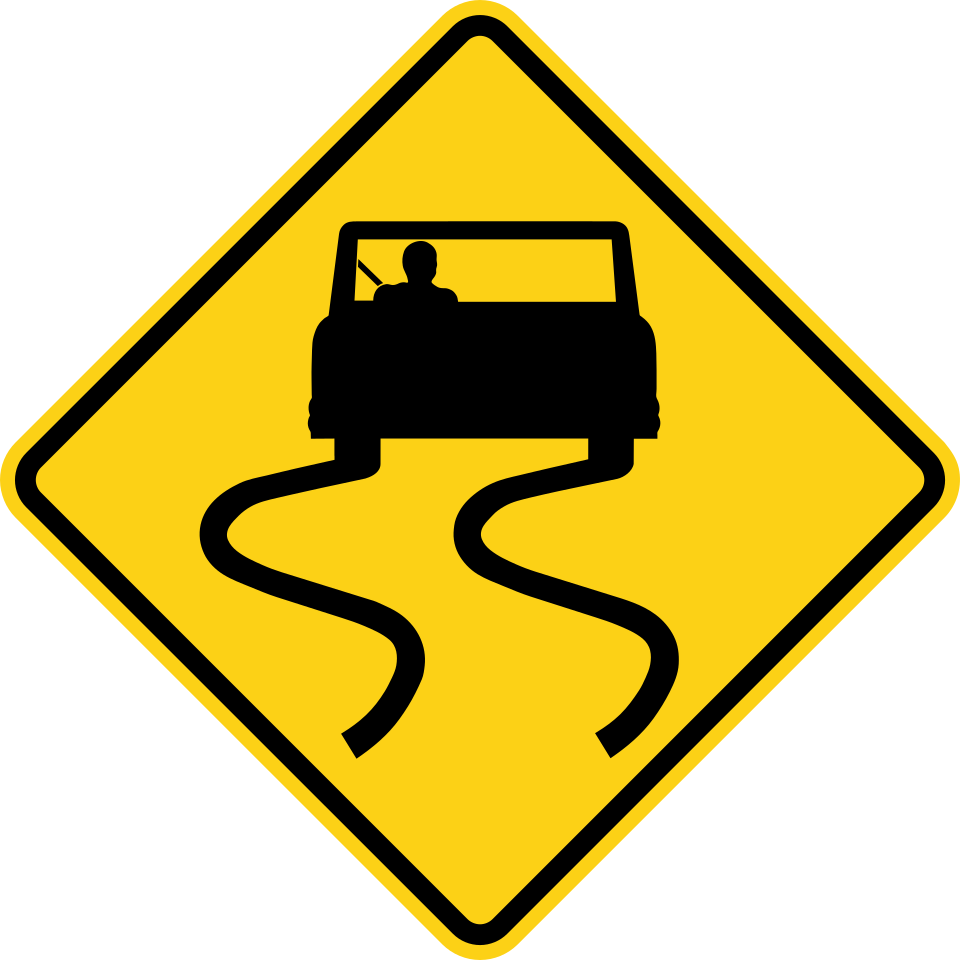
- Slippery when wet (W8-5) - reduced traction in rain. Covered in detail in our slippery when wet sign guide.
- Pedestrian (W11-2) and Bicycle (W11-1) - crossing and shared-use warnings, frequently in fluorescent yellow-green. The federal manual files the pedestrian sign under non-vehicular warnings and the bicycle sign under vehicular ones, since a bicycle is a vehicle.
- Merge (W4-1) and Lane ends (W4-2) - lane geometry changing ahead.
A useful exam habit: when a question shows you a yellow diamond and asks what to do, the answer is almost never “stop” or “yield” as a legal requirement. It is some version of slow down, scan, and prepare. Reserve the mandatory answers for the shapes that carry them.
The warning signs that are not diamonds
Recall Pennsylvania’s careful “usually.” The federal standard opens with “except as provided in Paragraph 2 of this Section or unless specifically designated otherwise,” and those exceptions are exactly the kind of detail a test writer likes.
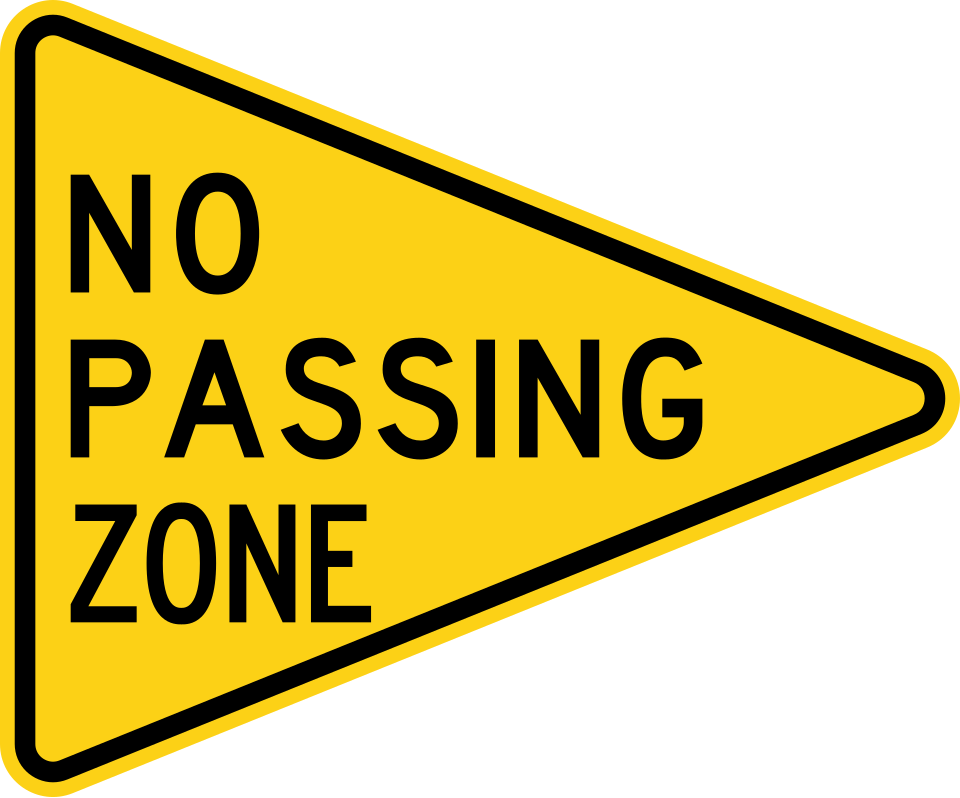
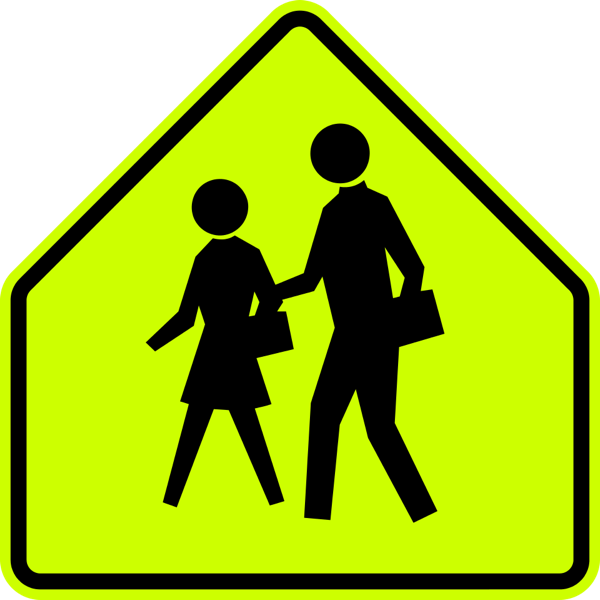
Three warning-family signs have their own exclusive outlines, each listed individually in Table 2A-1:
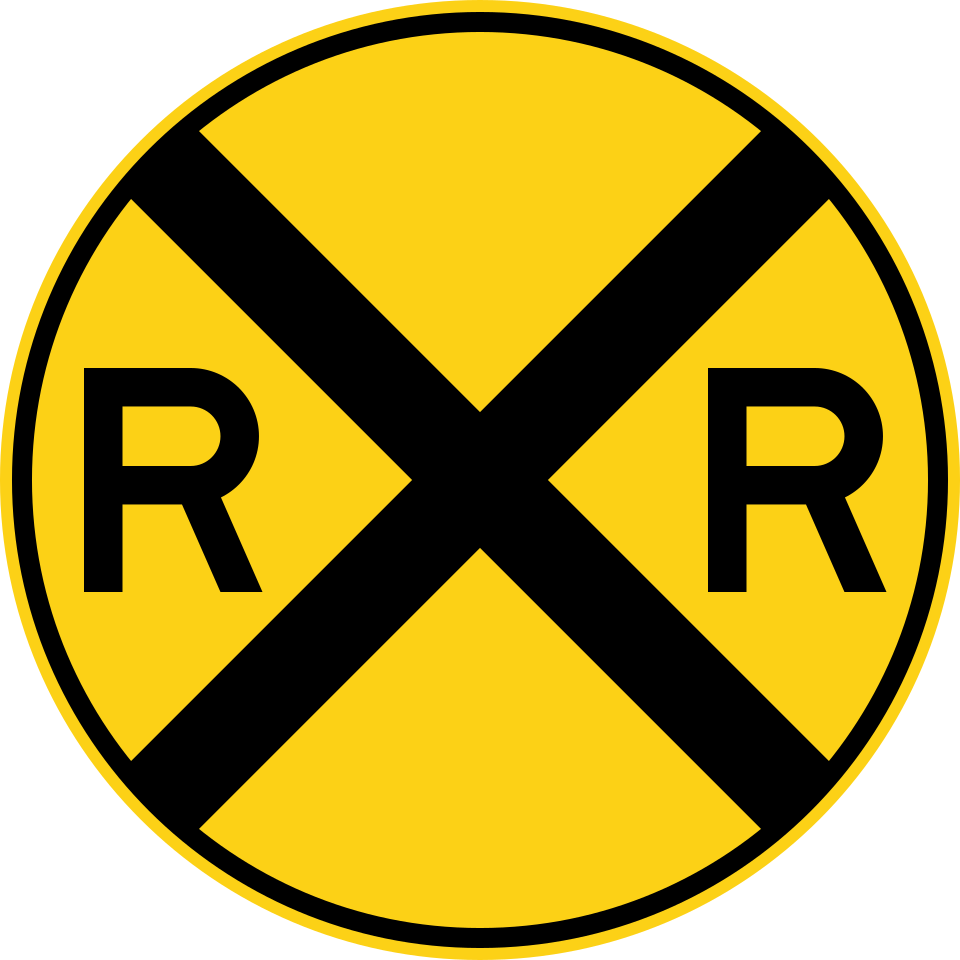
- The circle belongs to the Grade Crossing Advance Warning sign (W10-1), the yellow round sign with a black X and two R’s that appears before a railroad crossing. It is the only circular sign in the system, which is why it reads as “railroad” from a distance. Do not confuse it with the white X-shaped crossbuck sign (R15-1) at the tracks themselves, which is regulatory rather than warning.
- The pennant, a horizontal isosceles triangle pointing right, belongs to NO PASSING ZONE (W14-3). Section 2C.53 requires it be installed on the left-hand side of the roadway. Our guide to the pennant shaped sign covers why.
- The upward-pointing pentagon with squared bottom corners belongs to the School sign (S1-1).
Two more categories break the diamond without being exceptions to it. Supplemental warning plaques, the small signs mounted directly below a warning sign, “shall be square or rectangular” under Section 2C.58, and they take the same background color as the sign they serve. The advisory speed plaque above is one of these. And a diamond may legitimately become a rectangle for engineering reasons: the manual notes that a non-diamond shape “is typical for overhead installations,” and permits a vertically-oriented rectangle where lateral space is constrained, such as on a narrow median barrier or beside a retaining wall.
The message stays the same in every case. Yellow background, black legend, condition ahead.
The diamond that is not a sign at all
Search results for diamond shaped signs frequently mix in a completely different diamond: the white one painted on the pavement of a carpool lane, or shown as a symbol on a rectangular white sign above it.
That diamond is a symbol, not a shape. Chapter 2G of the federal manual governs preferential lanes and states that signs “that incorporate the diamond symbol shall be used exclusively with preferential lanes for high-occupancy vehicles,” displayed as “the white diamond symbol on a black background.” The manual is explicit that the symbol “shall not be used on the bus, taxi, or bicycle Preferential Lane signs.”
So a white diamond marking on the roadway means the lane has an occupancy requirement, typically two or more people. It is a regulatory instruction, and it is enforced. It has nothing to do with the yellow warning diamond, and confusing the two is a genuine test trap. If you want the full picture of what is painted on the road versus posted beside it, our road markings guide works through the difference.
What the permit test asks, and what the road asks
Exam questions about the diamond come in three reliable forms. The first is straight recall: what shape are warning signs, or what does a yellow diamond mean. The second is color discrimination: an orange diamond means a work zone, a fluorescent yellow-green diamond means pedestrians, cyclists or a school. The third is the category test, where you are shown a sign and asked whether it warns or regulates, and the shape is the entire answer.
Once you are actually driving, the useful reframe is one of timing. Warning signs are placed in advance of the condition, deliberately, to buy you the seconds needed to see, decide and adjust. A diamond is not describing where you are. It is describing where you will be in a few hundred feet. Drivers who treat it as a status report rather than a countdown are the ones who arrive at the curve still carrying highway speed.
Frequently asked questions about diamond shaped signs
Short answers to the questions we see most often about diamond shaped signs, drawn from the federal manual and state driver handbooks. For state-specific rules, start at our state practice hub or browse the full road sign library.
Learn the diamond as a single association, shape equals warning, then layer the color rule on top of it: yellow for general hazards, orange for work zones, fluorescent yellow-green for people outside a vehicle, pink for an incident. That covers the overwhelming majority of what any permit exam will ask. When the shape is automatic, drill the signs you are shakiest on with our road signs practice test, then run a timed set in your own state with DMV Ready, whether that is California permit test practice, New York permit test practice or Texas permit test practice. The exam rewards recognition; the road rewards reading the countdown.


 Scan to get the app