Divided Highway Sign: What It Means

A divided highway sign appears as a yellow diamond with two arrows curving away from a raised median, and it signals that the road ahead separates into two one-way roadways with a physical barrier between them. That is a warning about geometry, not an instruction to switch lanes. Federal code catalogs it as W6-1, and it shows up only along a stretch of highway where the roadway divides, never at an intersection. The white rectangular DIVIDED HIGHWAY sign posted on a side street is a different sign, R6-3, doing a different job. What follows breaks down all four signs in this family, what the median legally means for school buses and U-turns, and which version of this question actually surfaces on the permit test.
What the divided highway sign actually means

The federal rulebook for every public road in the country is the Manual on Uniform Traffic Control Devices, and its 11th Edition was published in December 2023. Section 2C.20 gives the W6-1 sign one job: it “should be used on the approaches to a section of highway (not an intersection or junction) where the opposing flows of traffic are separated by a median or other physical barrier,” according to the FHWA warning-sign chapter.
Two details in that sentence carry real weight. The parenthetical rules out intersections, so a W6-1 posted at a cross street is a misapplication. And “median or other physical barrier” reaches wider than grass: a concrete wall, a cable barrier run, or a raised island each qualify under Section 2C.20.
Section 2C.20 adds one hard prohibition. The Divided Highway sign “shall not be used instead of a Keep Right (R4-7 series) sign on the approach end of a median island.” The yellow diamond warns that a split is coming. It never dictates which side of the island to take, which is exactly what drivers assume it does. Standard sizes run 36 by 36 inches on conventional roads and 48 by 48 inches on expressways and freeways.
Yellow color plus diamond shape places this sign in the warning class, alongside every other hazard-ahead message on the road. If the color logic is still fuzzy, the guide to what each warning-sign color means covers the full set, and the road sign study hub groups them by shape.
The yellow diamond and the white rectangle are two different signs
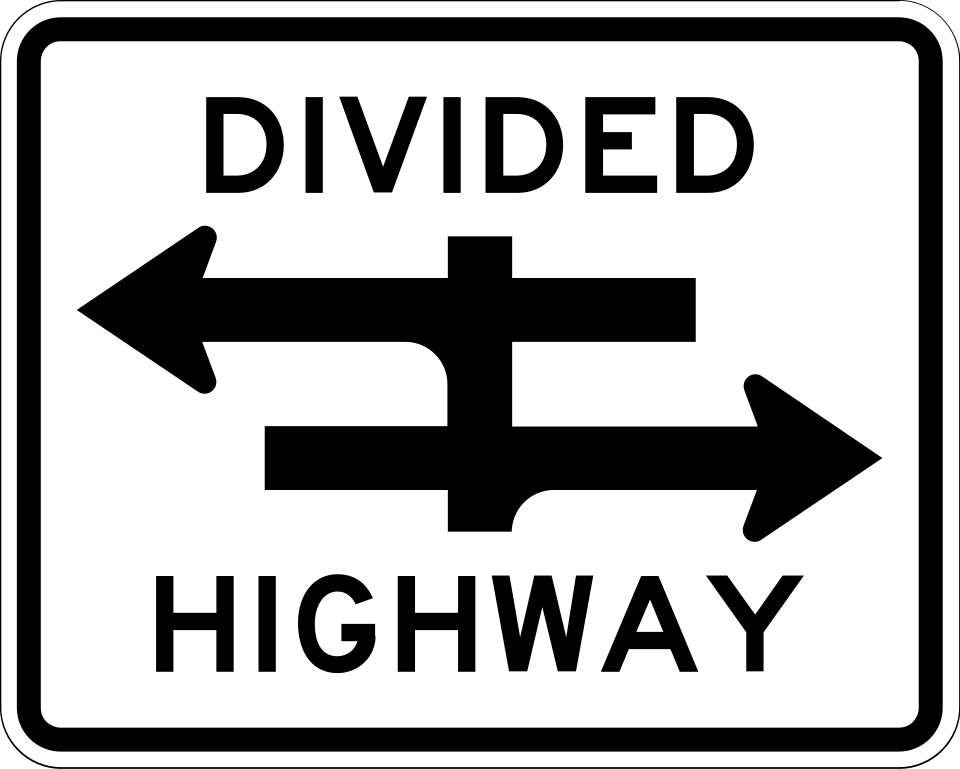
Search “divided highway sign” and half the results describe a regulatory sign that tells drivers the road they are on crosses a divided highway. That description belongs to a different sign entirely. Section 2B.50 of the same manual covers the Divided Highway Crossing signs, R6-3 and R6-3a, and the regulatory-sign chapter is specific about where they go.
R6-3 is required on unsignalized minor-street approaches where both left and right turns are allowed onto a divided highway “at a crossing that functions as two separate intersections.” It gets mounted on the near right corner, under the STOP or YIELD sign. A four-leg intersection takes R6-3; a T-intersection takes R6-3a. Agencies may skip the sign when the divided highway carries under 400 vehicles a day at 25 mph or less.
| Feature | W6-1 Divided Highway | R6-3 Divided Highway Crossing |
|---|---|---|
| Sign class | Warning | Regulatory |
| Shape and color | Yellow diamond, black symbol | White rectangle, black legend |
| MUTCD section | 2C.20 | 2B.50 |
| Where it is posted | On the divided highway itself, never at an intersection | On the side street approaching the divided highway |
| What it tells you | The road ahead splits around a median | Cross or turn in two stages, one roadway at a time |
Mixing the two up costs points on sign questions that supply only a shape and a color. Yellow diamond, the driver is already on the highway. White rectangle, the driver is the one waiting to cross it. The breakdown of how regulatory signs differ from warnings walks through the wider rule.
Divided highway ends is the half that hurts you
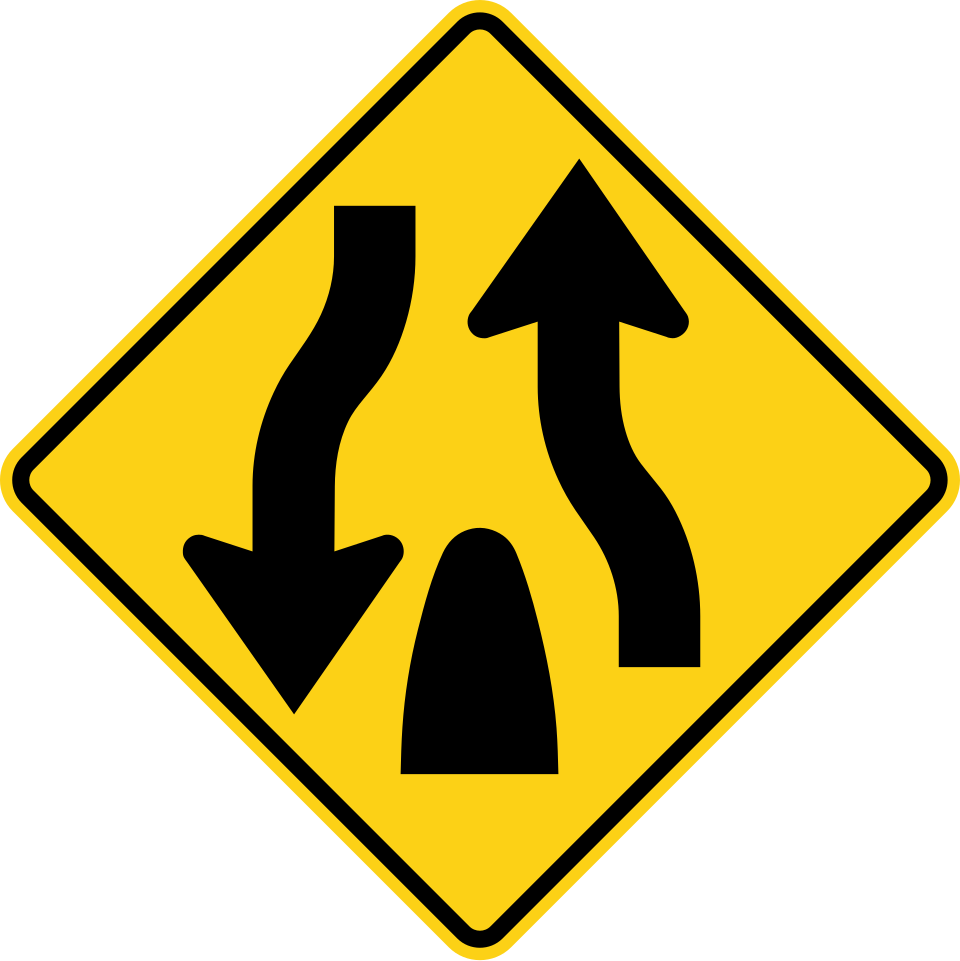

Section 2C.21 covers W6-2, posted in advance of the point where a physically divided highway stops being divided. The symbol is the mirror image of W6-1, and the position of the median island is the tell. Island at the top of the diamond, the split begins. Island at the bottom, the split is behind you and two-way traffic resumes.
The manual pairs W6-2 with a second sign. Section 2C.51 states the Two-Way Traffic sign, W6-3, “should be used to give warning and notice of the transition to a two-lane, two-way section,” and it may repeat at intervals along that road. Three-lane transitions use W6-5 and W6-5a instead. Seeing W6-2 followed by W6-3 is a sequence, not redundancy: the first warns that the barrier is ending, the second warns that oncoming cars now share the pavement.
How far ahead these signs sit is engineered, not guessed. Table 2C-3 sets advance placement from posted or 85th-percentile speed, at 325 feet for 25 mph, 565 feet for 35 mph, and 775 feet for 45 mph under Condition A, which covers speed reduction and lane changing in heavy traffic. On a 45 mph arterial that works out to roughly 12 seconds of notice before the median disappears.
Driving off the end of a divided section is where new drivers drift left out of habit. The lane that has been serving as a passing lane becomes an oncoming lane, and headlights arrive where there were none for the past 10 miles.
Three actions belong in those 12 seconds. Move right and stay there, since the left lane is about to belong to someone else. Cancel any pass already in progress rather than finishing it past the transition. Confirm the headlights are on, because the sight distance a driver needed on a divided road is not the sight distance needed when a car closes at a combined 90 mph.
Why the median is there, in crash numbers
A median is a piece of safety hardware with measurable results. FHWA’s evaluation of cable median barriers on divided roads, report HRT-17-070, compared crash records before and after installation across three states. The findings, published in the study’s before-after results, show what a barrier does and what it costs.
| Crash type | Illinois and Kentucky | Missouri |
|---|---|---|
| Cross-median crashes | 48 percent decrease | 96 percent decrease |
| Injury and fatal crashes | 24 percent decrease | 26 percent decrease |
| Total crashes | 27 percent increase | 25 percent increase |
| Property-damage-only crashes | About 51 percent increase | Not separately reported |
Read both columns twice. Total crashes climbed in each state while injury and fatal crashes fell, because the barrier converts a head-on collision into a car striking a cable and stopping. In Illinois and Kentucky the researchers traced that gap directly: property-damage-only crashes rose from a predicted 2,255 to an actual 3,397. More crashes, less carnage. That trade is the entire argument for medians, and it explains the engineering behind a simple yellow diamond.
It also explains the asymmetry between W6-1 and W6-2. Entering a divided section removes the worst risk. Leaving one hands it back.
Missouri’s 96 percent drop stands apart from the other two states for a documented reason: its roads lacked inside shoulder rumble strips before the barriers went in, so the barrier was doing all the work rather than adding to an existing countermeasure. Traffic engineers layer these devices, and the sign is the first layer. Every barrier in that study sits behind a W6-1 somewhere upstream, telling drivers the geometry changed before the hardware has to prove itself.
The median decides who stops for a school bus
Here is where the sign stops being trivia. Nearly every state writes its school bus stopping law around whether the road is divided, and the definitions do not match. Cross-checking all 50 driver handbooks against the underlying statutes for DMV Ready, this rule surfaced as one of the places where states disagree most sharply.
| State | Do oncoming drivers stop for a stopped school bus? |
|---|---|
| Florida | No, but only if a raised barrier or at least 5 feet of unpaved median separates the lanes. A paved median does not count and all traffic must stop. |
| California | No, on any divided or multiple-lane highway, defined as two or more lanes of travel in each direction. |
| New York | Yes. The statute says “meeting or overtaking from either direction” and writes in no divided-highway exception. |
Florida’s rule comes straight from the FLHSMV school bus safety page, which states that traffic approaching an oncoming bus does not stop only “if there is a raised barrier such as a concrete divider or at least five feet of unpaved space separating the lanes of traffic,” and that painted lines are not barriers. Passing a stopped bus carries four points and a minimum $265 fine, rising to $465 on the side where children board, under the Cameron Mayhew Act of 2017.
California takes the opposite approach. Vehicle Code 22454(b) excuses drivers on the far roadway of a divided or multiple-lane highway with no barrier required at all. New York keeps the strictest version: Vehicle and Traffic Law 1174 requires a stop from either direction and never carves out divided roads.
Common mistake: A 16-year-old learns to drive in Sacramento, passes the exam under California Vehicle Code 22454(b), then spends a summer with family in Buffalo. Encountering a school bus stopped across a grassy median on a four-lane road, that driver keeps rolling, because that behavior is legal at home. In New York it is a passing-a-stopped-school-bus violation under VTL 1174. The sign was identical. The law was not. Anyone practicing across state lines should run the New York question set and the California question set separately rather than assuming the rules travel.
Crossing the median, and what the test really asks
The second rule the median triggers is turning. California Vehicle Code 21651 defines a dividing section as one at least two feet wide, “either unpaved or delineated by curbs, double-parallel lines, or other markings on the roadway,” and makes it unlawful to drive across it or to make a left, semicircular, or U-turn except through an opening built for that purpose. Driving to the left of the barrier is a misdemeanor, and a willful violation causing injury carries jail time.
Set that beside Florida’s bus rule and a paradox worth memorizing emerges: painted double lines can legally divide a highway for turning purposes under California VC 21651 while failing to divide it for school bus purposes under Florida’s 5-foot-median rule. Same paint, two answers. When a question asks whether a road is divided, check what the question is testing before answering.
The DMV Ready question bank shows how this topic actually gets examined. Of roughly 4,000 questions maintained in the set, 21 mention a divided highway and 15 name it in the question text. Only 4 of those 15 ask about the sign, and 3 of the 4 target the ENDS version rather than the begins version. The remaining 11 test rules the median triggers: school bus stopping, U-turn legality, move-over behavior when an emergency vehicle sits on the far roadway, truck lane restrictions on roads with four or more lanes in one direction, and the plain definition of a divided highway.
That ratio is the practical takeaway. Studying the W6-1 symbol alone prepares a learner for about one question in fifteen. Studying what a median does to right-of-way covers the rest, which is why the right-of-way guide and lane control signs page carry more weight on test day than any single sign page. State-by-state practice sets live on the state test hub, and Florida and Texas learners can start with the Florida practice test or the Texas practice test.
Divided highway sign FAQ
These are the questions people search most often about this sign family, answered from the current federal manual and the state statutes cited above.
Learn the four signs as a set: W6-1 when the median begins, W6-2 when it ends, W6-3 when oncoming traffic returns, and R6-3 when the driver is the one crossing. Then learn what the median changes, because that is what the examiner asks about. Practice the sign questions for your own state in DMV Ready, where every question is matched to the handbook the local DMV actually tests from, and re-check the school bus rule any time the drive crosses a state line. The median looks the same in every state. The law behind it does not.


 Scan to get the app