Crossbuck Sign: What It Means
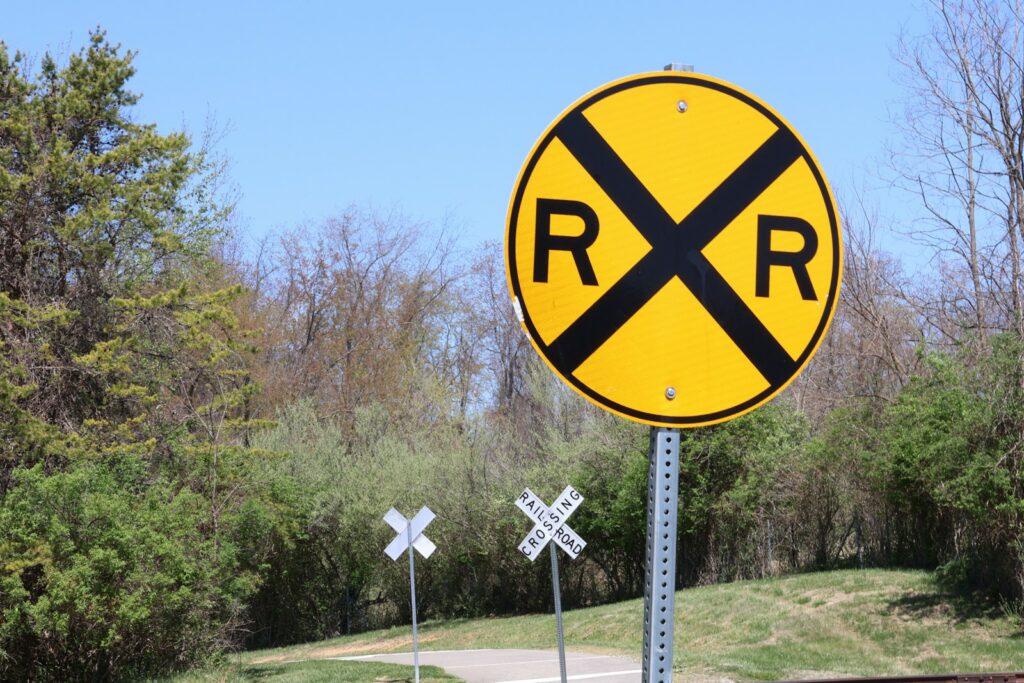
A crossbuck sign is the white X at a railroad crossing, and it carries the legal force of a yield sign: you have to give way to any train on the tracks. That is the answer most drivers came here for. The part almost no study page mentions is that the crossbuck stopped being a complete traffic control device in 2019. Federal rules now require a second regulatory sign, usually a YIELD, mounted on the same post at every passive crossing in the country. Building DMV Ready, we read the federal manual itself rather than paraphrasing other study sites, and the gap between what drivers assume the crossbuck means and what it legally does turned out to be wider than we expected.
What a crossbuck sign actually means
The crossbuck carries the code R15-1, and it lives in Part 8 of the Federal Highway Administration’s Manual on Uniform Traffic Control Devices, the chapter covering railroad and light rail grade crossings. Its formal name is the Grade Crossing sign. Section 8B.03 sets the appearance in one sentence: the sign “shall be retroreflectorized white with the words RAILROAD CROSSING in black lettering.” Each of the two blades runs 48 inches long and 9 inches wide, and the preferred mounting height puts the center of the X roughly 9 feet above the roadway.

Here is the detail that changes how you should think about it. The crossbuck sits in the regulatory chapter, alongside stop and yield signs, not in the warning chapter with the yellow diamonds. A regulatory sign tells you what the law requires. A yellow warning sign only tells you what is ahead. Confusing the two is the single most common error we see in permit questions about railroad crossings.
Then comes the wrinkle. The federal manual does not itself declare that a crossbuck means yield. Paragraph 02 of Section 8B.03 is filed under “Support,” which is the manual’s label for background information rather than a binding rule, and it reads: “In most States, the Crossbuck sign requires road users to yield the right-of-way to rail traffic at a grade crossing.” Most states. Not all. The yield duty comes from your state vehicle code, not from the sign itself, which is exactly why federal regulators eventually bolted a real yield sign onto the post.
| Sign or plaque | Code | What it does |
|---|---|---|
| Crossbuck (Grade Crossing) | R15-1 | Marks the crossing; regulatory, yield to rail traffic |
| Number of Tracks plaque | R15-2P | States how many tracks you are about to cross |
| Yield | R1-2 | Default second sign on the crossbuck post |
| Stop | R1-1 | Substitute for yield only after an engineering study |
| Advance warning | W10-1 | Round yellow sign warning of a crossing ahead |
The crossbuck stopped being the whole sign in 2019
Federal rules from the 2009 edition of the manual created something called a Crossbuck Assembly, and the deadline for retrofitting existing crossings was December 31, 2019. Section 8B.04 defines the assembly precisely: a crossbuck, plus a Number of Tracks plaque if two or more tracks are present, plus “either a YIELD (R1-2) or STOP (R1-1) sign installed on the same support.” One sign is no longer enough on its own.

Which second sign goes up is not left to the crew installing it. The rule is blunt: “A YIELD sign shall be the default traffic control device for Crossbuck Assemblies on all highway approaches to passive grade crossings,” unless an engineering study by the agency with jurisdiction concludes a stop sign is appropriate. A crossing only earns a stop sign under unusual conditions, weighed against four named factors: sight distance to approaching trains, including seasonal crops and vegetation, the number of tracks, train and vehicle speeds, and the crash history at that specific crossing.
FHWA explained the reasoning in its guidance to state highway agencies, and the logic is worth borrowing when you study. “Indiscriminate use of the STOP sign at all or many passive grade crossings can cause poor compliance, increasing the risk of collisions associated with a high non-compliance rate.” Drivers who stop at forty empty crossings stop looking. A yield sign asks for the behavior the situation actually calls for, which is slowing enough to look down the track and being ready to stop.
So on a modern permit test, the safest reading of a bare crossbuck in a photo is this: it means yield to rail traffic, and at a real passive crossing you should also expect a yield or stop sign underneath it.
What a crossbuck tells you is missing
Crossings come in two families. Active crossings have equipment that reacts to an approaching train: flashing red lights, bells, and often gates. Passive crossings have signs and pavement markings only, and nothing about them changes when a train is coming. Counting them out, a 2025 Government Accountability Office review of FHWA’s biennial report to Congress found 130,209 public railway-highway crossings nationwide, of which 54 percent were active and 46 percent were passive. Close to 60,000 public crossings in this country will never tell you a train is coming.
A crossbuck standing alone, with no signal heads and no gate arms, is therefore information in itself. It tells you the crossing has no way to warn you. The Georgia Department of Driver Services handbook puts the burden plainly: at a passive crossing “the decision to proceed rests entirely in your hands.”
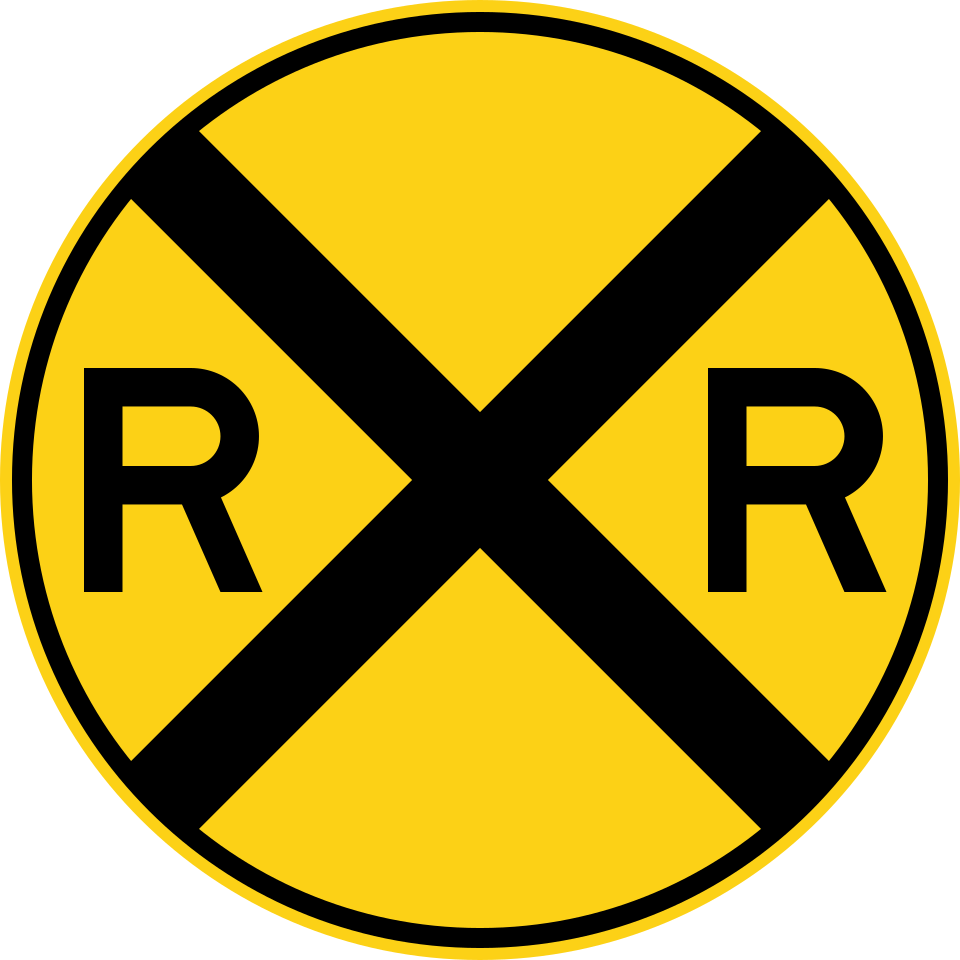
Before you reach the crossbuck, two other devices usually appear. The round yellow W10-1 sign, one of the few circular signs in American traffic control, warns that a crossing is ahead and tells you to slow down and look. Painted on the pavement you get a large X with the letters RR and a no-passing line on two-lane roads. Both of those sit in advance of the tracks. The crossbuck sits at the tracks. Test questions love that distinction.
| Passive crossing | Active crossing | |
|---|---|---|
| Share of public crossings | 46 percent | 54 percent |
| Devices present | Crossbuck, tracks plaque, yield or stop sign, pavement markings | Flashing lights, bells, often gates |
| Warns of an actual train | No | Yes |
| Who decides it is safe | The driver | The equipment, then the driver |
What the law makes you do when you get there
Yielding is the baseline. On top of it, every state adds conditions that convert the yield into a mandatory stop, and the stopping distance is written into statute. Illinois is representative: under 625 ILCS 5/11-1201, a driver “shall stop within 50 feet but not less than 15 feet from the nearest rail” and “shall not proceed until the tracks are clear.” Five circumstances trigger it, including a lowered gate, a flagger’s signal, a train sounding a warning while close enough to be an immediate hazard, and a train that is simply “plainly visible and is in hazardous proximity.”
California writes the same rule without the ceiling. Vehicle Code section 22451 requires a stop “not less than 15 feet from the nearest rail” and sets no maximum distance, then adds a separate prohibition that catches people every year: no driver or pedestrian may proceed “through, around, or under any railroad or rail transit crossing gate while the gate is closed.” Some California crossings also run automated enforcement cameras. If you are studying in either state, the practice sets on our Illinois permit test and California permit test pages use the statutory numbers, not generic ones.
| State | Minimum distance from nearest rail | Maximum distance |
|---|---|---|
| Illinois | 15 feet | 50 feet |
| California | 15 feet | None stated |
| Texas | 15 feet | 50 feet |
| Georgia | 15 feet | 50 feet |
The 15-foot floor is not arbitrary padding. Rolling stock is wider than the rails it runs on, so a car stopped at the rail edge is inside the space the train will occupy. The upper bound, where a state sets one, keeps you close enough to see down the track before you commit.
The crossbuck mistake that costs lives
When two or more tracks cross the road and no automatic gates are present, an inverted-T plaque goes up under the crossbuck stating the number of tracks. Read it. That number is the whole warning about the failure mode nobody expects.
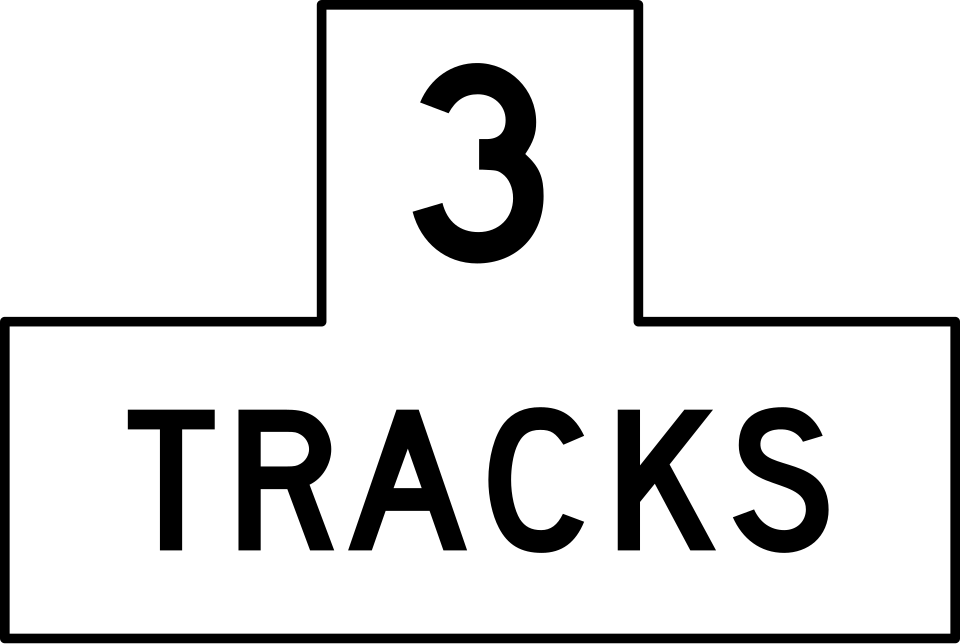
Picture Marisol, 17, driving a two-lane county road outside Bloomington with a crossbuck and a 2 TRACKS plaque. A freight clears the near track. She waits for the last car to pass, sees open road, and rolls forward. A second train, running the far track in the opposite direction, was screened by the first one the entire time. That is the classic multi-track collision, and the plaque above her head was the only device on that road that predicted it. The rule that beats it is simple: after a train passes, wait until you can see clearly down every track named on the plaque before moving.
Grade crossings stay deadly even as the numbers improve. Federal Railroad Administration figures compiled by Operation Lifesaver record 2,274 collisions, 286 deaths, and 764 injuries at highway-rail crossings in 2025, against 2,265 collisions and 262 deaths in 2024. The long trend is genuinely good, down about 81 percent from roughly 12,000 collisions in 1972, but crossing crashes and trespassing still account for more than 95 percent of all railroad fatalities.
One more thing worth knowing after dark. Section 8B.03 requires a strip of retroreflective white material “not less than 2 inches in width” on the back of each blade, running the blade’s full length, at every crossing except those where crossbucks are mounted back to back. When your headlights pick up two bare white stripes forming an X with no black lettering on it, you are reading the back of the crossbuck that faces the opposite approach. The tracks are between you and that sign.
The blue sign next to the crossbuck
Look to the side of almost any crossbuck and you will find a small blue rectangle that no study guide covers. It is an Emergency Notification System sign, required by federal regulation 49 CFR 234.309, and it must run at least 12 inches wide by 9 inches high with white text on a blue background, a white border, retroreflective sheeting, and characters at least 1 inch tall.
Two things appear on it: a toll-free number that reaches the dispatching railroad, and the U.S. DOT National Crossing Inventory number assigned to that exact crossing. If a gate is stuck, a signal is dark, or a vehicle is stalled on the rails, that inventory number is how a dispatcher knows which of more than 200,000 public and private crossings you are standing at, so approaching trains can be stopped. Railroads must replace a missing or damaged ENS sign within 30 calendar days of finding it. Knowing that sign exists is worth more on the road than any single test question.
On the test itself, crossbuck questions cluster into three shapes: identify the sign, state what it requires, and pick the correct stopping behavior. Our question bank builds all three from the state handbooks directly, and when we re-verified every answer against official sources we corrected 28 of them, several in this sign category, where competing study sites had quietly copied each other’s errors. You can drill the whole set of road sign questions, browse the full road sign library, or work through the dedicated railroad crossing signs page.
Crossbuck sign questions we get asked
Short answers to the questions that come up most often when drivers study railroad crossings, drawn from state handbooks and the federal manual.
Practice is what makes this stick. Work through Texas permit test questions or Georgia permit test questions if that is where you are testing, and pair them with the sign-shape drills in our guides to the pennant-shaped no passing sign and the school zone sign. Every state handbook puts railroad crossings on the exam, and the questions are free points once the crossbuck, the tracks plaque, and the stopping distance are automatic. DMV Ready is free to start, with roughly 4,000 practice questions organized by state, so you can find out today whether your railroad crossing answers are solid or just familiar.


 Scan to get the app