Wrong Way Sign: What It Means

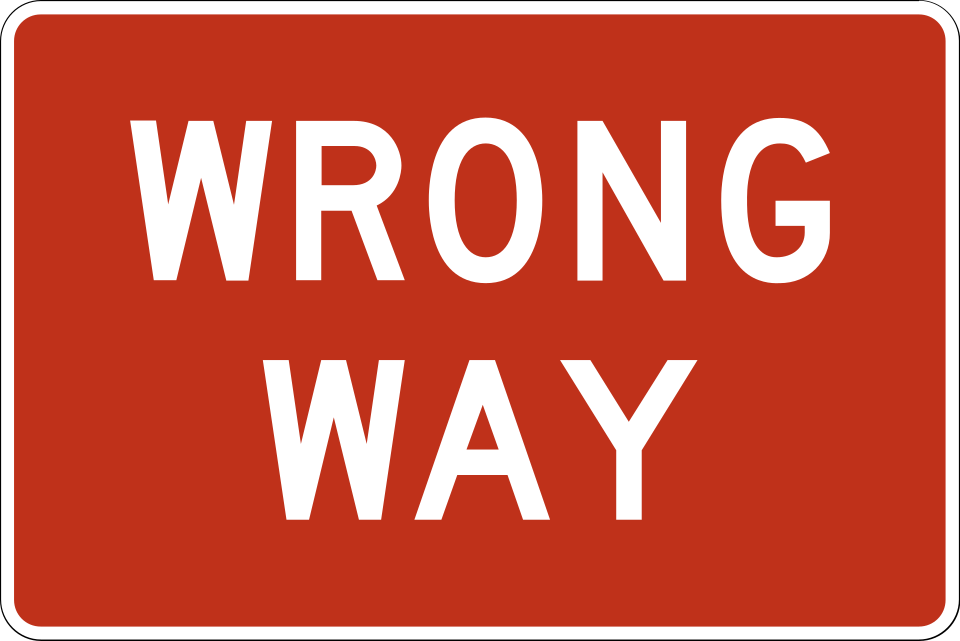
A wrong way sign is a red and white regulatory sign, MUTCD code R5-1a, that means exactly one thing: you are driving against the legal flow of traffic and you need to stop going forward. It is not a caution. By the time this sign is readable in your headlights you have passed the point where you were meant to be turned back, which is why it sits deeper into a ramp than DO NOT ENTER. Below we cover what the sign means, where federal rules require it, the night-time clues that go with it, and the recovery steps your state handbook actually asks for.
What the wrong way sign actually tells you
The sign carries a white legend on a red background and, unlike almost every other red and white sign you will meet, it is a horizontal rectangle rather than a square or an octagon. In the Federal Highway Administration’s 11th Edition MUTCD, Chapter 2B, the standard conventional-road size is 36 by 24 inches, stepping up to 42 by 30 inches on multi-lane approaches and freeway ramps, with a 30 by 18 inch minimum. That shape is deliberate: a driver who catches only a shape and a color at distance can still separate it from the square DO NOT ENTER panel.
Red on an American sign means prohibition or an immediate stop, which is the family this sign belongs to. If you want the broader logic behind that color rule, our guide to regulatory signs covers the whole class, and the companion piece on the rectangular shaped sign explains why rectangles carry orders rather than warnings.
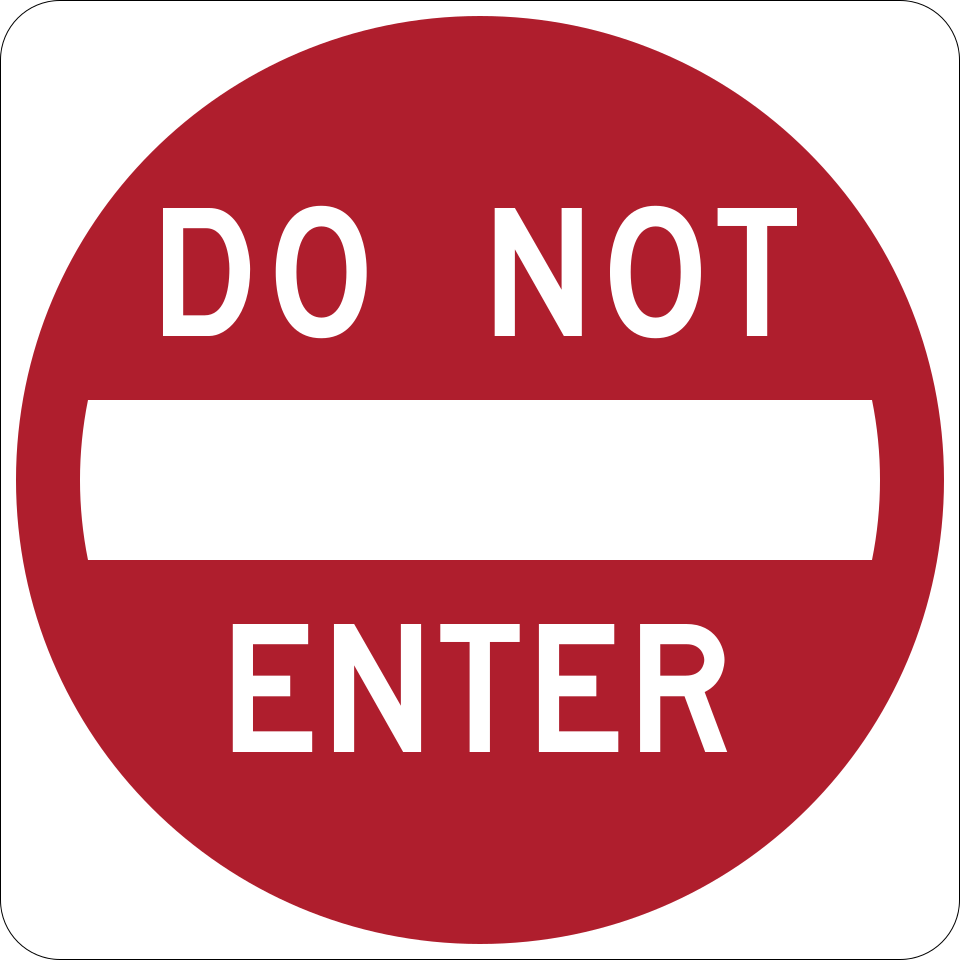
Here is the part most sign glossaries skip. The wrong way sign does not tell you that you might be about to make a mistake. It tells you the mistake is in progress. The DO NOT ENTER sign faces you at the mouth of a ramp, before you commit. The wrong way sign faces you from farther along that same ramp, after you have committed. Reading one instead of the other changes what you should do next.
Wrong way and DO NOT ENTER are not the same sign
Vendor pages and quick sign lists treat these two as interchangeable. The federal manual does not. They sit in separate sections, they carry separate rules, and one of them is mandatory in far more situations than the other.
| Feature | DO NOT ENTER | WRONG WAY |
|---|---|---|
| MUTCD code | R5-1 | R5-1a |
| MUTCD section (11th Edition) | 2B.46 | 2B.47 |
| Shape | Square | Horizontal rectangle |
| Conventional-road size | 30 x 30 in | 36 x 24 in |
| Rule type | Standard, “shall be used” at four listed location types | Option, “may be used as a supplement” in general |
| Placement | Near the crossroad end of the ramp | Farther along the ramp, same side of the road |
| What it means for you | Do not turn in here | You already turned in here |
Section 2B.46 makes DO NOT ENTER a Standard. It shall be used where a two-way roadway becomes one-way, at interchange exit ramp intersections, at channelized turning roadways meeting a two-way undivided crossroad, and at divided-highway crossings that work as two separate intersections. Section 2B.47 makes the wrong way sign an Option: it may be used as a supplement to DO NOT ENTER where a crossroad meets a one-way roadway in a way that does not physically prevent wrong-way entry. When it is used, two pieces of guidance carry the whole meaning of the sign. It should sit farther from the crossroad than DO NOT ENTER, and on the same side of the road.
Where the sign is required rather than optional
The “optional” label is the detail that trips people up, because there is one location where the wrong way sign is not optional at all. Section 2B.48 of the same chapter covers wrong-way traffic control at interchange ramps, and it is written as a Standard. At an interchange exit ramp terminal where wrong-way entry could inadvertently be made, three signs shall be used: at least one ONE WAY sign for each direction of travel on the crossroad, at least one DO NOT ENTER sign placed near the downstream end of the ramp, and at least one WRONG WAY sign placed on the exit ramp facing a driver traveling in the wrong direction.
So the federal answer is layered. On an ordinary one-way city street, an agency may rely on ONE WAY and DO NOT ENTER alone. On the off-ramp of a freeway, that discretion disappears, and that is where the consequences live: a wrong-way driver on a divided highway meets traffic head-on at closing speeds no ordinary intersection produces.
Two pavement treatments back the signs up. The manual permits slender, elongated wrong-way arrow markings placed upstream of the ramp terminus, and it permits bidirectional raised pavement markers that show red to a wrong-way driver and white to everyone traveling correctly. Those markers are the reason the color of the reflectors ahead of you carries information, which is the next thing worth knowing.
The other clues that you are pointed the wrong way
Signs are only part of the system. The California Driver Handbook puts the night-time version plainly: “If you are driving at night, you will know you are going the wrong way if the road reflectors shine red in your headlights.” Most state handbooks never mention that cue, and it is the one that works when a sign is behind you or blocked.
| What you see | What it means | How much time you have |
|---|---|---|
| DO NOT ENTER square facing you | You are at the entrance and have not entered | Full stop and turn away, no maneuvering needed |
| WRONG WAY rectangle facing you | You are on the ramp or roadway already | Seconds; stop before you reach the through lanes |
| Pavement reflectors glowing red | You are facing the reverse of legal travel | Immediate; this cue appears with no sign at all |
| Arrows on the pavement pointing at you | Lane-use arrows read backwards | Immediate |
| Headlights of oncoming cars in your lane | You are in live opposing traffic | None; get to the right shoulder |
Building DMV Ready, we cross-check state handbook wording against the federal manual whenever we write a sign question, and this sign shows why that matters. California states the red-reflector rule outright. The Texas handbook covers the regulatory sign family without spelling that cue out. A study guide built on one state’s phrasing leaves the other state’s driver without the clue that works in the dark.
Why some wrong way signs are mounted knee high
If you have ever noticed a WRONG WAY panel sitting oddly low on a freeway off-ramp, that was deliberate engineering, not a maintenance error. MUTCD Section 2B.48 allows a DO NOT ENTER or WRONG WAY sign located along an exit ramp to be installed at a minimum mounting height of 3 feet, measured from the bottom of the sign to the near edge of the pavement, where an engineering study supports it and there are no parked cars, pedestrians, snow, or vegetation in the way. The manual’s own figures show typical primary mounting at 5 and 7 feet, so a 3-foot sign sits at roughly half the usual height.
The reason is who the sign is aimed at. Researchers at the Texas A&M Transportation Institute ran nighttime closed-course studies with alcohol-impaired drivers for a Texas Department of Transportation wrong-way driving project and found that impaired drivers “tend to look less to the left and right and more toward the pavement area in front of the vehicle.” They also confirmed that drivers at higher blood alcohol levels take longer to locate signs and must be closer before they can read the legend. A sign hung at seven feet is outside the cone those drivers are searching. A sign at three feet is inside it, and inside the headlight beam.
Mounting height only matters because of what the sign is made of. MUTCD Section 2A.21 requires regulatory signs to be “retroreflective or illuminated to show the same shape and similar color by both day and night,” and it states plainly that street or highway lighting does not satisfy that requirement. Section 2A.22 requires agencies to keep sign retroreflectivity at or above minimum levels. In practice that means an aluminum panel faced with retroreflective sheeting, specified by grade, from basic engineer grade material up to high intensity prismatic sheeting. Retroreflective material bounces light back toward its source rather than scattering it, so the brighter the sign looks to you, the more directly your own headlights are hitting it. Drop the panel into the beam and the same sheeting returns far more intensity to the driver who needs it.
Florida took the idea further. The Florida Department of Transportation wrong-way driving program uses an LED-highlighted WRONG WAY sign as its primary countermeasure: detection equipment spots a vehicle entering the ramp backwards, the lights on the sign activate to warn that driver, and the system pushes alerts to traffic managers and to message boards upstream so drivers already on the highway get warning too. The 11th Edition MUTCD now carries explicit provisions for LED-enhanced conspicuity on both this sign and DO NOT ENTER.
The mistake that turns a wrong turn into a head-on crash
Picture Marisol leaving a restaurant in Columbus at 11 p.m. and turning left onto what she reads as the on-ramp for Interstate 70. Thirty yards in, a low red rectangle catches her headlights. Her instinct is to swing the wheel and U-turn across the ramp. That is the move that kills people, because a U-turn puts her broadside across both lanes at the exact moment a car may be exiting the freeway at 55 mph with no reason to expect anything in its path.
The handbook answer is narrower and calmer. California’s wording is “When it is safe, back out or turn around.” The order matters: get out of the travel path first, then reverse the direction. Pull hard to the right, stop, put the hazards on, and back straight out only when you can see the ramp is clear behind you. If you cannot back out safely, stay stopped on the shoulder with hazards running and call 911, because a stationary car with lights on the shoulder is a survivable problem and a moving car facing the wrong way is not.
Scale explains why the engineering keeps escalating. A March 2026 research brief from the AAA Foundation for Traffic Safety counted 4,164 fatal wrong-way crashes on U.S. divided highways from 2014 through 2023, causing 5,730 deaths, with the annual number roughly doubling across the decade, from 278 crashes in 2014 to 520 in 2023. Three findings from that brief change how you should read this sign.
| Risk factor | Share of wrong-way drivers | What the data shows |
|---|---|---|
| Driving alone | 86.4% had no passengers | Carrying one passenger cut the odds of being the wrong-way driver to roughly a third |
| Darkness | 80.7% in the dark | Odds about 2.4 times higher than in daylight |
| Blood alcohol above 0.12 | 59.9% of wrong-way drivers | The single largest factor in the analysis by a wide margin |
| Age 80 and over | 6.5% | Sharply elevated odds compared with drivers in their fifties |
| Rural roads | 34.6% | Odds about 1.8 times the urban rate |
Read those together and the low-mounted, LED-lit, reflector-backed design of modern wrong-way signing makes sense. It is built for a driver who is alone, in the dark, and not searching the scene the way a rested sober driver would. The passenger seat, it turns out, is a safety device: the person next to you notices the red rectangle you missed.
How the wrong way sign shows up on the permit test
Traffic signs make up 243 of the roughly 4,000 questions in our bank, and the red and white group is where test writers like to probe whether you understand sign families rather than memorized pictures. Expect one of three shapes: identify what the sign means, choose the correct action, or separate it from DO NOT ENTER. Written tests rarely ask for the R5-1a code, but they often ask which sign appears where, and the answer is the placement rule above.
The other trap is the recovery step. Answer options usually include a U-turn, reversing, and continuing to the next exit. The keyed answer follows the handbook: stop, clear the travel lanes, and turn around only when it is safe. That is the same logic our stop sign and divided highway sign guides use, and why we sort signs by family in the guide signs breakdown. It is also why we re-verified every answer in the bank against official state sources and corrected 28 of them; red and white signs are where sources drift apart.
Sign questions are the cheapest points on the exam because the answer set is finite. Work through the road signs practice test, then run your own state’s version in DMV Ready, whether that is Ohio, California, Florida, or Texas. Browse the full road sign library if you want the sign families side by side, or pick your state from the state guides. Learn the red rectangle now, in a quiet room, so that if you ever meet one at night the only thing you have to decide is where to pull over.
Frequently asked questions
Short answers to the questions drivers ask most about this sign.
What does a wrong way sign mean?
You are driving against the legal flow of traffic. It is a regulatory sign, MUTCD code R5-1a, not a caution. Stop, clear the travel lanes, and turn around only when it is safe.
What is the difference between a wrong way sign and a DO NOT ENTER sign?
DO NOT ENTER is a square posted at the entrance, where you can still turn away. WRONG WAY is a rectangle posted farther along the ramp, facing a driver who has already entered.
What shape and color is the wrong way sign?
A horizontal rectangle, wider than it is tall, with a white legend and border on red. Standard conventional-road size is 36 by 24 inches, rising to 42 by 30 inches on freeway ramps.
What should you do if you see a wrong way sign at night?
Slow, pull right, and stop before the through lanes. Back straight out only if the way behind is clearly empty. Otherwise wait on the shoulder with hazards on and call 911.
Why are some wrong way signs mounted so low?
Federal rules allow a 3-foot minimum height on freeway exit ramps. Impaired drivers look more toward the pavement ahead, so a lower sign sits inside both their gaze and their headlight beam.
How do you know you are going the wrong way if there is no sign?
Watch the reflectors. Raised pavement markers show red to a wrong-way driver and white to everyone else, so red reflectors in your headlights mean you are facing the reverse of legal travel.
Is the wrong way sign on the DMV permit test?
Yes, regularly, usually paired with DO NOT ENTER or as an action question. Knowing that WRONG WAY sits deeper into a ramp than DO NOT ENTER answers most versions.


 Scan to get the app