T Intersection Rules: Who Has Right of Way
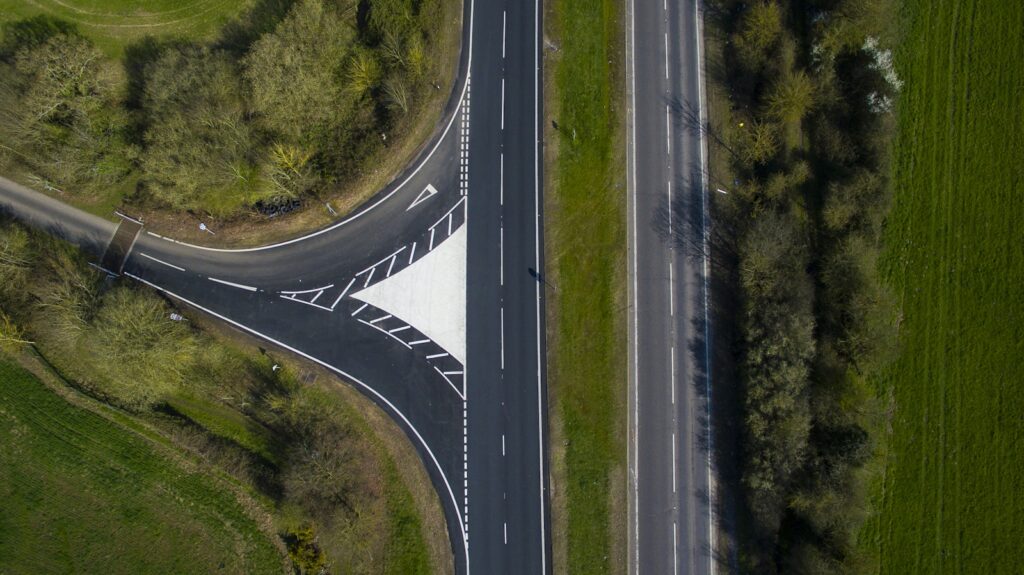
A T intersection is a three-way junction where one road dead-ends into another road that continues in both directions. The rule that decides who moves first is short: the driver on the road that ends yields to everyone already on the road that keeps going. That is the answer nine out of ten permit-test questions on this topic are looking for.
What the top results for this query leave out is that the legal duty is not written the same way everywhere. Illinois orders a full stop at an unsigned T intersection. California only orders a yield. We read both statutes, the California handbook and the federal sign manual to sort out what applies to you, and which movement out of a T costs test takers the most points.
What counts as a T intersection, and who yields
Picture the letter. The horizontal bar is the through road, sometimes called the continuing highway. The vertical line is the stem, and the stem is the road that ends. Traffic on the bar passes straight through without any decision to make. Traffic on the stem has to enter that flow, which is why the burden sits on the stem driver in every state we checked.
California writes the rule into its right-of-way statute. Under California Vehicle Code section 21800, when two vehicles reach an intersection at the same time the driver on the left yields to the driver on the right, “except that the driver of any vehicle on a terminating highway shall yield the right-of-way to any vehicle on the intersecting continuing highway.” The same section defines a terminating highway as one that “intersects, but does not continue beyond the intersection, with another highway which does continue beyond the intersection.” That definition is the legal description of a T.
The California Driver Handbook says it in plain language: at “T intersections without STOP or YIELD signs,” vehicles, bicyclists and pedestrians on the through road have the right of way. Note the second and third nouns in that list. A cyclist rolling along the bar of the T outranks a car waiting on the stem, and so does a pedestrian, whether or not a crosswalk is painted.
None of this makes the through-road driver invincible. Right of way is something you give, never something you take, so a stem driver who has already committed to the intersection has to be allowed to clear it.
The signs that mark a T intersection
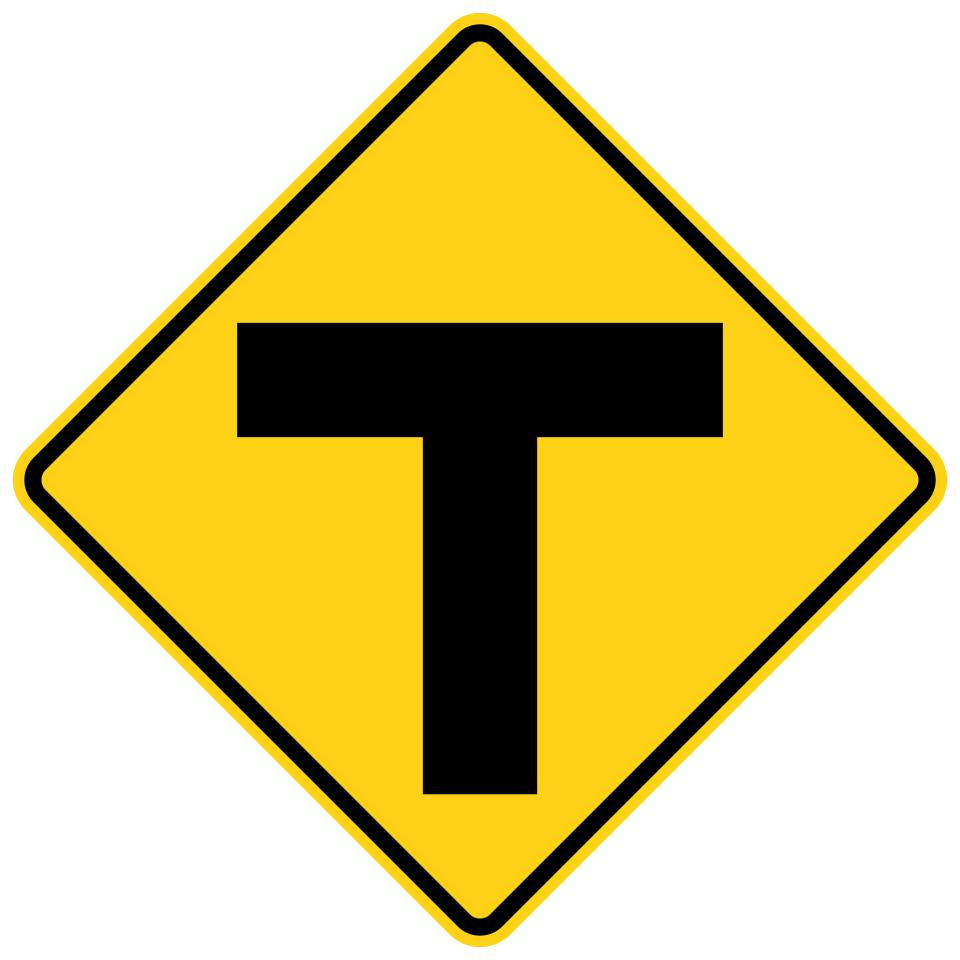
Two federal sign designs do the work here, and they appear at different points on your approach. The advance warning is the T-Intersection sign, catalog code W2-4, a yellow diamond carrying a black T. Section 2C.41 of the 11th Edition Manual on Uniform Traffic Control Devices, published December 2023, groups it with the Cross Road (W2-1), Side Road (W2-2) and Y-Intersection (W2-5) signs and says the symbol “should illustrate and depict the general configuration of the intersecting roadway.”
Here is a detail almost no driving-school page mentions. Paragraph 7 of that same section says intersection warning signs “should not be used on approaches controlled by STOP signs, YIELD signs, or signals,” and then names three exceptions. The T-intersection W2-4 sign is one of them, alongside the circular-intersection sign and the railroad advance-warning signs. Engineers are allowed to post the T sign even where a stop sign already governs the approach, because running out of road is a hazard worth flagging twice.
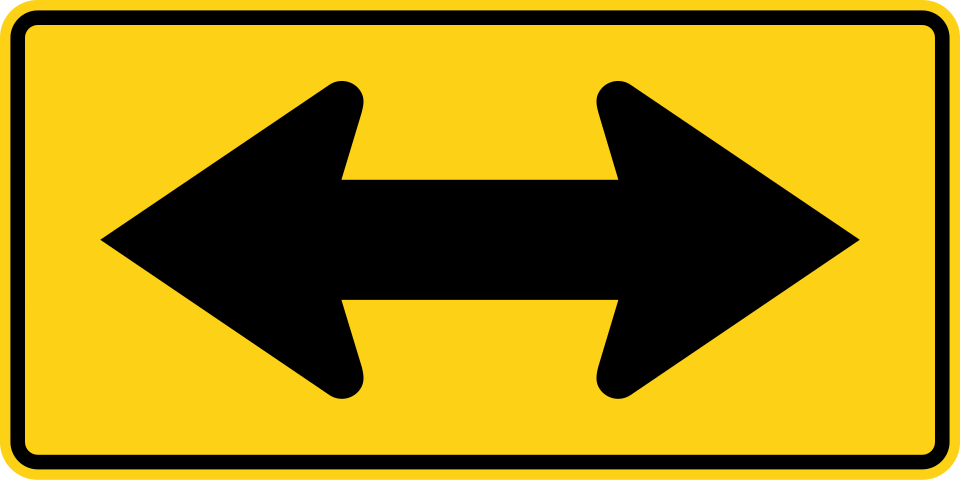
The second sign is the one staring back at you from the far side. Section 2C.43 requires the Two-Direction Large Arrow (W1-7) to be “installed on the far side of a T-intersection in line with, and at approximately a right angle to, traffic approaching from the stem.” A double-headed black arrow on yellow means your options are left or right, and nothing else. Table 2C-1 fixes the sizes.
| Sign | Code | Conventional road | Minimum | Oversized |
|---|---|---|---|---|
| T-Intersection warning | W2-4 | 30 x 30 in | 24 x 24 in | 48 x 48 in |
| Side Road warning | W2-2 | 30 x 30 in | 24 x 24 in | 48 x 48 in |
| Two-Direction Large Arrow | W1-7 | 48 x 24 in | not listed | 60 x 30 in |
| Stop Ahead warning | W3-1 | 30 x 30 in | 30 x 30 in | not listed |
Yellow diamonds are warnings, and every one shares that grammar. If shape and color rules still feel slippery, our breakdown of yellow diamond warning signs and the full road sign reference cover the pattern the test leans on.
Your state law may say stop, not yield
Reading the statutes side by side is where this topic stops being simple. Illinois is the outlier that matters. Section 11-901.01 of the Illinois Vehicle Code is literally titled “Vehicles approaching or entering a ‘T’ intersection,” and it does not use the word yield alone. A driver arriving from a highway that terminates at the intersection, where the approach is not otherwise controlled by signs or signals, “shall stop, yield, and grant the privilege of immediate use of the intersection” to traffic on the non-terminating highway, and may proceed only “after stopping.” Illinois has required that since Public Act 81-860.
Compare that to California, where the identical piece of pavement calls only for a yield. A driver who rolls up to an unmarked T in Illinois at 5 mph and eases through a clean gap has satisfied California law and violated Illinois law. Same geometry, different duty. That single contrast is the thing we would most want a test taker to walk away with.
| State | Statute | Names T intersections? | Duty on the stem |
|---|---|---|---|
| Illinois | 625 ILCS 5/11-901.01 | Yes, in the section title | Stop, then yield, then proceed |
| California | Veh. Code 21800(b) | Yes, as “terminating highway” | Yield to the continuing highway |
| Florida | F.S. 316.121 | No | Yield by road class and arrival order |
| Washington | RCW 46.61.180 | No | General rule, modified at arterials |
| New York | Veh. & Traf. Law 1140 | No | General rule, modified at through highways |
Florida reaches the same result by another route. Florida Statutes section 316.121 never says T intersection. It ranks roads instead: a driver entering a state-maintained road from any paved or unpaved road with no traffic control device yields to everything on the state road, and a driver entering a paved county or city road from an unpaved one yields as well. Since the stem of a rural T is usually the lesser road, Florida arrives at the same duty through road class rather than geometry. Anyone studying for the Florida permit test should expect the paved-versus-unpaved phrasing.
Building DMV Ready meant cross-checking all 50 state handbooks against the statutes behind them, and right of way is where those two documents drift apart most. Our re-verification audit corrected 28 answers across the question bank, and intersection priority accounted for a disproportionate share. Handbooks paraphrase. Statutes do not.
Turning left out of the stem is the hard part
Every T offers a stem driver exactly two choices, and they are not equally difficult. Turning right means finding one gap in traffic coming from your left. Turning left means finding a gap in both directions at once, then crossing the near lane while merging into the far one.
Gap judgment is what actually gets graded on a road test. A driver who accepts a four-second gap to turn left across a 45 mph road is asking oncoming traffic to brake, which is the definition of failing to yield even if nobody touches. Wait for the gap you would accept twice.
Sight distance makes the left turn worse at a skewed T, where the stem meets the through road at something other than a right angle. On an acute approach the pillar between windshield and side window sits exactly where the traffic you need to see is coming from. Lean forward and look twice.
Watch for the second vehicle too. If a car on the through road is signaling a turn into your stem, its signal is a statement of intent, not a guarantee, and the standard advice from examiners is to wait until you see the vehicle actually begin turning before you commit.
Positioning inside the stem matters as much as timing. Pull forward far enough that your sightlines open in both directions, but not so far that you block the crosswalk. Stopping three car lengths back to be polite is the version that fails road tests, because from there you see nothing and end up creeping forward twice.
One more rule applies once you commit. A left turn out of the stem places you in the far lane, and a divided through road turns that single movement into two separate yields with a median stop in between. Treat each carriageway as its own intersection when a median is wide enough to hold your vehicle.
Controlled T intersections change the analysis
Most T intersections in built-up areas are not unmarked. A stop sign or a yield sign usually governs the stem, and once a sign is posted the sign controls, not the geometry. Stopping at a stop sign on the stem does not buy you priority afterward; you still wait for a safe gap.
Traffic signals reverse the intuition entirely. At a signalized T the through road can be held on red while the stem gets a green arrow, and drivers who learned “the through road always goes first” hesitate on a green they legally own. Our guide to a flashing yellow arrow covers the version of this that shows up most on modern signal heads.
Supplemental plaques are the detail worth memorizing. The MUTCD W4-4P series puts CROSS TRAFFIC DOES NOT STOP or TRAFFIC FROM LEFT DOES NOT STOP under a stop sign precisely because drivers assume any intersection with a stop sign must be an all-way stop. At a T, that assumption is usually wrong, since the through road normally has no control at all.
Volume explains why this matters. The Insurance Institute for Highway Safety reports that in 2024, 34 percent of urban crash deaths occurred at intersections against 17 percent in rural areas, a total of 10,391 people. Intersections are where the conflicts are, and a T concentrates them into one approach.
Rural Ts deserve their own caution. Out of town the through road often carries a 55 mph limit with no shoulder and no lighting, which is the geometry the double-arrow sign exists to announce. Approach speed is the variable you control, so slow early enough that the decision at the stop line is about the gap rather than your brakes.
The mistake that costs points
Here is the scenario that catches people. You are on the stem of an unmarked T in a residential neighborhood. A car appears on the through road to your right, and it is signaling a right turn, which would take it into your street. You start rolling, because the car is turning anyway and your paths never cross.
Stop rolling. Two things can undo you. The through-road driver can cancel the turn, which happens constantly when someone realizes they picked the wrong street, and now you have pulled into their lane. Worse, if you are in Illinois you have already broken the law by failing to make the required full stop, regardless of what the other driver does.
The mirror-image error shows up on the through road. Drivers on the bar of a T sometimes stop to wave a stem driver out, which feels generous and creates a trap: the waved-out driver cannot see the vehicle overtaking in the next lane, and the courtesy stop is a recurring pattern in T-intersection collision reports. Keep your speed steady and let the stem driver read the gap themselves.
A third version involves the sign itself. Seeing the yellow W2-4 diamond, some drivers treat it as an instruction to stop, which it is not. Warning signs describe a condition ahead; regulatory signs give an order. The diamond tells you the road ends, and whether you stop depends on what is posted and which state you are in.
Nothing about a T removes the ordinary duties either. Pedestrians crossing the stem still have priority, the crosswalk still counts whether or not it is painted, and a driver already inside the intersection finishes the movement first. Test writers fold these into a T question to see whether you memorized one rule or understood the sequence.
How T intersections show up on the permit test
Test writers use three reliable framings. The first is the plain right-of-way question, usually phrased as a road that ends at another road, with the correct answer being that the driver on the ending road yields. The second is a sign-identification item that shows the W2-4 diamond and asks what is ahead. The third is a diagram question that places two or three cars around a T and asks which one moves first.
State-specific wording is where scores slip. Question banks written for one state get recycled into another, so a Californian can meet an Illinois-worded question about stopping and mark it wrong for the right reason. We rebuilt our state coverage around exactly this problem, and the same drift shows up in our review of permit tests offered in other languages, where translated banks preserve the source state’s rules.
Diagram items reward a fixed reading order. Find the road that continues through the picture first, mark every car sitting on the stem as a yielder, and only then apply the tiebreakers between two cars that are both on the bar. Working in that order turns a four-car diagram into two easy decisions instead of six comparisons, and it survives the trick versions where the drawing is rotated so the stem points up.
Practice with the right state selected. The California permit test practice set and the New York permit test set score right-of-way items against their own state’s handbook, and the broader right-of-way rules for the permit test guide covers the four-way and uncontrolled cases a T question often hides inside. Every state page is built the same way.
Frequently asked questions
These are the questions drivers actually type into search after meeting a T intersection they were not sure about. Short answers below, with the state-by-state detail above.
Treat a T the way the law treats it: the road that ends gives way to the road that continues, and the only question left is whether your state expects you to stop first or simply yield. Check the statute for the state whose test you are taking, since Illinois and California disagree on identical pavement. Then drill the diagrams until the answer arrives before you finish reading the question. Practice T intersection and right-of-way questions by state in DMV Ready, where every item is scored against the handbook that governs your exam.