Pennant Shaped Sign: What It Means

A pennant shaped sign means one thing on American roads: NO PASSING ZONE. It is the only sign in the federal catalog built as a sideways triangle, it is yellow with a black legend and border, and it is posted on the left-hand side of the pavement instead of the right. For anyone studying for a learner’s permit, those three facts answer almost every version of the question you will see. What the exam rarely explains, and what matters far more once you are behind the wheel, is that the pennant does not create the no-passing zone. Below we cover the federal rule that defines the sign, the sight-distance math that decides where the zone begins, and the assumption that gets new drivers ticketed.
What a pennant shaped sign actually says
The sign has a federal designation, W14-3, and a single paragraph of federal law behind it. Section 2C.53 of the Manual on Uniform Traffic Control Devices, 11th Edition, published by the Federal Highway Administration in December 2023, states that the sign “shall be a pennant-shaped isosceles triangle with its longer axis horizontal and pointing to the right.” That is the whole geometry requirement, and it is why no other sign in the manual shares the shape.
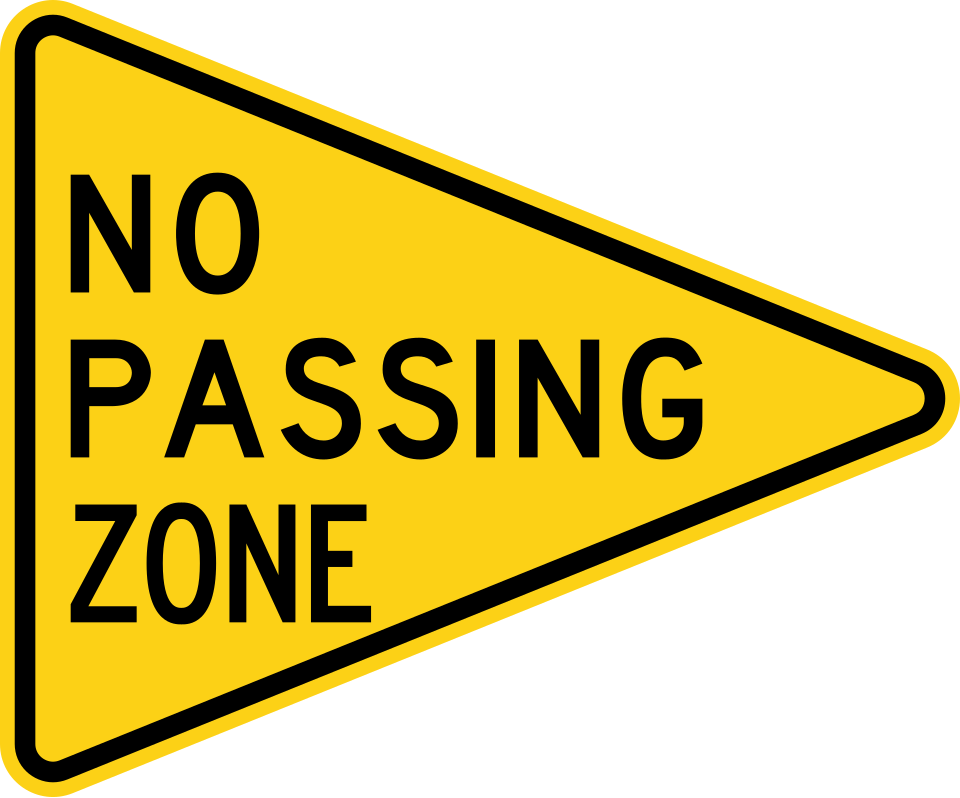
Color does real work here. Yellow with a black legend is the warning family, the same palette used on yellow warning signs for curves, crests and merges. Pennsylvania’s driver manual puts it plainly, calling this “the only pennant-shaped warning sign” and noting that it is “placed on the left side of the road facing the driver,” according to the Pennsylvania Driver’s Manual chapter on signs. So the shape is unique, the color says warning, and the message is a restriction. Yellow is the default for that family but not the whole of it - see the four colors a warning sign is allowed to wear.
One nuance trips people up on test day. Warning signs normally describe a road condition, such as a curve or a narrowing bridge. This one warns you about a legal restriction instead, which is why it travels alongside a black-and-white regulatory sign rather than replacing it.
Shape exclusivity is doing the heavy lifting. The federal manual reserves particular outlines for particular messages so a driver can decode a sign before the words resolve, which is why an octagon is never anything but a stop and a crossbuck is never anything but a railroad crossing. The pennant belongs to a category of one. Nothing else in the catalog is a horizontal triangle, so recognizing the silhouette at 400 feet tells you the whole message without reading a letter of it.
Why this one sign sits on the left
Nearly every sign you meet arrives from the right shoulder. The pennant breaks that pattern by federal mandate, not by local preference: 2C.53 says that when the sign is used, it “shall be installed on the left-hand side of the roadway at the beginning of no-passing zones.” That word “shall” is the manual’s strongest term, and it points the sign at the one place your eyes go when you start hunting for a gap.
Think about where a driver looks in the seconds before passing. You ease left toward the centerline to see around the vehicle ahead, and your gaze drifts to the oncoming lane. A sign on the right shoulder sits behind the vehicle you are trying to get around. A sign on the left lands directly in that sightline.
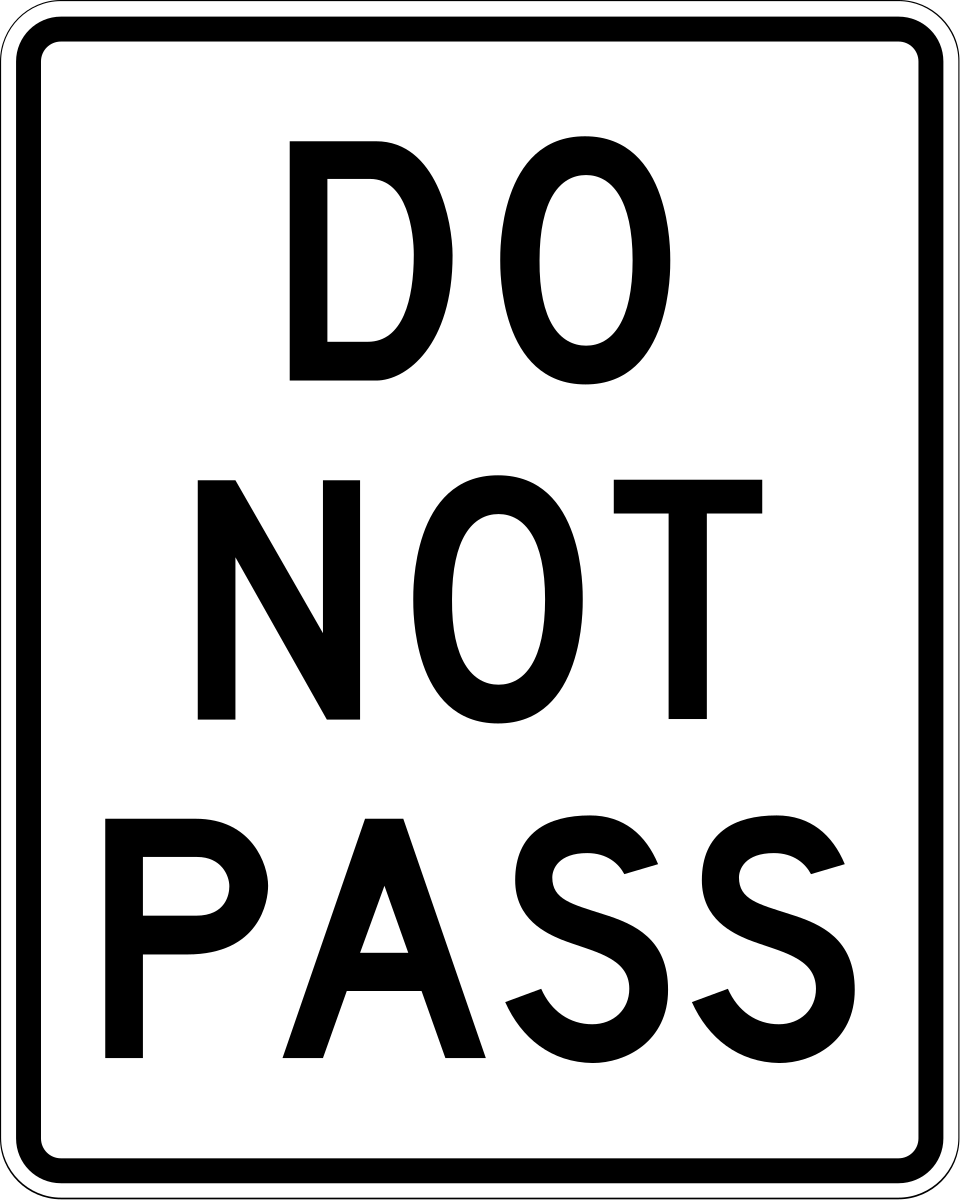
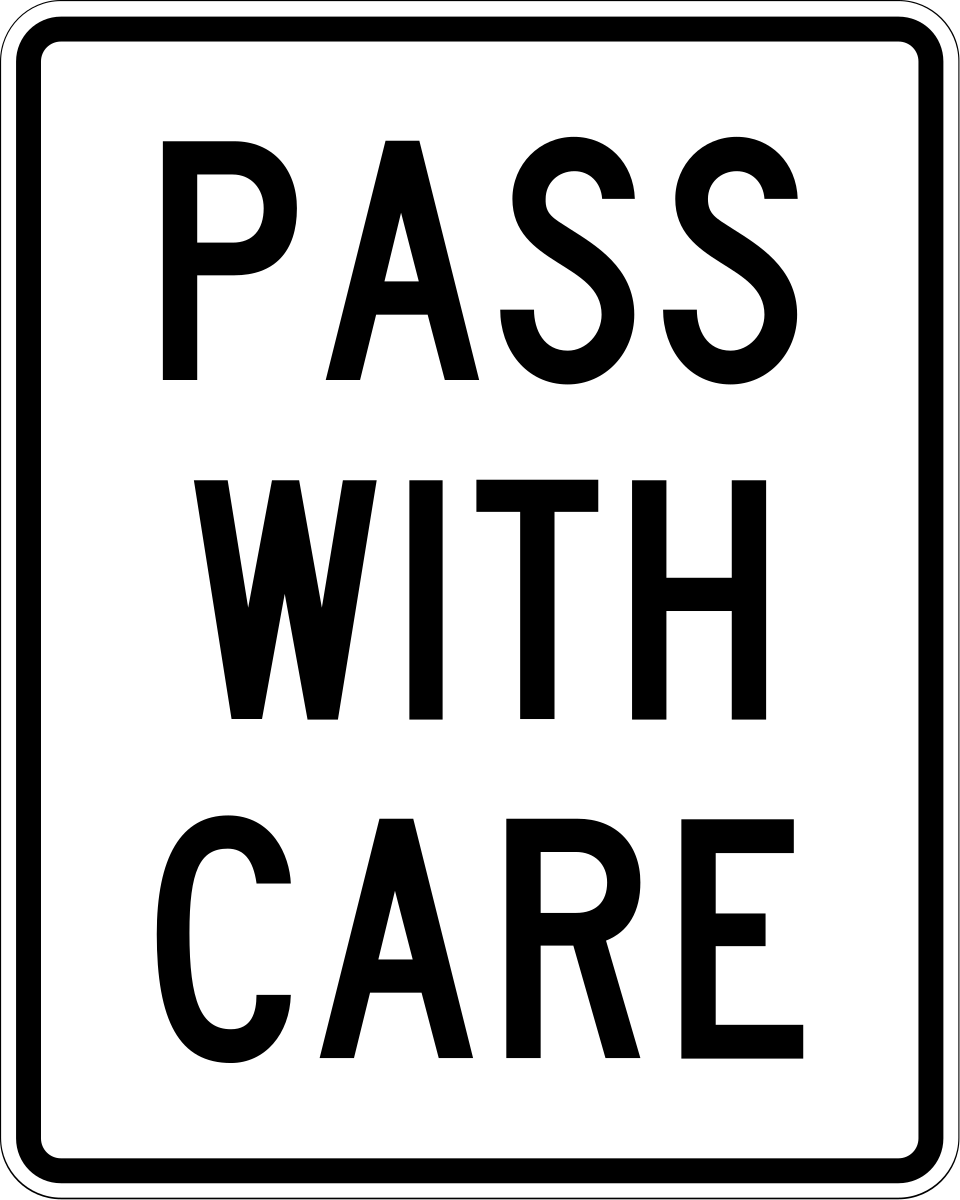
Its partner, the DO NOT PASS sign (R4-1), stays on the right. Section 2B.36 of the federal manual describes that sign as an option “in addition to pavement markings” and adds that “if signing is needed on the left-hand side of the roadway for additional emphasis, NO PASSING ZONE (W14-3) signs may be used.” Where the restriction lifts, the PASS WITH CARE sign (R4-2) appears, and there is no pennant-shaped counterpart for the end of a zone.
Size is set by road type, and the numbers below come from Table 2C-1 of the same manual. Each figure lists the two equal sides and the base of the triangle in inches.
| Road type | W14-3 size (inches) |
|---|---|
| Conventional road, single lane | 48 x 48 x 36 |
| Conventional road, multi-lane | 48 x 48 x 36 |
| Expressway | 64 x 64 x 48 |
| Freeway | 64 x 64 x 48 |
| Minimum permitted | 40 x 40 x 30 |
| Oversized | 64 x 64 x 48 |
The pennant is not what makes passing illegal
Here is the finding that surprised us most while reading the current manual line by line, and it is missing from every page currently ranking for this term. The pennant is an emphasis device layered on top of the real control. Section 2C.53 opens the placement rule with “when used,” Section 2B.36 says the left-side sign “may be used” for “additional emphasis,” and the pavement-marking chapter notes that no-passing zone signs “are sometimes used to emphasize the existence and extent of a no-passing zone.”
Read those three together and the hierarchy is clear. Yellow centerline markings establish the zone. Signs repeat the message where a driver is most likely to miss it. A highway agency can mark a mile of blind curves with a solid yellow line and post no pennant anywhere along it, and the restriction is fully in force.
State law is written the same way. Florida Statute 316.0875 prohibits driving “on the left side of the roadway within such no-passing zone or on the left side of any pavement striping designed to mark such no-passing zone,” per the Florida Senate’s published statute. New York attaches the duty to markings too: under Vehicle and Traffic Law section 1126, where official markings are in place, “no driver of a vehicle proceeding along such highway shall at any time drive on the left side of such markings.”
Neither statute mentions a pennant. That is the practical takeaway: the absence of the sign proves nothing, and the line under your left tire is what a citation will reference. Drivers who learn the meaning of road markings alongside the signs stop guessing.
Budget explains most of the gaps you will notice. A pennant is a large sign on its own post in the opposing lane’s field of view, so agencies concentrate them where passing crashes actually happen rather than at every marked zone in the network. Rural county routes tend to get one at the worst crest and nothing at the next three. That distribution is a maintenance decision, not a legal signal, and reading it as permission is the error this whole section exists to prevent.
How engineers decide where a no-passing zone begins
No-passing zones are not placed by feel. Section 3B.03 requires them on roadways with centerline markings “at horizontal or vertical curves where the passing sight distance is less than the minimum shown in Table 3B-1 for the 85th-percentile speed or the speed limit.” Those minimums scale with speed, because a faster pass eats more road.
| 85th-percentile or speed limit | Minimum passing sight distance |
|---|---|
| 25 mph | 450 feet |
| 30 mph | 500 feet |
| 35 mph | 550 feet |
| 40 mph | 600 feet |
| 45 mph | 700 feet |
| 50 mph | 800 feet |
| 55 mph | 900 feet |
| 60 mph | 1,000 feet |
| 65 mph | 1,100 feet |
| 70 mph | 1,200 feet |
Measurement is unusually literal. Sight distance is taken between two points 3.5 feet above the pavement, roughly eye height in a sedan looking at the roof of another sedan, as shown in Figure 3B-4 of Part 3 of the federal manual. The zone starts where that distance first drops below the table value and ends where it climbs back above. Zones separated by less than 400 feet should simply be joined into one.
Curves are not the only trigger. Markings are also required at lane-reduction transitions, on approaches to obstructions that must be passed on the right, on approaches to grade crossings, and on approaches to crosswalks. Anyone studying from older material should check the low end of that table, because the 2023 edition raised the 25 mph minimum from 400 feet to 450 feet.
Direction matters as much as distance. A no-passing zone can be one-directional, marked with a solid yellow line on your side and a broken line facing oncoming traffic, which means they may pass while you may not. Two-direction zones use two solid yellow lines and close the road to passing both ways. Since the zones in each direction are computed separately from each driver’s own sightline, they often start and end at different points along the same curve.
The mistake that costs new drivers a ticket
Picture Marisol, 16, driving a two-lane state route outside Lancaster with a parent in the passenger seat. She waits behind a slow truck through a marked zone, sees the pennant fall behind her, and passes a quarter mile later on a rise where the centerline is still one solid yellow stripe. No pennant stood at that second crest, so she treated the road as open. The ticket she collects cites the marking, because Pennsylvania, Florida and New York all write the prohibition around the line rather than the sign.
Two smaller errors ride along with that one. Some new drivers read a left-side sign as meant for oncoming traffic, since everything else they obey comes from the right; the pennant faces your lane and belongs to you. Others expect a matching pennant to announce the end of the zone, when the actual signal is the centerline breaking or a PASS WITH CARE sign on the right shoulder.
Our advice is unglamorous and it works. Watch the line, treat every pennant as confirmation of what the pavement already told you, and never let the lack of a sign talk you into a pass you cannot see the end of. Practicing sign questions inside your own state’s rules helps, whether you are working through Pennsylvania permit test questions, Florida permit test practice, or New York permit test practice.
What the permit test asks, and what the law still allows
Exams lean on the shape system, because shape alone carries meaning at a distance. An octagon is always a stop sign, a downward triangle is always a yield sign, and a sideways pennant is always a no-passing zone. Expect a question on the shape, one on the color, and one on which side of the road it occupies. Our road signs practice test drills the same three angles.
Real roads add exceptions the test usually skips. Both states below let you cross the line in narrow circumstances, and knowing them keeps you from freezing behind a stopped vehicle.
| State | Permitted inside a no-passing zone |
|---|---|
| Florida (316.0875) | Avoid an obstruction; turn left into or from an alley, private road or driveway; overtake a bicycle, other nonmotorized vehicle or an electric bicycle |
| New York (VTL 1126) | Turn left while entering or leaving the highway; use a two-way left turn lane or paved dividing section to prepare for a left turn |
Consequences stay meaningful. Florida classifies the violation as a noncriminal traffic infraction punishable as a moving violation under chapter 318. The safety case is blunter. Frontal impacts accounted for 59 percent of passenger vehicle occupant deaths in 2024, according to the Insurance Institute for Highway Safety’s occupant data, and the same organization’s rural and urban comparison puts 16,006 of that year’s 39,254 crash deaths on rural roads, which carry just 31 percent of miles traveled. Two-lane rural highways are exactly where pennants live.
Building DMV Ready, we cross-checked all 50 state driver handbooks against the federal manual, and the pennant is one of the few signs where the states agree almost word for word. When we re-verified our full question bank against official state sources and corrected 28 answers, none of the corrections touched this sign. Shape, color and left-side placement have held steady across editions, which is why it remains a reliable exam question and a reliable road cue.
Frequently asked questions about pennant shaped signs
Short answers to the questions we see most often about the W14-3 sign, drawn from the federal manual and state driver handbooks. For state-specific rules, start at our state practice hub or browse the full road sign library.
Passing decisions are among the few permit-test topics where the wrong answer has a physical cost. Learn the pennant as a triangle of three facts, unique shape, warning yellow, left-hand side, then learn the habit underneath it: read the centerline first and treat the sign as backup. Once the shape is automatic, work through the sign categories you are shakiest on, then run a timed set in your own state with DMV Ready, whether that is California permit test practice or Texas permit test practice. The exam rewards recognition, and the road rewards the habit.


 Scan to get the app