Pedestrian Crossing Sign: What It Means
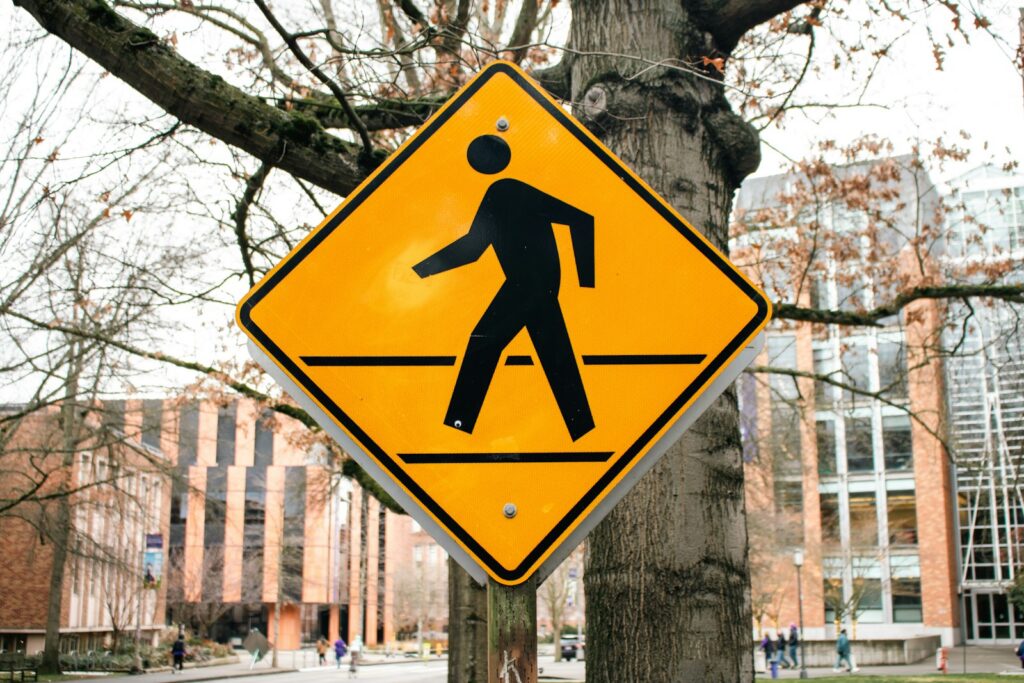
The pedestrian crossing sign shows a walking figure above two lines inside a yellow diamond, and it flags one thing: people may step into the roadway here, and nothing else will stop you. The federal sign catalog codes it W11-2. It counts as a warning sign, not a regulatory one, so the sign itself issues no order. Your state’s crosswalk statute decides your legal duty, and those statutes split cleanly into two camps. During the build of DMV Ready, all 50 state driver handbooks got cross-checked, and pedestrian right-of-way turned up as the single topic where wording diverges most. Below sits what the sign encodes, what the plaque under it changes, and what a driver actually owes a pedestrian standing at the curb.
What the W11-2 pedestrian crossing sign actually means
Every element on this sign gets specified. The Manual on Uniform Traffic Control Devices, 11th Edition files it in Section 2C.55 under Non-Vehicular Warning Signs, alongside the equestrian, snowmobile, and large-animal warnings. That grouping tells the story: each sign warns about something entering the road that isn’t a car.
The diamond shape carries the meaning before you read anything. Diamond signals warning across the entire US system, which explains why the pedestrian sign shares a silhouette with the deer crossing and the winding road ahead. Read the shape first and the symbol second and you’ll decode signs faster than drivers who memorize pictures.
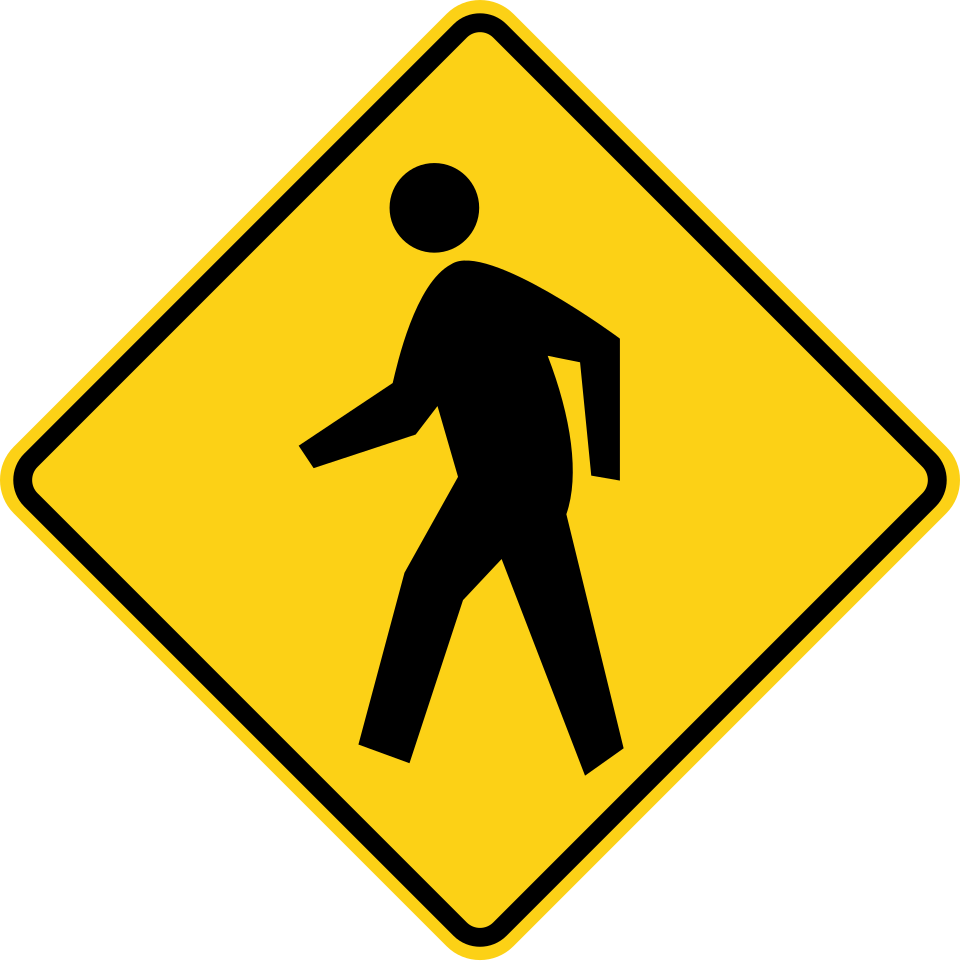
Color trips up most drivers. Section 2C.55 lists fluorescent yellow-green as an option for the W11-2, not a requirement, so the same sign passes muster in standard yellow or in the bright lime green you see near schools. Agencies that pick the brighter color get told to apply it systematically, since the manual warns against mixing standard yellow and fluorescent yellow-green backgrounds inside one area. A yellow-green pedestrian sign doesn’t mean you’ve entered a school zone.
| Element | Specification | What it tells the driver |
|---|---|---|
| Shape | Diamond | Warning, not a command |
| Sign code | W11-2 | Non-vehicular warning class (MUTCD 2C.55) |
| Background | Yellow or fluorescent yellow-green | Both legal, color carries no extra rule |
| Standard size | 30 x 30 in single-lane, 36 x 36 in multi-lane | Bigger sign, wider road, less reaction time |
| Symbol | Walking figure over two lines | The two lines represent the crosswalk itself |
The plaque underneath changes what the sign is telling you
Two drivers can spot the identical yellow diamond and land in completely different situations, because the small rectangle mounted below it carries the actual location detail. Skip the plaque and the most useful half of the message drops out.
When the crossing sits somewhere ahead, the sign gets supplemented with an AHEAD plaque or a distance plaque reading something like 500 FEET. Section 2C.55 states that advance-mounted pedestrian signs should carry one of these so drivers know they’re approaching a point where crossing activity might occur. You’ve got room to scan and slow.
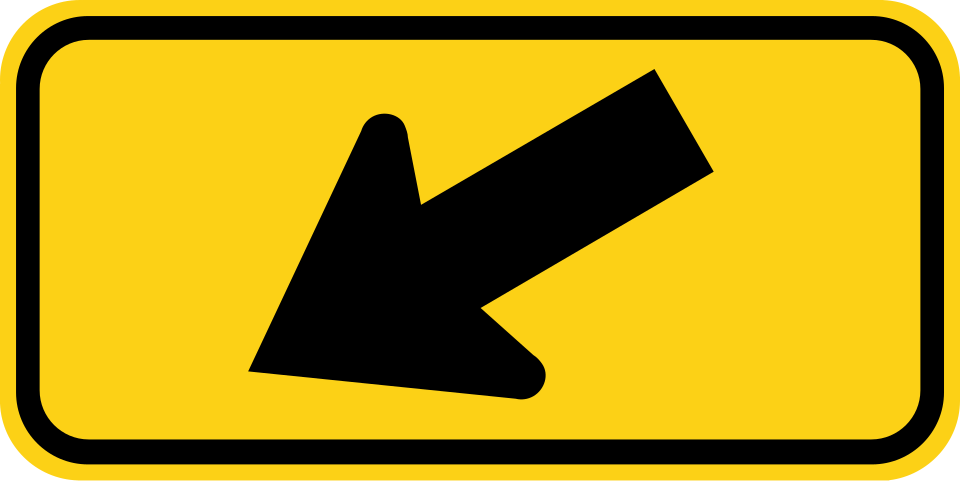
At the crossing point itself, the rule hardens into a Standard. If a post-mounted W11-2 sits where people actually step off the curb, a diagonal downward-pointing arrow plaque, coded W16-7P, shall get mounted below it. The arrow isn’t decorative. It signals that the crosswalk sits at this sign, not somewhere up the road. That same paragraph forbids the arrow plaque on overhead-mounted signs, since an overhead sign already sits above the crossing it marks.
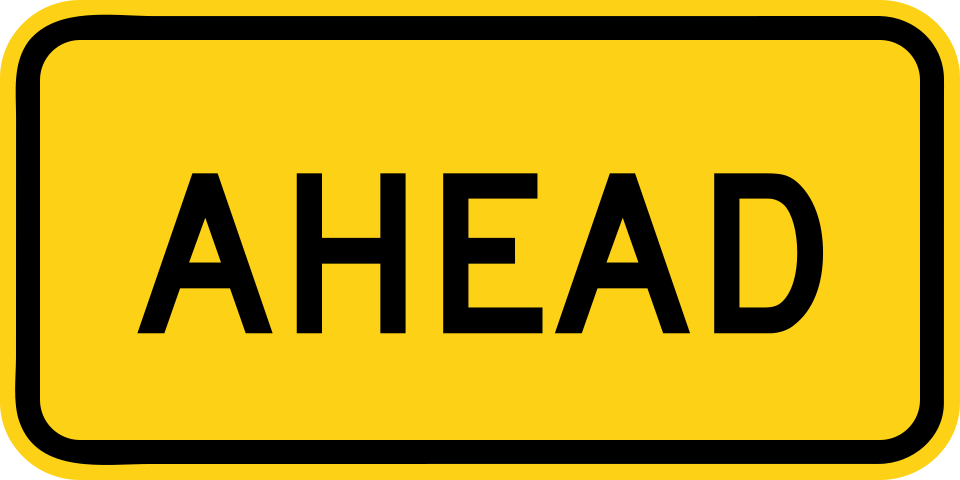
| What you see | Where the crosswalk sits | What to do |
|---|---|---|
| W11-2 alone, post-mounted | Somewhere in this stretch of road | Scan both shoulders, cover the brake |
| W11-2 with AHEAD or XX FEET plaque | Farther along your path | Drop your speed before you arrive |
| W11-2 with diagonal arrow plaque | At this exact sign | Prepare to stop now |
| W11-2 mounted overhead | Directly beneath the sign | Check the lane beside you before proceeding |
Why you never see this sign at a stop sign or a traffic light
Here sits the detail that reframes the whole sign, and none of the pages currently ranking for this term mention it. Section 2C.55 states that a non-vehicular warning sign assembly shall not get installed on an approach controlled by a STOP or a YIELD sign. Narrow exceptions cover roundabout entries and channelized right-turn lanes where the crosswalk sits at least 20 feet ahead of the yield point, but the default bars the sign flat.
Think about what that means in practice. Road engineers can’t put this sign where some other device already tells you to stop. So its presence signals something in itself: you’ve reached a crossing where no signal, no stop sign, and no yield sign will make the decision for you. The sign appears exactly where the entire judgment falls on the driver.
Crash data drops that placement rule out of the academic column. The Insurance Institute for Highway Safety counted 7,080 pedestrian deaths in 2024, about 18 percent of all crash deaths, and 74 percent of them happened away from intersections rather than at them. Another 73 percent occurred between 6 p.m. and 6 a.m., and 84 percent hit in urban areas. Pedestrian deaths have climbed 72 percent since their 2009 low point.
Set the placement rule beside the crash numbers and the pattern jumps out. This sign marks uncontrolled crossings, and uncontrolled crossings account for three of every four pedestrian deaths.
Stop or yield: your state statute decides, not the sign
Ask two drivers what a pedestrian crossing sign legally requires and you’ll often get two answers, since both can be right in their own state. Some states command a full stop. Others require yielding, which permits rolling through when nobody blocks your path. That conflict surfaced repeatedly during DMV Ready’s answer re-verification audit, when every question in the app got checked against official state sources and 28 of them got corrected. Pedestrian right-of-way generated more source conflicts than any other rule category.
| State | Statute | Duty toward a pedestrian in a crosswalk |
|---|---|---|
| Illinois | 625 ILCS 5/11-1002 | Shall stop and yield the right-of-way |
| Minnesota | Minn. Stat. 169.21 subd. 2 | Shall stop to yield, marked or unmarked |
| Washington | RCW 46.61.235 | Shall stop and remain stopped |
| Florida | Fla. Stat. 316.130(7)(b) | Shall stop and remain stopped where signage so indicates |
| California | Veh. Code 21950(a) | Shall yield the right-of-way |
| New York | VTL 1151(a) | Shall yield, slowing or stopping if need be |
Florida rewards study. Its statute conditions the stop duty on the phrase where signage so indicates, which hands the sign real legal force. That isn’t an isolated quirk. MUTCD Section 2B.19 restricts the Stop Here For Pedestrians sign to jurisdictions where the law specifically requires a driver to stop for a pedestrian in a crosswalk, so the wording posted at the curb ties back to the statute behind it. Read the sign carefully enough and it tells you which camp your state sits in.
Compare Illinois, which requires drivers to stop and yield, against California, where the duty gets written as yield, and you’ve got two different correct answers to the same test question. Practice the version your DMV will actually ask by working through the Illinois permit test guide, the California permit test guide, or the Florida permit test guide before exam day.
Pedestrian crossing, school crossing, and in-street signs are three different things
These get confused constantly, and the distinctions turn up on tests. The school crossing sign, coded S1-1, takes a pentagon shape rather than a diamond, and pentagon stands as the only shape in the US system reserved for schools. Its color also stays settled rather than optional: school warning signs shall carry a fluorescent yellow-green background, while that same color remains merely permitted on the W11-2. The guide to the school zone sign works through that assembly in detail.
Neither sign posts a speed limit. A school zone speed limit comes from a separate rectangular sign, and pedestrian crossing signs carry no speed at all. Drivers who assume the diamond implies a reduced limit either crawl for no reason or, more often, miss the actual posted limit on the sign that does carry one.
Then comes the in-street sign, coded R1-6, the black-and-white panel planted on the centerline of the road itself. That one counts as regulatory, not a warning, and it may display the legend STATE LAW along with a stop or yield instruction. For the general logic separating command signs from warnings, the breakdown of regulatory signs and what they require covers the split, and the road signs hub maps the full system. The crossbuck sign guide walks through the same warning-versus-regulatory tension at railroad crossings.
The mistake that turns a warning sign into a citation
Picture a driver on a four-lane arterial in Tacoma at 6:15 p.m. in November. The driver spots a pedestrian crossing sign with a diagonal arrow plaque, glances at the crosswalk, sees the near lanes clear, and rolls through at 30 mph. A car in the outside lane has stopped, and a pedestrian steps out from in front of it.
Two rules just caught that driver. Washington requires drivers to stop and remain stopped once a pedestrian sits within one lane of the driver’s half of the roadway, so the pedestrian didn’t need to be in the driver’s lane for the duty to attach. Second, a vehicle already stopped at a crosswalk counts as a legal signal in its own right: overtaking and passing that stopped vehicle triggers a separate prohibition under RCW 46.61.235, and similar multiple-threat provisions appear in Minnesota Statute 169.21.
Engineers have a name for this geometry: the multiple-threat crash, where the stopped vehicle screens the pedestrian from the driver in the next lane and screens that driver from the pedestrian. MUTCD Section 2B.19 exists specifically to address it, placing Yield Here To or Stop Here For Pedestrians signs 20 to 50 feet ahead of crosswalks on uncontrolled multi-lane approaches so the stop line pulls drivers back far enough to restore sight lines. If a car beside you stops at a crosswalk, assume the reason is a person you can’t see yet.
How this sign shows up on the permit test
Sign questions rarely ask you to name the sign. They ask what you must do, and the difference matters when the correct answer depends on state statute. A California test question about a pedestrian in a crosswalk wants yield, while the same scenario in Minnesota or Washington wants stop, and a New York question sits with the yield states.
Expect distractors built from the confusions above: that the sign sets a speed limit, that fluorescent yellow-green always signals a school zone, or that a warning sign carries the same legal force as a regulatory one. Working through mixed sign sets stops the guessing fastest, and the road signs practice test and right-of-way rules guide drill both the identification and the duty layers together.
One more distinction earns its own line, since handbooks bury it. A crosswalk isn’t only the painted stripes. Under both the California and Minnesota statutes quoted above, the driver’s duty attaches at marked and unmarked crosswalks alike, and an unmarked crosswalk legally exists at most ordinary intersections whether or not anyone painted it. A pedestrian crossing sign therefore flags a location worth watching, not the boundary of where pedestrians hold the right-of-way. Questions that hinge on the word unmarked show up often, and they trip drivers who learned crosswalks as paint rather than as law.
Frequently asked questions
These sit as the questions drivers most often search after spotting a pedestrian crossing sign, answered against the current MUTCD and state statutes.
Learning the pedestrian crossing sign well means learning three separate things: the diamond signals a warning coming, the plaque tells you where the crossing sits, and your state statute tells you whether you stop or yield. Miss the third and you can identify the sign perfectly and still answer the exam question wrong. Check your own state’s rule before test day, then drill it until the response fires automatically rather than gets calculated. Practice sign questions by state in DMV Ready, where every answer gets checked against the official handbook for the state you’re testing in.


 Scan to get the app