Rectangular Shaped Sign: What It Means
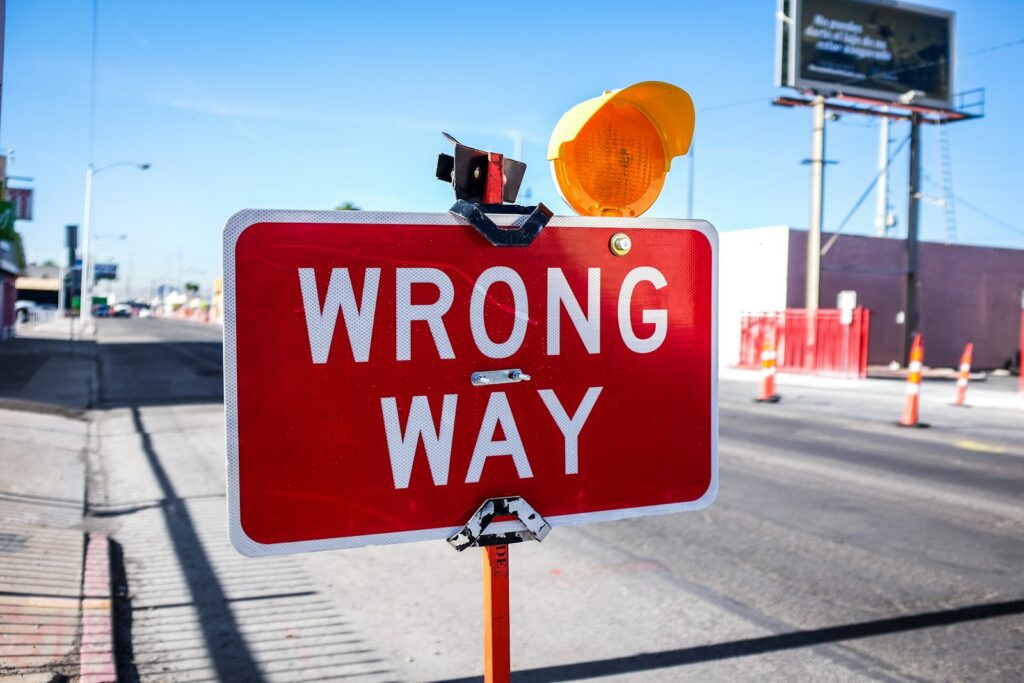
A rectangular shaped sign is the one road sign shape that does not tell you what the sign does. Federal standards assign the rectangle to three different sign families at the same time: regulatory, guide, and warning. Every other reserved shape on an American road points to exactly one thing. An octagon is always a stop. A downward-pointing triangle is always a yield. A rectangle can be a 45 mph speed limit, a green mileage panel, or a red WRONG WAY sign at a freeway ramp. We build DMV Ready, and this is the shape our users misread more than any other, because the shortcut most study guides teach is only half true. Here is what the rectangle actually signals, and what to read instead.
What a rectangular shaped sign means
Table 2A-1 of the Manual on Uniform Traffic Control Devices, 11th Edition (December 2023) is where American sign shapes are decided. The table lists each shape against the sign or series it belongs to. Next to “Rectangle (including square)” it lists three separate entries: Regulatory Series, Guide Series, and Warning Series.
Read the rest of that table and the significance lands. Seven shapes carry an asterisk defined as “This shape shall be limited exclusively to the sign(s) indicated.” The octagon belongs to STOP and nothing else. The pennant belongs to NO PASSING ZONE. The crossbuck belongs to the railroad grade crossing. The rectangle carries no such restriction, and it is the only shape in the entire table assigned to more than one sign series. That single formatting detail is the whole answer: a rectangle narrows the possibilities down to almost nothing.
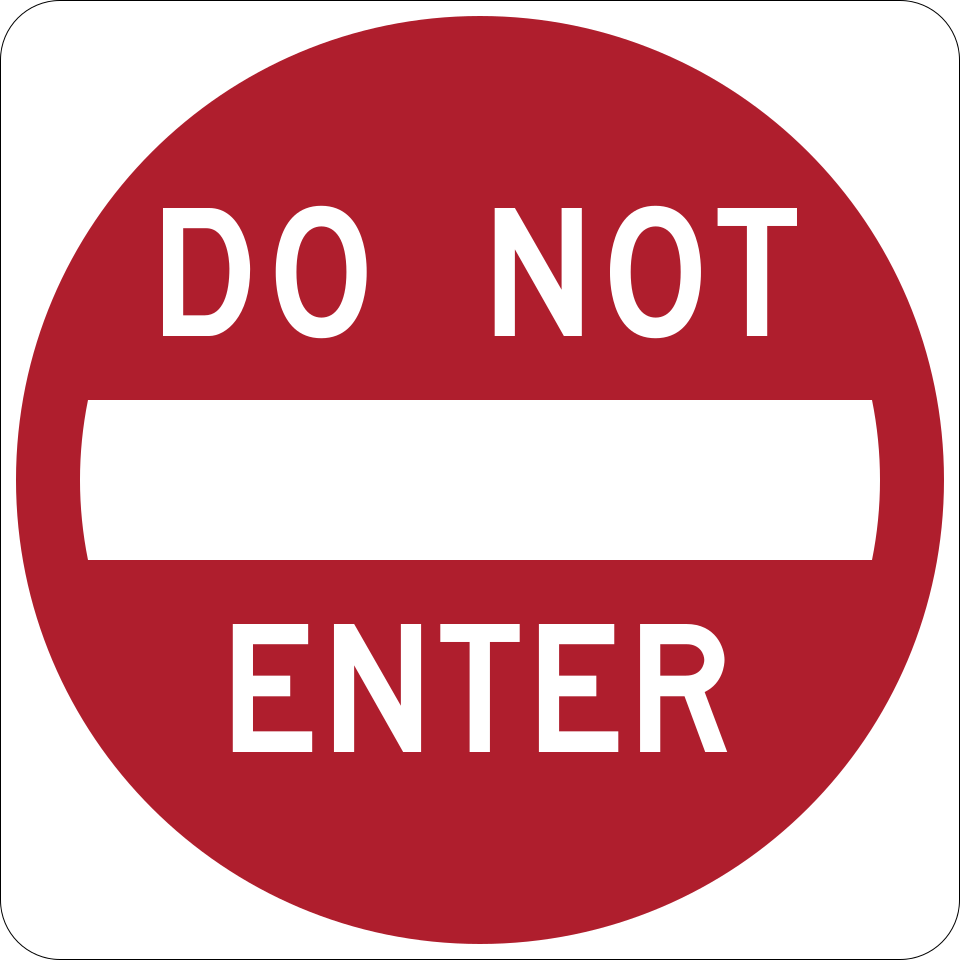
Squares count too. The table reads “Rectangle (including square),” so the 30 by 30 inch DO NOT ENTER sign is filed as a rectangle even though its sides are equal. Drivers who learned that a square is its own category are working from a rule that federal standards never wrote down.
The shapes the federal manual locks down, and the one it leaves open
Shape is a redundancy channel. A sign face can be snow-covered, sun-faded, or lit only by your low beams, and an exclusive outline still carries the message. That is why the manual protects those outlines so carefully.
| Shape | Reserved for | Code | Locked to one meaning |
|---|---|---|---|
| Octagon | STOP | R1-1 | Yes |
| Equilateral triangle, point down | YIELD | R1-2 | Yes |
| Circle | Grade crossing advance warning | W10-1 | Yes |
| Pennant, point right | NO PASSING ZONE | W14-3 | Yes |
| Pentagon, point up | School, county route | S1-1, M1-6 | Yes |
| Crossbuck | Railroad grade crossing | R15-1 | Yes |
| Trapezoid | Recreational areas, forest routes | M1-1 | Yes |
| Diamond | Warning series | W series | One series |
| Rectangle (including square) | Regulatory, guide, and warning series | R, D, W series | No |
Section 2A.05 goes further than most drivers realize. Where a second sign would be mounted on the back of a stop sign or a pennant and would poke past its edge, the manual tells agencies to use separate mountings, enlarge the exclusive-shape sign, or raise it instead. Where a narrow median or retaining wall leaves too little room, agencies may angle the sign up to 45 degrees toward the roadway or shrink it and duplicate it on the opposite side. Modifying the outline itself, such as clipping the left and right points off a diamond shaped warning sign, is flatly prohibited. Nobody guards a rectangle that way, because there is nothing unique to guard.
Vertical means regulatory, horizontal means guide: where that rule comes from
Ask any driving instructor and you will hear the shortcut. A tall rectangle is a rule; a wide rectangle is information. It is a useful teaching device and it is right most of the time, which is exactly what makes it dangerous.
Where does the shortcut come from? Layout. A speed limit stacks a number under two words, so it grows tall. A destination sets a place name beside an arrow, so it grows wide. The pattern is real, but it falls out of lettering rather than from any rule about meaning.
The California Driver Handbook states the safer version: a white rectangular sign communicates important rules you must obey. Notice the qualifier. The handbook attaches the meaning to the color and the shape together, not to the outline alone, and it treats red regulatory signs such as DO NOT ENTER as a separate group.
Search the federal manual for an orientation rule and you find the opposite of the folk version. The only rectangle-orientation provisions in the shapes section, Paragraph 05 of Section 2A.05, are space-constraint options for warning signs: where a warning sign normally displayed in a horizontal rectangle will not fit, its legend may be displayed in a vertical rectangle, and a standard warning sign mounted overhead may display its word legend in a horizontal rectangle. Both provisions describe warning signs and available room. Neither one splits regulatory from guide.
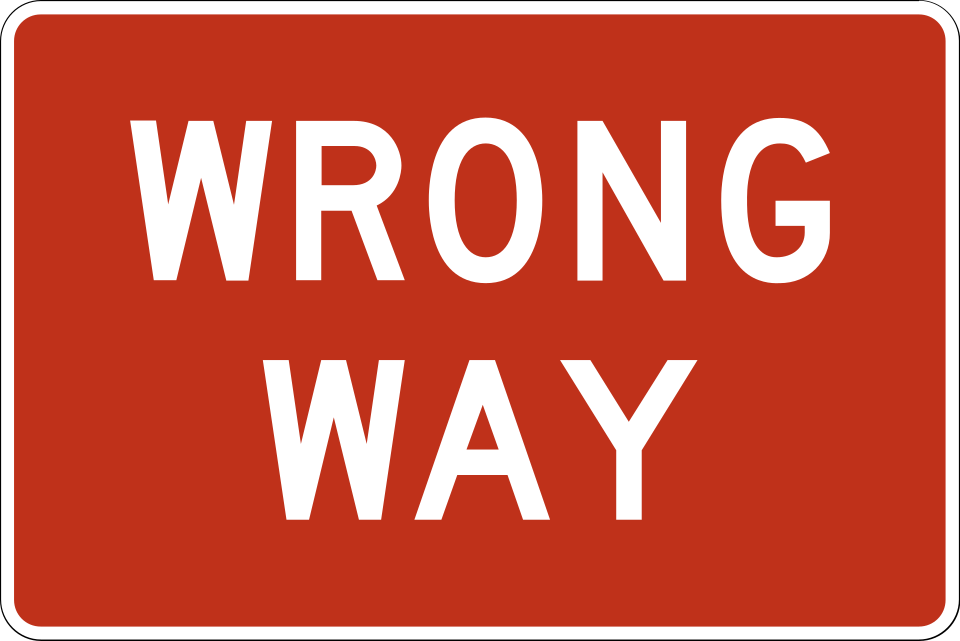
The common mistake: Priya, 15, is studying for her permit test in Austin and has drilled the shortcut until it is automatic. A question describes a red sign, wider than it is tall, reading WRONG WAY, and she marks it as a guide sign because of the orientation. WRONG WAY is R5-1a, a regulatory sign, and its conventional-road size is 36 inches wide by 24 inches tall. Its companion, DO NOT ENTER, is R5-1 at 30 by 30 inches, a perfect square. Two of the most urgent regulatory signs on any American road fail the vertical test outright.
Read the color before you read the shape
Because the rectangle is ambiguous by design, the color does the work the shape cannot. Table 2A-2 of the same manual sets out the standard assignments, and those nine backgrounds cover every category of traffic signs a test can ask about, from road conditions and construction to school children at an intersection.
| Background | What it marks | Rectangular example |
|---|---|---|
| White | Regulatory rules you must obey | SPEED LIMIT (R2-1) |
| Red | Prohibition | DO NOT ENTER (R5-1), WRONG WAY (R5-1a) |
| Yellow | General warning | Advisory word-message signs and plaques |
| Orange | Temporary traffic control | Work zone advance signs |
| Green | Guide, direction, distance | Exit and mileage panels |
| Blue | Road user services | Rest area, hospital, fuel panels |
| Brown | Recreational and cultural interest | Park and trailhead panels |
| Fluorescent yellow-green | School, pedestrian, bicycle warning | School speed limit assemblies |
| Fluorescent pink | Incident management | Emergency scene ahead signs |
Legend color is standardized alongside the background: black lettering on white, yellow, orange, and fluorescent yellow-green, and white lettering on red, green, blue, and brown. Symbols follow the same rules as words, which is how the meanings survive a language barrier.
Two footnotes in that section reward attention. Purple is restricted to electronic-toll account-only lanes, and coral and light blue are held in reserve by the Federal Highway Administration for uses it has not assigned yet, so the roadside color vocabulary is not finished. Our deeper breakdowns of regulatory signs and what each one requires, warning signs by color, and blue service signs walk through each family in turn.
The rectangles you will meet on the permit test
Sizes are published in Table 2B-1 of Part 2B of the manual, and they make the orientation argument concrete. Every dimension below is width by height in inches, for a conventional single-lane road.
| Sign | Code | Series | Size (w x h) | Orientation |
|---|---|---|---|---|
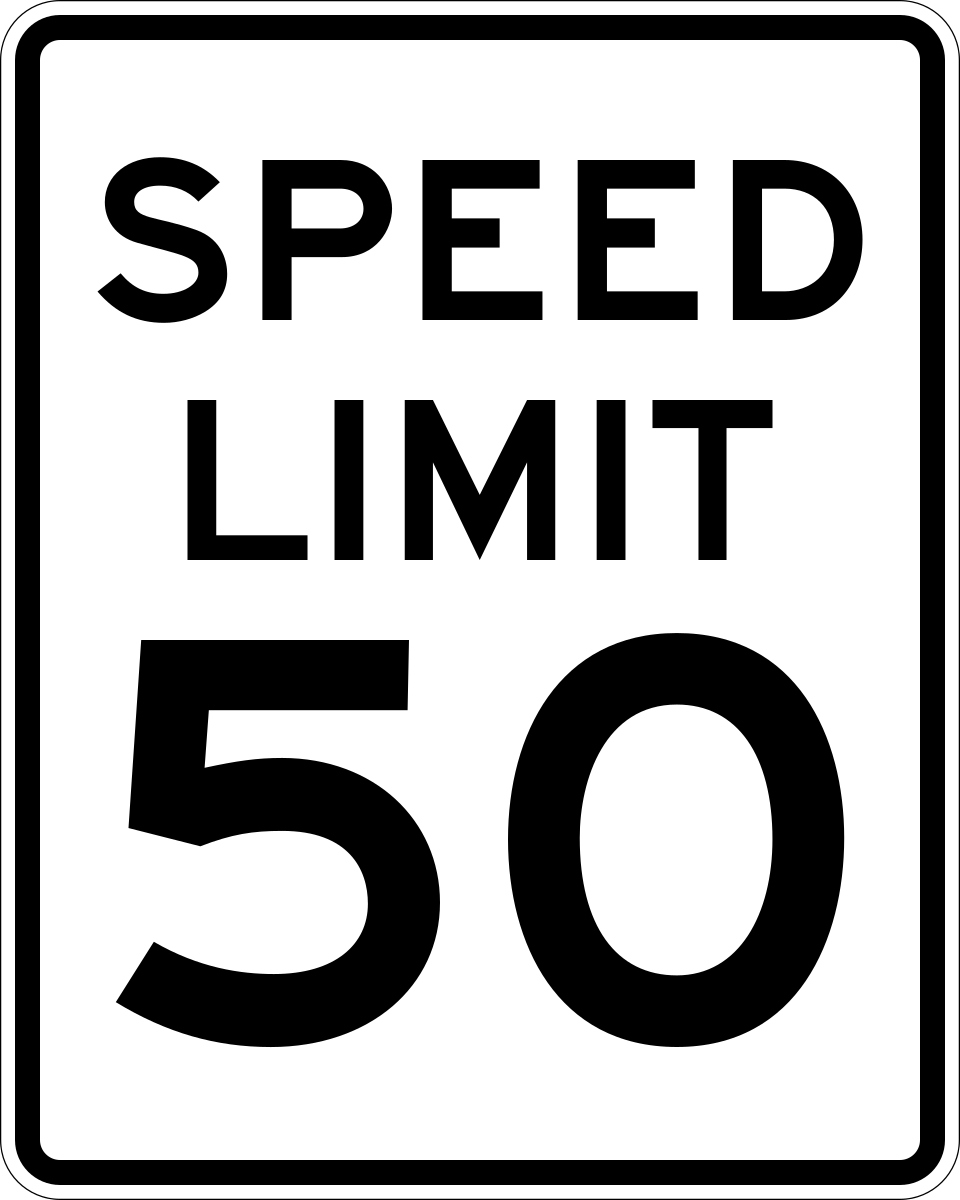
| SPEED LIMIT | R2-1 | Regulatory | 24 x 30 | Vertical |
| DO NOT ENTER | R5-1 | Regulatory | 30 x 30 | Square |
| WRONG WAY | R5-1a | Regulatory | 36 x 24 | Horizontal |
| Minimum Speed Limit plaque | R2-4P | Regulatory plaque | 24 x 24 | Square |
| BEGIN HIGHER FINES ZONE | R2-10 | Regulatory | 24 x 30 | Vertical |
| END TRUCK SPEED LIMIT | R2-14 | Regulatory | 24 x 30 | Vertical |
| Combined Max and Min Speed Limits | R2-4a | Regulatory | 24 x 48 | Vertical |
Every sign in that table is regulatory, which is precisely the trap. Guide rectangles outnumber them on any drive: the green panel counting down miles to the next city, the directional tab above an exit ramp, the green street name blade at the corner, the brown panel naming a state park. None of that signage carries a rule you can be ticketed for ignoring, and all of it is rectangular. Parking rectangles sit in between, since a NO PARKING sign is enforceable regulation but is designed as a plain white rectangle with a red legend. Warning rectangles round out the set as word-message signs and as plaques hung beneath a diamond to add a speed or distance, such as the advisory plaque under a school zone sign or a curve warning.
The speed limit sign scales with the road rather than changing shape: 24 by 30 inches on a conventional single-lane road, 30 by 36 on a multi-lane road, 36 by 48 on an expressway, and 48 by 60 on a freeway. Section 2B.21 also fixes what it may say. The posted number must be the limit established by law, ordinance, or regulation, it must be a multiple of 5 mph, and a sign must sit at each point where one limit changes to another. State guides follow the same federal spine, which is why the rectangles look identical whether you test for the California permit test, the Texas permit test, or the New York permit test.
What actually makes a rectangular sign enforceable
A shape has no legal force on its own. State law supplies it. California Vehicle Code section 21400 requires the Department of Transportation to adopt uniform standards and specifications for all official traffic control devices, naming speed restriction signs among them. New York takes a more direct route: under Vehicle and Traffic Law section 1680, the national manual is the state manual except where it conflicts with state law, with supplements added by the commissioner. Two states, two mechanisms, one rectangle that means the same thing on both roads.
The stakes behind those two rectangles are not abstract. The Insurance Institute for Highway Safety reports that roughly 11,000 deaths, or 29 percent of all crash fatalities, occurred in speed-related crashes in 2024. The AAA Foundation for Traffic Safety counted 4,164 fatal wrong-way crashes on United States divided highways between 2014 and 2023, causing 5,730 deaths, and found those crashes rising faster than traffic deaths overall. R2-1 and R5-1a are the two signs standing against those numbers, and one of them is vertical while the other is horizontal.
How rectangle questions show up on the written test
State question banks phrase it plainly: “A rectangular-shaped sign is…” with four options. The credited answer is almost always regulatory or guide, and the trap options are stop signs, yield signs, and railroad crossings, all three of which own an exclusive outline. Every knowledge test in the country leans on that one distinction, so getting it right takes a single step: eliminate anything with a reserved shape.
Reading Part 2A of the 11th edition line by line this week, what struck us is how much of the popular shortcut simply is not in the document. When we re-verified every answer in our question bank against official state sources, we corrected 28 of them, and shape-to-meaning items were exactly where third-party sources drifted from the handbooks. So we teach the sequence instead of the shortcut. Check whether the outline is reserved. If it is a rectangle, read the background color. Then read the legend, because on a rectangle the words carry the meaning that the shape gave up. The same discipline pays off on flashing yellow signals and on the pennant shaped no-passing sign, two other places where drivers guess from appearance and lose points. Our road signs practice test and the wider free DMV practice test both drill the shape-and-color pairing directly, and what is on the DMV permit test shows how heavily signs are weighted.
Rectangular shaped sign questions we get asked
These are the questions readers and app users send us most often about rectangles, answered against the current federal manual and state handbooks rather than the version of the rule that circulates in study forums.
What is a rectangular shaped sign?
A rectangle is the one sign outline federal standards assign to three families at once: regulatory, guide, and warning. It narrows nothing down by itself, so you read the background color and the legend to get the meaning.
Is a rectangular shaped sign always a regulatory sign?
No. MUTCD Table 2A-1 lists the rectangle against the regulatory, guide, and warning series. Green mileage panels and blue service panels are rectangles too, and neither carries a rule you can be cited for ignoring.
Does a vertical rectangle always mean regulatory?
No. That shortcut is a teaching convention rather than a federal standard. WRONG WAY (R5-1a) is regulatory and measures 36 inches wide by 24 tall, and DO NOT ENTER (R5-1) is a 30 by 30 inch square.
Is a square a rectangular sign?
Yes. Table 2A-1 reads Rectangle (including square), so square signs such as DO NOT ENTER are filed as rectangles. The federal manual has no separate square category.
What color is a rectangular guide sign?
Green marks direction, distance, and exits. Blue marks road user services such as fuel and lodging. Brown marks recreational and cultural sites. A white background on a rectangle signals regulatory instead.
Is a speed limit sign a rectangle?
Yes. The Speed Limit sign is R2-1, a vertical rectangle measuring 24 by 30 inches on a conventional single-lane road and 48 by 60 inches on a freeway. Its posted number must be a multiple of 5 mph.
What shape is a WRONG WAY sign?
A horizontal rectangle. WRONG WAY is R5-1a, 36 inches wide by 24 inches tall on a conventional road, white letters on red. It is regulatory despite being wider than it is tall.
One rectangle at a time, the shape stops being a puzzle. Treat the outline as a filter rather than an answer: it rules out stop, yield, and the railroad crossing, then hands the job to color and legend. Work through 4,000 practice questions in DMV Ready by state, and pay attention to the sign items you miss, since a wrong answer on a rectangle usually means the color went unread. Learn the reserved shapes cold, learn the nine background colors, and read the words. Then failing a sign question on test day takes real effort. If a retake does happen, our guide to the California written test retake rules covers what comes next.


 Scan to get the app