Pentagon Shaped Sign: What It Means

A pentagon shaped sign means school. It has five sides, points up, and under current federal standards carries a fluorescent yellow-green background with a black border and legend. Its federal code is S1-1, and it belongs to the warning family: it tells you schoolchildren may be in or near the roadway, and on its own it sets no speed limit you can be ticketed for exceeding. Two things about this sign trip up new drivers and permit test takers. The same pentagon does four different official jobs depending on the small plaque bolted underneath it, and the pentagon is not reserved for schools alone, so both of those are below with the federal text behind them.
What a pentagon shaped sign means
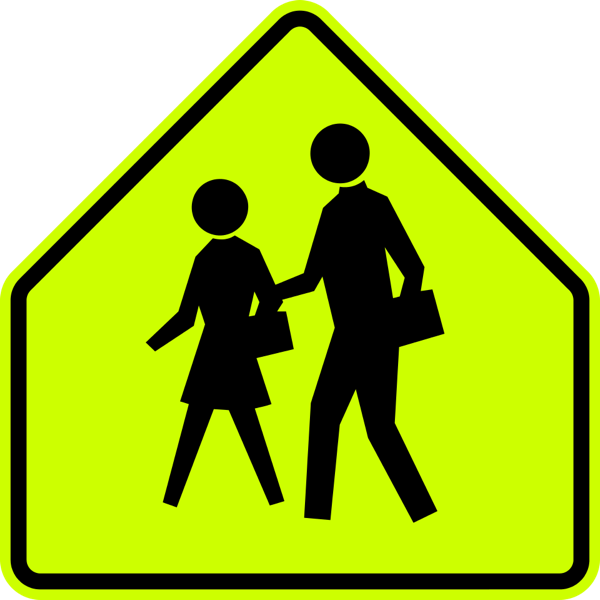
The Manual on Uniform Traffic Control Devices, Part 7 is where this sign is defined. Section 7B.01 requires that school warning signs “shall have a fluorescent yellow-green background with a black legend and border,” and that every sign used for school area traffic control be retroreflective or illuminated. That yellow-green is not decorative. The federal manual hands it to one purpose, so a driver scanning a suburban arterial at 40 mph can sort a school warning from an ordinary yellow warning diamond before reading a single word.
Size is standardized too. Table 7B-1 puts the S1-1 at 36 by 36 inches on a conventional road, 30 by 30 inches as an absolute minimum, and 48 by 48 inches on expressways and on roads with four or more lanes posted at 40 mph or higher. A pentagon that looks unusually large is not a different sign. It is the same S1-1 scaled for the speed you are carrying.
State manuals describe it in plainer language. The Pennsylvania driver manual tells applicants the pentagon “means you are approaching a school zone. If the sign is accompanied by a downward-pointing arrow, it means you are at the school zone crosswalk,” and it adds a detail worth holding onto: the sign “may have either a yellow background (as shown) or a fluorescent yellow-green background.” Older plain-yellow pentagons are still standing on plenty of roads. The shape, not the color, is what identifies it.
That last point matters more than it sounds. Fluorescent yellow-green sheeting entered the federal manual well after millions of school signs were already in the ground, and agencies replace signs on a maintenance cycle rather than all at once. A driver who has learned “school signs are yellow-green” and nothing else can miss a faded 1990s pentagon on a county road entirely. A driver who has learned the shape catches it in a mirror, in fog, or with half the face covered in snow, which is exactly the redundancy the federal manual is buying by reserving outlines in the first place.
The pentagon is a reserved shape, and there are two of them
Section 2A.05 of the federal manual states that “particular shapes, as shown in Table 2A-1, shall be used exclusively for specific signs or series of signs.” Seven outlines get that exclusive treatment.
Most of them behave the way you would expect. The octagon belongs to STOP and nothing else. The downward-pointing equilateral triangle belongs to YIELD, the circle to the grade crossing advance warning sign, the pennant to NO PASSING ZONE. The upward-pointing pentagon is the exception: it belongs to two signs, not one.
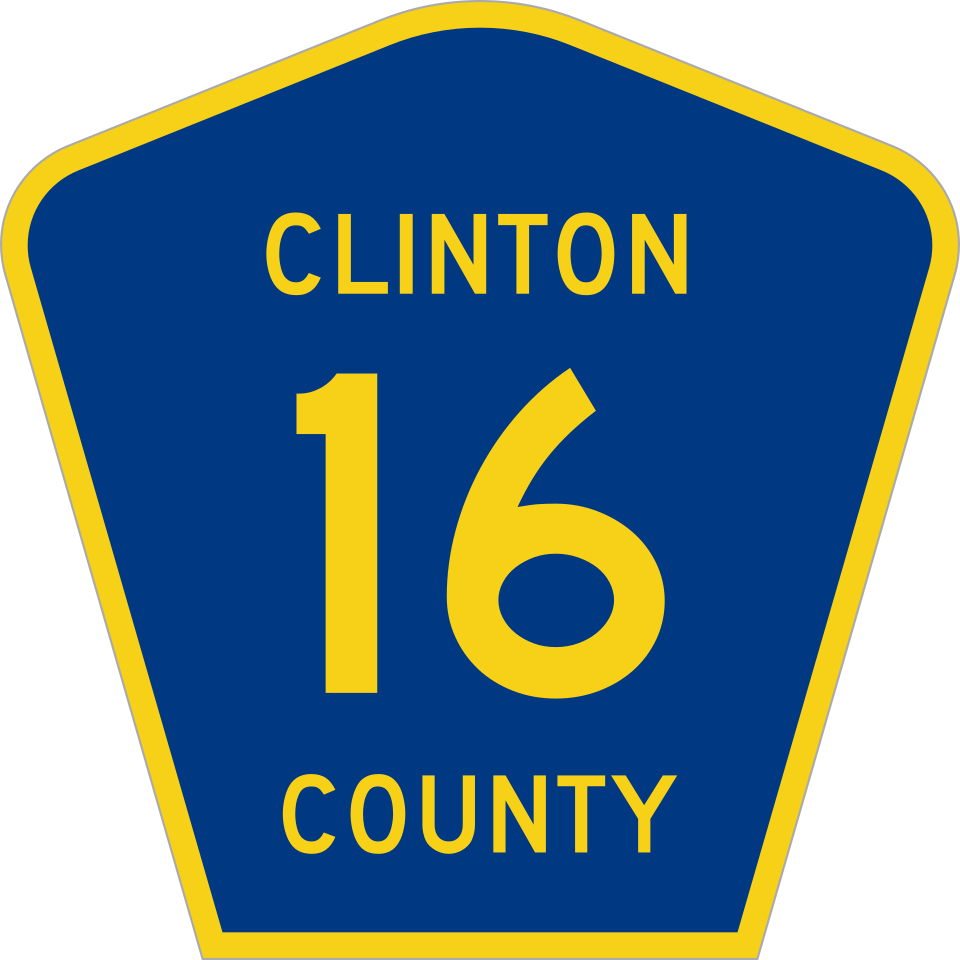
Read Table 2A-1 in Chapter 2A closely and the pentagon row lists the School sign (S1-1) with squared bottom corners and the County Route sign (M1-6) with tapered lower sides. The county marker is a guide sign, not a warning: Section 2D.11 requires it to carry “a yellow county name and route number and border on a blue background” at a minimum of 24 by 24 inches. Nothing about it concerns schoolchildren. It tells you which county road you are on.
| Pentagon sign | Code | Shape detail | Colors | Sign class | Minimum size |
|---|---|---|---|---|---|
| School | S1-1 | Squared bottom corners | Fluorescent yellow-green field, black legend and border | Warning | 30 x 30 in |
| County Route | M1-6 | Tapered lower sides | Blue field, yellow legend and border | Guide | 24 x 24 in |
Building DMV Ready meant reading all 50 state handbooks against the federal source, and this is one of the spots where nearly every state simplifies. Pennsylvania’s manual calls the pentagon “the only pentagon-shaped sign used on the roadway.” That is a fair teaching shortcut for a 16-year-old studying for a knowledge test, and it is what your state exam will almost certainly reward. It is also not what the federal manual says. If you drive rural county roads in Wisconsin, Ohio or New York, you have passed blue M1-6 pentagons for years.
Confusing the two in daylight is close to impossible, which is why the shortcut survives. Warning colors and guide colors sit at opposite ends of the palette, and the county marker carries a number where the school sign carries a symbol. The shortcut breaks only when a test writer asks which signs use the pentagon rather than what the pentagon means.
Exclusive shapes are not a filing convention either. Section 2A.05 tells agencies not to obscure one by mounting a second sign on the back of the same assembly, and offers remedies when space is tight: separate posts, a larger sign, a higher mount. The outline itself is treated as information, worth protecting even when the legend cannot be read.
One pentagon, four official jobs
Section 7B.02 lists four applications for the S1-1, and the plaque hung beneath it is what selects between them. This is the part competitors flatten into a single sentence, and it is the part that changes what you should actually do behind the wheel.
| Assembly | Pentagon plus | Where it stands | What it is telling you |
|---|---|---|---|
| School Area | Nothing, or an arrow plaque (W16-5P, W16-6P) | Approaching school buildings, grounds or activity | A school is adjacent to this road. Speed limit unchanged |
| School Zone | Optional SCHOOL (S4-3P) or ALL YEAR (S4-7P) plaque | The legal start point of a designated school zone | You have entered a zone with its own statutory standing |
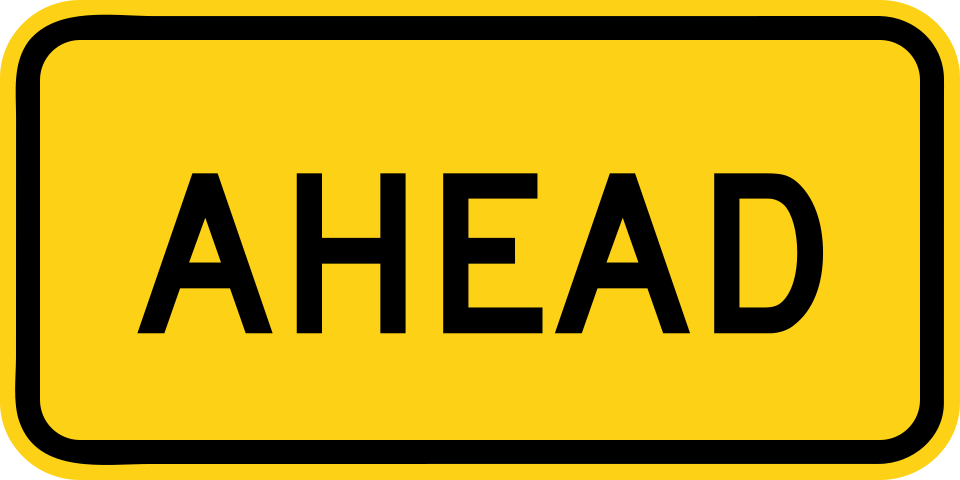
| School Advance Crossing | AHEAD (W16-9P) or XX FEET (W16-2P, W16-2aP) | In advance of the first crossing on your approach | A marked school crossing is coming. Cover the brake |
| School Crossing | Diagonal downward arrow (W16-7P) | At the crossing itself | The crosswalk is here, beside this post |
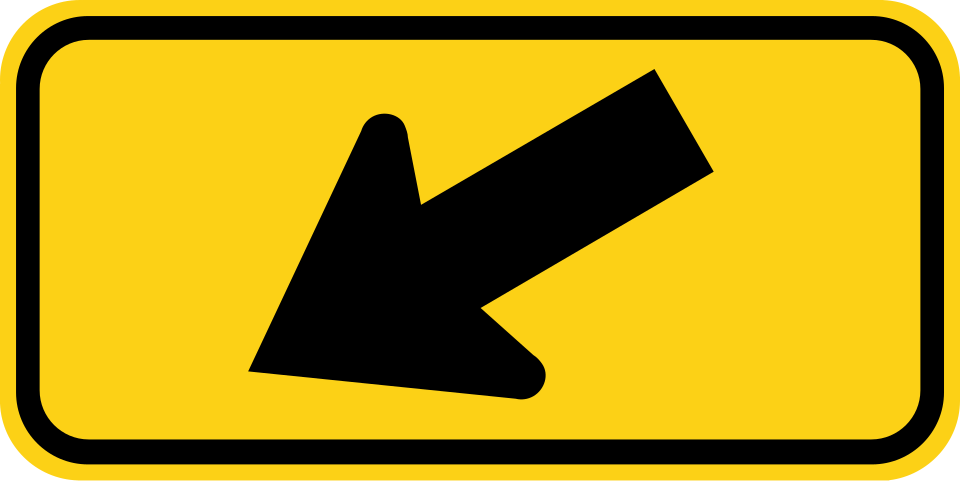
The W16-7P arrow plaques come in handed versions, and the direction is deliberate. Each one points down and toward the crosswalk it serves, so a left-hand variant on a divided road is telling you the crossing sits on the far side of the median rather than at your shoulder. Where a school or a crossing is on a cross street near an intersection, agencies may mount the pentagon with a directional arrow (W16-5P) or an advance turn arrow (W16-6P) so a driver who turns is warned before the turn rather than after it. Section 7B.03 also permits a reduced 12-inch S1-1 mounted in the roadway itself on a flexible base, which is why a knee-high pentagon standing on the centerline is a legitimate federal sign and not a school fundraiser.
Where a school zone has been designated under state or local statute, Section 7B.02 requires an S1-1 at the beginning point. Agencies may close the zone with an END SCHOOL ZONE (S5-2) sign, and they may add an S4-7P ALL YEAR plaque where a school runs a 12-month calendar. So the presence or absence of a small rectangle under the pentagon tells you whether the restriction you are entering pauses in July. Our deeper breakdown of the sign in context sits in the school zone sign guide.
The pentagon warns, the rectangle sets the speed limit
No pentagon anywhere in the federal manual carries an enforceable speed. Section 7B.05 assigns that job to a separate device: either a School Speed Limit assembly built on the standard SPEED LIMIT sign (R2-1), or the School Speed Limit When Flashing sign (S5-1), a 24 by 48 inch rectangle paired with a flashing yellow beacon. Both are regulatory, both are rectangles, and both are what an officer writes a citation against.
The plaques on that assembly are where states differ most. A WHEN FLASHING plaque (S4-4P) ties the reduced limit to the beacon overhead. A time-of-day plaque (S4-1P) spells out windows such as 7:30 to 8:30 AM and 2:30 to 3:30 PM. A MON-FRI plaque (S4-6P) rules out weekends.
Section 7B.06 adds the money: BEGIN HIGHER FINES ZONE (R2-10), END HIGHER FINES ZONE (R2-11), and plaques reading FINES HIGHER, FINES DOUBLE, or a specific dollar figure. Our page on school zone speed limits works through how those windows are written state by state, and the same warning-versus-regulatory split runs through every shape we cover in the rectangular sign guide.
Practically: if you slow for the pentagon and hold the posted limit, you have complied. If you see a rectangle with a number under a flashing beacon, that number is the law until the END sign. The order of the two devices on a well-signed approach is worth memorizing, because permit tests like to scramble it. The pentagon comes first as a warning, the R2-1 rectangle follows as the rule, and an END SCHOOL SPEED LIMIT (S5-3) or END SCHOOL ZONE (S5-2) sign closes it. Anything you can be cited for happens between the second sign and the last one.
The mistake that gets drivers ticketed, and children hurt
Picture a 16-year-old driving to school in Columbus. She passes a yellow-green pentagon with a diagonal W16-7P arrow, sees no stop sign, no signal and no painted stop line, and rolls through at 30 mph because nothing told her to stop. Her instinct is backwards, and the federal manual explains why.
Section 7B.03 states that the School Crossing assembly “shall not be installed on an approach controlled by a STOP or a YIELD sign,” with narrow exceptions at roundabouts and channelized right-turn lanes where the crosswalk sits at least 20 feet ahead of the yield point. Read that in reverse and it becomes a rule you can drive by: where a pentagon carries a downward arrow, you are almost certainly the only traffic control at that crosswalk. Nothing will stop the driver behind you either. The same section bars the assembly from any crossing that is not adjacent to a school or on an established school pedestrian route, which means the sign is never decorative. Somebody’s daily walking route crosses there.
The timing data lines up with the sign placement. NHTSA’s school-transportation-related crash fact sheet (DOT HS 813 731, June 2025) counted 971 fatal school-transportation-related crashes from 2014 to 2023, with 1,079 people killed, an average of 108 per year. Of the 209 school-age children who died, 79 were pedestrians, and about half of those killed on foot were 5 to 10 years old. More school-age pedestrians were killed between 7:00 and 7:59 a.m. and between 3:00 and 3:59 p.m. than in any other hour of the day. Those are precisely the two hours the pentagon exists to cover.
What that driver should have read was the pair of signs, not the single one. An advance crossing assembly, pentagon plus AHEAD (W16-9P) or a distance plaque (W16-2P), had already gone by before she reached the arrow, because Section 7B.03 requires one in advance of the first crossing on each approach unless a school zone sign has already opened the zone. Two pentagons on one block is not redundancy. The first buys braking distance, the second marks the paint. Treat the second one the way you would treat an unsignalized crosswalk anywhere else and let anyone waiting at the curb go.
How pentagon questions show up on the permit test
Written exams ask about this sign by shape rather than by picture more often than any other warning sign, because the pentagon is unmistakable in text. Expect phrasings such as “a pentagon-shaped sign is a ___,” “what does a five-sided sign mean,” or a question showing the S1-1 with a downward W16-7P arrow and asking what the arrow adds. The distractors are consistent: railroad crossing, hospital, no passing zone, and speed limit. Only the last one is genuinely tempting, and the answer is that the pentagon warns while a rectangle regulates.
When we re-verified our full question bank against official state sources, we corrected 28 answers, and sign questions were where published sources disagreed most often, usually because a state handbook still pictured a plain yellow pentagon that the federal manual had already moved to fluorescent yellow-green. Traffic Signs is one of the 14 topic categories in DMV Ready, with 243 questions behind it, and the school pentagon appears in nearly every state’s set. If you want the shape family side by side, our diamond sign guide covers the general warning outline, and our road signs practice test mixes them the way a real exam does. Everything we publish on signage is indexed on the traffic signs hub.
State question sets are not identical, so practice in yours: Pennsylvania, Ohio and California all weight sign questions differently, and the full list is on our states page. Crossing-related questions also lean on right of way, which our pedestrian crossing signs page covers.
FAQs about pentagon shaped signs
What does a pentagon-shaped sign mean?
It means school. The five-sided, upward-pointing sign is the School sign, federal code S1-1, and it warns that a school area, school zone or school crossing is present. It is a warning sign, so it sets no speed limit by itself.
What sign has a pentagon shape?
Two do. The School sign (S1-1) has squared bottom corners and a fluorescent yellow-green background. The County Route marker (M1-6) has tapered lower sides and carries a yellow county name and number on a blue background at a minimum of 24 by 24 inches.
What should I do when I see a pentagon sign?
Slow down, scan both shoulders and be ready to stop for children. If a downward diagonal W16-7P arrow plaque hangs below it, the crosswalk is at that post, and federal Section 7B.03 rules mean the approach is almost never stop-controlled or yield-controlled.
What does a five-sided sign mean?
Five-sided and five-sided pointing up are the same thing on US roads: a school warning sign. Your state exam will phrase it as five-sided, pentagon-shaped or pentagonal, and all three describe S1-1.
Is a pentagon sign a speed limit sign?
No. Section 7B.05 puts the enforceable school speed limit on a rectangular sign, either a School Speed Limit assembly built on the R2-1 speed limit sign or the 24 by 48 inch School Speed Limit When Flashing sign (S5-1) paired with a flashing beacon.
Why are school signs yellow-green instead of yellow?
Federal Section 7B.01 requires a fluorescent yellow-green background on school warning signs so drivers can separate them from ordinary yellow warnings at a glance. Legacy plain-yellow pentagons remain legal until agencies replace them.
Is the pentagon sign the same as a school crossing sign?
There is no separate school crossing pentagon. The School Crossing assembly is the same S1-1 sign with a diagonal downward-pointing arrow plaque (W16-7P) added beneath it to mark the crossing location.
Pentagon questions are free points once the shape is locked in, because no other US warning sign competes for it. Fix three things in memory and you have the whole family: five sides pointing up means school, the plaque underneath tells you whether the crossing is ahead or right here, and the number you can be ticketed for is always on a rectangle. Then practice in your own state’s question set, since the sign appears in every state bank but the wording around it is local. Open DMV Ready, pick your state, and run the Traffic Signs topic until pentagons stop making you pause.


 Scan to get the app