Warning Signs: What Each Color Means
A warning sign tells you a condition is coming. It does not state a legal requirement, and it carries no penalty of its own. That single distinction runs through the entire class. The federal Manual on Uniform Traffic Control Devices sets the default in Section 2C.02: warning signs “shall be diamond-shaped (square with one diagonal vertical) with a black legend and border on a yellow background.” Yellow diamond, black symbol. That description covers most warning signs and misses several that matter on a permit test. Reading the current 11th edition of Part 2C line by line, then checking it against our own question bank, turned up three things no page currently ranking for this term explains.
What actually makes a sign a warning sign
Function defines the class, not shape and not color. A warning sign describes something ahead that a driver would not otherwise expect: a curve tighter than the road has been, a crossing, a surface that behaves differently when wet. The Oregon driver manual puts the responsibility question plainly. Warning signs “alert you to known possible hazards or a change in road conditions ahead,” and then the manual adds the sentence most study guides leave out: “As a driver, you are ultimately responsible for recognizing and reacting correctly to changing conditions, signed or not.”

Read that against the regulatory sign class and the split gets sharp. A regulatory sign creates a duty at that exact spot. A warning sign transfers information and leaves the judgment with you. Nobody gets cited for passing a Deer Crossing sign at the posted limit. Plenty of people get cited under a state’s basic speed law for the crash that followed, which is a different charge entirely and one the sign never mentioned.
Shape backs up the function. The diamond has one job in the American sign system, and drivers learn it before they can read the symbol inside. Our guide to diamond shaped signs covers the shape itself; this page covers the class that shape usually announces.
Scarcity is written into the standard as a design principle. Section 2C.01 requires that every warning sign rest on “an engineering study or on engineering judgment,” then adds a warning about warnings: their use “should be kept to a minimum as the unnecessary use of warning signs tends to breed disrespect for all signs.” Seasonal conditions get their signs removed or covered once the condition is gone. A yellow diamond is meant to be rare enough that it still registers, which is close to the opposite of how most drivers assume the system was built.
The four colors a warning sign is allowed to wear
Yellow is the default, not the whole list. Table 2A-2 in Part 2A assigns background colors by sign function, and four of them land on warning signs. Section 2C.02 then splits two of those into an option and a requirement. Signs for pedestrians, bicyclists and playgrounds “may have a black legend and border on a yellow or fluorescent yellow-green background.” Signs for school buses and schools “shall have a black legend and border on a fluorescent yellow-green background.” May for the first group, shall for the second, which is why a pedestrian crossing sign turns up in both colors depending on the town and a school zone sign never does.
| Background | What it signals | Where you see it |
|---|---|---|
| Yellow | Standard warning | Curve, Slippery When Wet, Deer Crossing, Merge |
| Fluorescent yellow-green | Pedestrian, bicycle, playground, school | Optional for the first three, required for school signs |
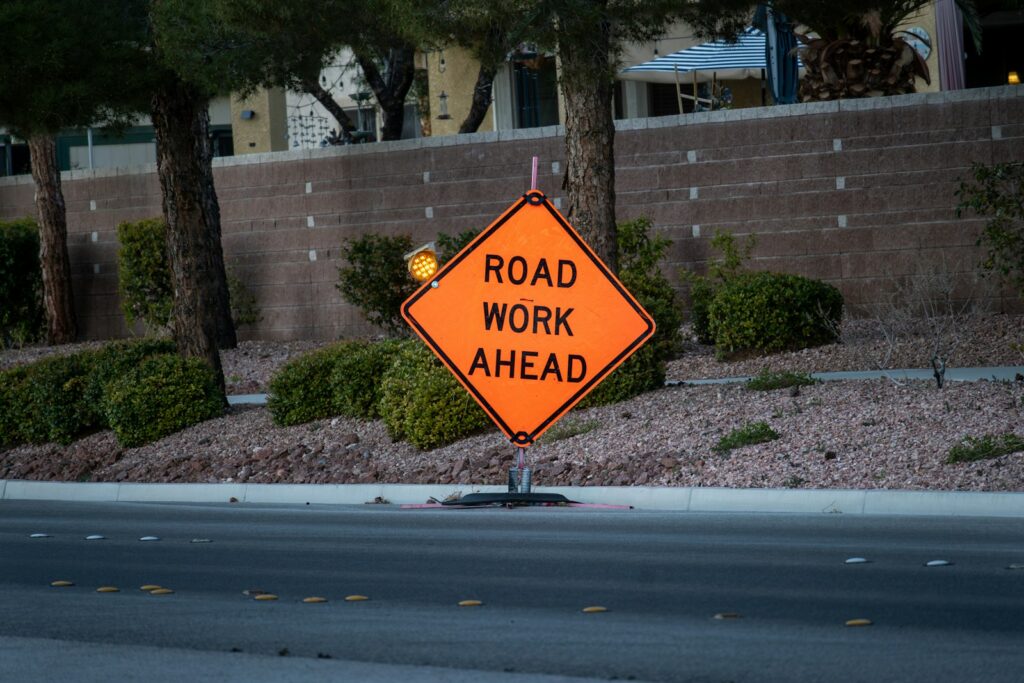
| Orange | Temporary traffic control | Road Work Ahead, Flagger Ahead, Lane Closed |
| Fluorescent pink | Incident management | Crash and emergency scenes, temporary detours around them |
Fluorescent pink is the one almost nobody teaches. Table 2A-2 gives it to incident management, the temporary signing crews put out around a crash or a hazmat spill, and a driver who has only studied yellow reads pink as decoration. Two colors sit in the table doing nothing at all: coral and light blue “are being reserved for uses that will be determined in the future by the Federal Highway Administration.” They are placeholders in a federal standard, waiting for a job.
Color is worth using as a decoding tool rather than a memory item. If the background is yellow, something about the road ahead changes. If it shifts to fluorescent yellow-green, people on foot or on bikes are the reason. If it goes orange, the condition is temporary and somebody is working in it. If it is pink, an incident happened here recently and the signing went up in a hurry. Four questions answered before you have read a single word of the legend.
Why the sign sits so far before the hazard
The distance is engineered, and the number comes out of a table. Section 2C.04 explains that warning sign placement is built around Perception-Response Time, the interval a driver needs to detect a sign, recognize it, decide, and act. Table 2C-3 then converts speed into feet. At 25 mph a sign warning of a lane change in heavy traffic goes 325 feet ahead of the condition. At 55 mph the same sign goes 990 feet ahead, roughly a fifth of a mile.
| Posted or 85th-percentile speed | Speed reduction and lane changing (Condition A) | Deceleration to a stop (Condition B, 0 mph) |
|---|---|---|
| 25 mph | 325 ft | 155 ft |
| 35 mph | 565 ft | 250 ft |
| 45 mph | 775 ft | 360 ft |
| 55 mph | 990 ft | 495 ft |
| 65 mph | 1,200 ft | 645 ft |
| 70 mph | 1,250 ft | 730 ft |
Two footnotes on that table change how it reads. Signs carrying legend smaller than six inches, or more than four words, get a minimum of 100 additional feet so the text stays legible long enough to matter. Condition B distances assume an alignment warning symbol readable from 250 feet, which is why a symbol beats a word message at speed.
Placement earns that engineering on curves. An FHWA study of Fatality Analysis Reporting System data found that roughly 27 percent of fatal crashes occurred along horizontal curves, that run-off-road and head-on crashes together made up 81 percent of those, and that the average crash rate on horizontal curves runs about three times the rate on other highway segments. A winding road sign placed 990 feet out is not caution for its own sake. It is the gap a driver needs to shed speed before geometry stops forgiving.
Drivers can read that table backwards at the wheel. A curve sign that shows up with no curve in sight is not premature: at 65 mph the manual puts it 1,200 feet out, which is several seconds of nothing before the geometry arrives. A sign that appears late is the one worth noticing, because the manual allows an alignment warning sign to sit anywhere from the point of curvature up to 100 feet in advance when site conditions force it. Late placement means constrained, and constrained means less room than usual.
The advisory speed plaque is not a speed limit
Under a curve sign you will often find a small yellow square with a number on it. That is the Advisory Speed plaque, MUTCD code W13-1P, and its rules are stricter than its reputation. Section 2C.59 states that the plaque “shall only be used to supplement an advance warning sign” and “shall not be installed as a separate sign installation.” An advisory speed never stands alone on a post. If a speed number is by itself on a white rectangle, it is a regulatory speed limit and a different animal.

Two more rules from the same section are worth carrying into the test. The displayed speed “shall be a multiple of 5 mph,” so an advisory of 37 does not exist. And except in emergencies or temporary conditions, the plaque “shall not be installed until the advisory speed has been determined by an engineering study.” Somebody measured that curve. The number under the arrow is a finding, not a suggestion someone painted on a Tuesday.
Because the plaque is yellow, it belongs to the warning class, and the enforceable number on that stretch of road remains the posted speed limit. Drivers who read the advisory as the ceiling on a dry day at noon are misreading it in the other direction. Study the difference between advisory and regulatory numbers alongside your own state’s rules on the California permit test guide or the Texas permit test guide, since the wording each handbook uses varies more than the federal standard does.
Gap size decides what else goes up around the curve. Section 2C.06 keys device selection to the speed differential, meaning the difference between the curve’s advisory speed and the posted limit, statutory limit, or 85th-percentile speed on the approach. A small differential gets a curve sign by itself. A large one pulls in chevrons, a large arrow, and delineators along the curve. So a row of chevrons is not decoration, it is the manual saying this curve runs far slower than the road you were just on.
The warning signs that are not diamonds
Three exceptions get written into the manual one sign at a time, and each one is a permit test favorite precisely because it breaks the shape rule.
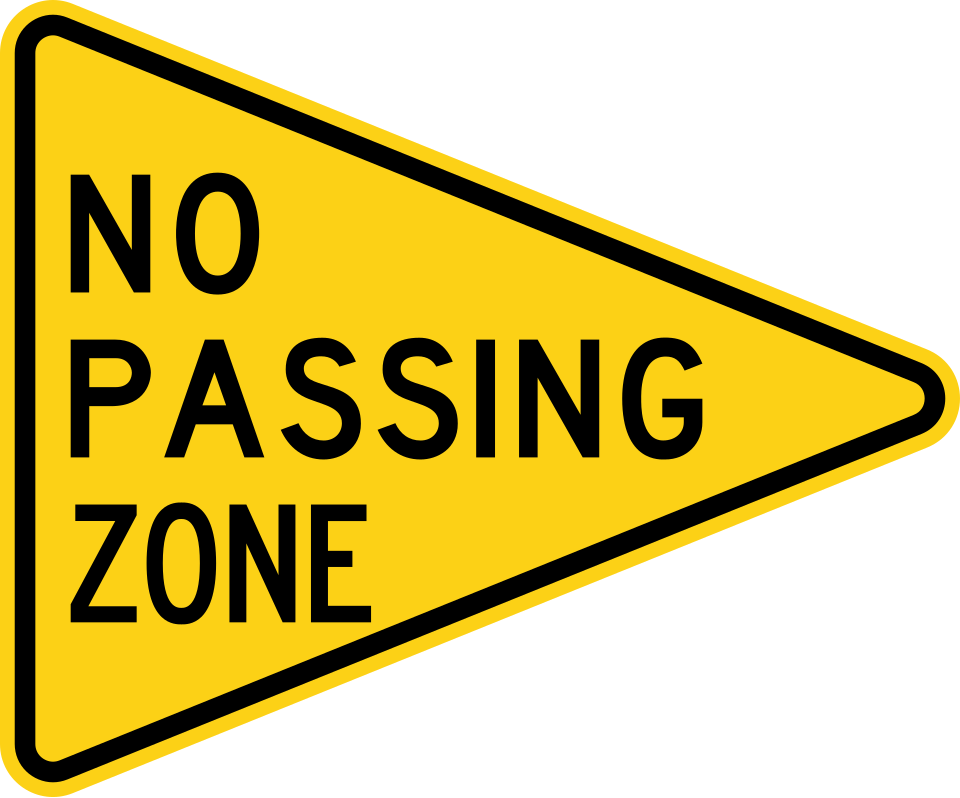
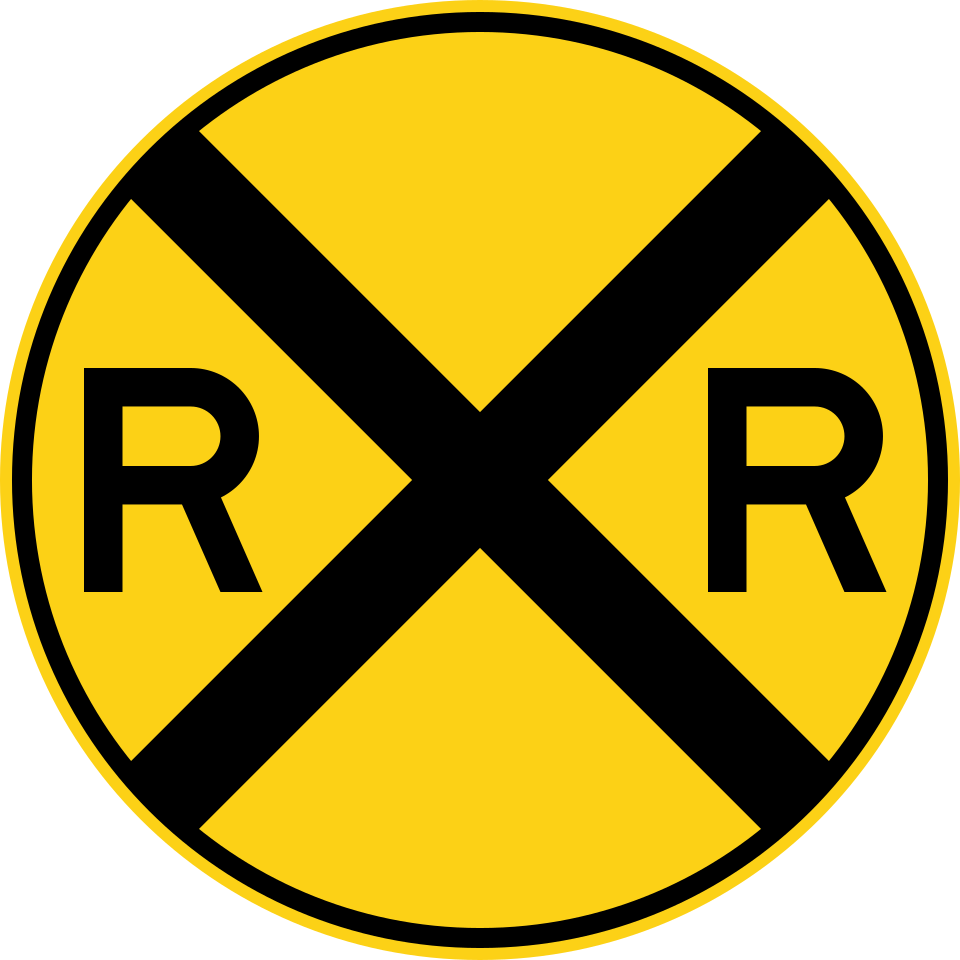
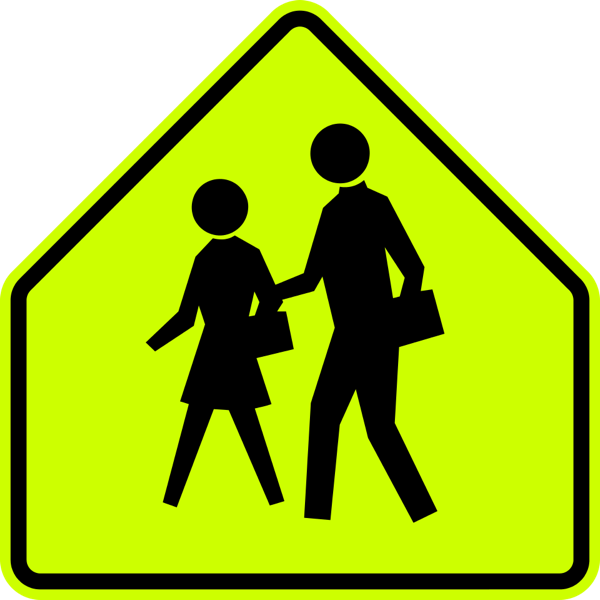
The pennant shaped NO PASSING ZONE sign, W14-3, is a horizontal triangle mounted on the left side of the road, opposite the black-and-white DO NOT PASS sign facing you on the right. Round belongs to W10-1, the railroad advance warning sign, the only circular sign in regular American use and a companion to the crossbuck at the tracks themselves. The pentagon belongs to school signs and nothing else.
Each of those shapes was reserved for the same engineering reason the octagon was. A shape reads from a distance, in a mirror, at night, and under the snow or grime that hides a legend. Reserve a shape for one message and the message survives conditions that destroy the words. That is why the exceptions cluster around hazards where a late read is expensive: a passing maneuver into oncoming traffic, a train, a child stepping off a curb.
One more exception is structural rather than symbolic. Section 2C.02 allows a warning sign larger than the oversized column in Table 2C-1 to be “diamond-shaped or may be rectangular or square in shape,” and the manual notes that a non-diamond shape “is typical for overhead installations.” The giant yellow rectangle hanging over a freeway lane is doing warning-sign work. It gave up the diamond because a diamond that size does not fit a sign bridge.
The mistake our question bank sees most
Building DMV Ready meant tagging every question in the bank against the sign it describes, and the distribution surprised us. Across roughly 4,000 questions covering all 50 states and DC, 204 name a sign in the question text itself. Sixty of those describe a warning sign and 63 describe a regulatory sign, so the two classes are nearly balanced. Inside the warning group the ranking is not what most study plans assume: work zone signs lead with 16 questions, ahead of railroad at 8, pedestrian and school at 8, merges and lane changes at 6, and curves at 5.
Orange is the reason. The Pennsylvania driver manual describes work zone signs as “normally diamond-shaped, like warning signs, but they are orange with black lettering instead of yellow,” and most study guides file them in a separate chapter called construction. Students then study warning signs and work zone signs as two unrelated topics, and the test asks about the orange ones more than the yellow ones.
Picture Marisol, 16, testing in Harrisburg. She has memorized the yellow diamonds cold. A question shows an orange diamond with a worker symbol and asks what class of sign it is. She answers “construction sign,” which is not one of the classes, and she misses it. On the road the same gap costs more than a point: FHWA reported 891 work zone traffic fatalities in 2022, and orange is the color that announces the zone before the cones start. Anyone preparing in Pennsylvania should work through the Pennsylvania permit test guide with the orange signs treated as what they are, which is warning signs on a temporary background.
Frequently asked questions
These are the questions people actually type after searching this term. Each answer below is checked against the 11th edition of the MUTCD and the state manuals cited above. Where a rule varies by state, the answer says so rather than picking one state and calling it the national answer, and the state-level detail lives on our state permit test pages.
What is a warning sign?
A warning sign tells drivers about a condition ahead, such as a curve, crossing or surface change. MUTCD Section 2C.02 makes the default a black legend on a yellow diamond. It carries information, not a legal duty.
What color are warning signs?
Yellow is standard. Fluorescent yellow-green is optional for pedestrian, bicycle and playground signs and required for school signs. Orange marks temporary traffic control and fluorescent pink marks incident management.
What shape is a warning sign?
A diamond, meaning a square turned so one diagonal is vertical. The exceptions are the pennant W14-3 no passing zone sign, the round W10-1 railroad advance sign, the school pentagon, and oversized signs mounted overhead.
Are orange construction signs warning signs?
Yes. Work zone signs are diamond-shaped like other warning signs but use an orange background for temporary traffic control. In our question bank they are the most frequently tested warning subject.
Is an advisory speed sign a speed limit?
No. The Advisory Speed plaque W13-1P is yellow, so it is a warning device. MUTCD Section 2C.59 says it may only supplement an advance warning sign and can never be installed alone. The enforceable number is the posted speed limit.
Why are warning signs placed so far ahead of the hazard?
MUTCD Table 2C-3 converts speed into placement distance using Perception-Response Time. At 25 mph a sign sits about 325 feet ahead; at 55 mph about 990 feet; at 70 mph about 1,250 feet.
What is the difference between a warning sign and a regulatory sign?
A regulatory sign states a legal requirement at that spot and disobeying it is a violation. A warning sign describes a condition ahead and leaves the judgment to the driver.
What does a diamond shaped sign mean?
A diamond shaped sign is a warning sign. MUTCD Section 2C.02 sets the diamond, a square turned so one diagonal is vertical, as the default shape for warning signs, with a black legend on a yellow background. It flags a condition ahead such as a curve, a crossing or a merge rather than stating a law you must obey, and an orange diamond carries the same meaning inside a work zone.
Warning signs are the half of the sign system that argues rather than orders, and that is exactly why they get misread. Learn the yellow diamond default first, then learn the four backgrounds and the three shapes that break the pattern. Treat orange as a warning color, not a separate subject. When a plaque under a curve shows a number, remember an engineer measured it and rounded to the nearest 5. Ready to see how your state words these questions? Practice with your own state’s question set on DMV Ready, where every sign question links back to the handbook section it came from.


 Scan to get the app