Regulatory Signs: What Each One Requires

A regulatory sign tells you what the law requires at that exact spot. Disobeying one is a moving violation. That is the whole definition. The federal Manual on Uniform Traffic Control Devices nails it in one sentence in Section 2B.01: regulatory signs “shall be used to inform road users of selected traffic laws or regulations and to indicate the applicability of the legal requirements.” Warning signs describe what might happen. Guide signs point to where you are. Regulatory signs are the only class that carries a duty. Reading the current 11th edition of Part 2B line by line turns up three things not taught on any permit-test page currently indexed.
What actually makes a sign regulatory
Most study guides teach the shape-and-color shortcut: white rectangle equals regulatory. Close enough, and worth understanding why it works. Section 2B.02 opens with a Standard: “Regulatory signs shall be rectangular unless specifically designated otherwise in this Manual.” Rectangular is the default. Everything else is a named exception written into the book one sign at a time.
Two of those exceptions matter more than the rest. The octagon belongs to the STOP sign (R1-1) and nothing else. Its downward-pointing equilateral triangle cousin belongs to the YIELD sign (R1-2) and nothing else. Both shapes read from behind and under snow that covers the legend, which is why they were reserved. Table 2A-2 in Part 2A then splits regulatory signs into a general group and a prohibitive subgroup, and only the prohibitive ones get red.

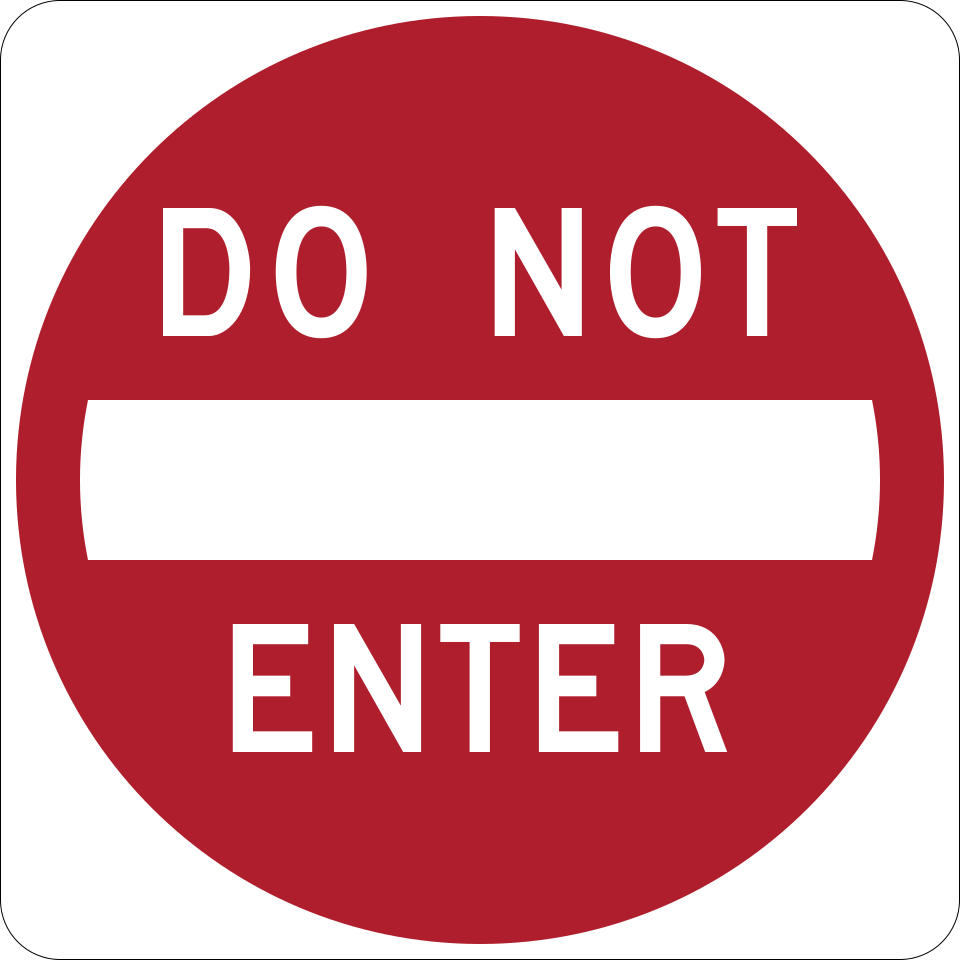
Red is doing specific work in that table. It marks prohibition rather than instruction, which is why DO NOT ENTER (R5-1) and WRONG WAY (R5-1a) are red while ONE WAY (R6-1) is a plain black-and-white arrow. One pair bans an action. The other points out which direction traffic runs. Students who memorize “red means regulatory” get DO NOT ENTER right and then miss ONE WAY, which is just as regulatory with no red on it.
Sizes are fixed too, and they scale with the road rather than with the sign shop’s inventory. Table 2B-1 sets the minimums:
| Sign | Code | Conventional road, single lane | Multi-lane | Freeway |
|---|---|---|---|---|
| STOP | R1-1 | 30 x 30 in | 36 x 36 in | not listed |
| YIELD | R1-2 | 36 x 36 x 36 in | 48 x 48 x 48 in | 60 x 60 x 60 in |
| Speed Limit | R2-1 | 24 x 30 in | 30 x 36 in | 48 x 60 in |
| DO NOT ENTER | R5-1 | 30 x 30 in | 36 x 36 in | 48 x 48 in |
| ONE WAY | R6-1 | 36 x 12 in | 48 x 18 in | 48 x 18 in |
One more Standard from Section 2B.01 tends to appear in night-driving questions: regulatory signs “shall be retroreflective or illuminated.” A regulatory sign that only works in daylight is not a compliant regulatory sign.
Stop signs are not speed bumps, and the manual says so
Here is the line most guides skip. Section 2B.06, paragraph 6, is a Standard, which is the manual’s binding language: “YIELD or STOP signs shall not be used for speed control.”
Every year, neighborhoods petition their city for a stop sign because cars come through too fast. The federal manual forbids installing one for that reason. Its supporting paragraph explains why: unnecessary stop signs teach drivers that stop signs can be ignored, which degrades the ones doing real work. Traffic calming, geometry, and enforcement are the tools for speed. A red octagon is not.
So when does an all-way stop actually go in? Only after an engineering study, and the manual publishes the warrants. These numbers appear on no permit-test site currently indexed, and they explain most of the intersections a new driver will ever encounter:
| Warrant | Section | Threshold |
|---|---|---|
| Crash experience, four-leg intersection | 2B.13 | 5 or more reported crashes in 12 months, or 6 or more in 36 months |
| Crash experience, three-leg intersection | 2B.13 | 4 or more in 12 months, or 5 or more in 36 months |
| Sight distance | 2B.14 | A stopped driver on the minor road cannot see conflicting traffic |
| 8-hour volume, major street | 2B.16 | 300 units per hour for each of any 8 hours of a typical day |
| 8-hour volume, minor street | 2B.16 | 200 units per hour for each of the same 8 hours |
Two details in that table repay a second look. “Units” counts motor vehicles, bicycles, and pedestrians together, so a busy crosswalk can help justify a stop sign even when car traffic is light. And if the 85th-percentile speed on the major street tops 40 mph, Section 2B.16 lets the vehicle volumes drop to 70 percent of those figures. Section 2B.12 then closes the door on automatic installs: meeting a warrant “shall not in itself require the installation of all-way stop control.”
The sign does not create the law, your state’s vehicle code does
This is the second thing missing from the guides. MUTCD is a design and installation standard published by the Federal Highway Administration. It is not a criminal code, and it cannot ticket anyone. The duty to obey comes from your state’s vehicle code, and the wording varies in ways that matter.
California went the direct route. Vehicle Code section 21461 makes it unlawful for a driver “to fail to obey a sign or signal defined as regulatory in the federal Manual on Uniform Traffic Control Devices,” provided the device was erected by lawful authority. Read that carefully: in California the federal manual’s definition of regulatory becomes the operative legal test, which is why the shape-and-color question on California’s permit test is not trivia.
Illinois wrote a different set of hooks. Under 625 ILCS 5/11-305, a driver must obey any official device “placed or held in accordance with the provisions of this Act.” Subsection (c) then removes the charge if the device “is not in proper position and sufficiently legible to be seen by an ordinarily observant person.” Subsection (d) balances it back: a device that approximately conforms is presumed lawful unless the contrary is established by competent evidence. New York uses nearly identical legibility language in Vehicle and Traffic Law 1110, worth knowing before anyone sits New York’s written test.
The practical translation for a new driver: a regulatory sign binds you when it is official, correctly placed, and readable. A sign swallowed by a tree branch is a defense in Illinois and New York. It is not an invitation to guess, and the presumption in subsection (d) puts the burden of proving otherwise on the driver.
Which regulatory signs actually show up on the test
DMV Ready maintains a bank of roughly 4,000 practice questions covering all 50 states and DC, and every answer was re-verified against official state sources during a 2026 accuracy audit that corrected 28 of them. That legwork is the only honest way to answer the question students actually ask, which is not “what is a regulatory sign” but “which ones will they ask me about.”
A tally of the most recent full export tells the story. Of the questions in the bank, 352 turn on a road sign of any class, and 187 of those involve a regulatory sign. The distribution is not what most students expect:
| Regulatory sign family | Code | Questions in the bank |
|---|---|---|
| Speed limit | R2-1 | 78 |
| STOP | R1-1 | 62 |
| YIELD | R1-2 | 30 |
| Parking restrictions | R7 and R8 series | 12 |
| Turn prohibitions | R3 series | 10 |
| ONE WAY, DO NOT ENTER, WRONG WAY | R6-1, R5-1, R5-1a | 9 |

Speed limit beats the stop sign, and it is not close. Students spend their study time on the octagon because it is the sign they can picture, while the sign generating more questions is a plain white rectangle whose rules change by road type, by state, and by whether the limit was set statutorily or by engineering study. Section 2B.21 of the 11th edition tightened that second path in December 2023: on urban and suburban arterials and on rural roads serving as main streets, “the 85th-percentile speed should not be used to set speed limits without consideration of all factors” listed in the section. The old habit of posting whatever 85 percent of drivers already do no longer stands alone. The DMV Ready guide to speed limit signs works through the state variations, and the same split shows up in the question sets for Texas and every other state on the site.
The mistake that puts people in the hospital
Picture Andre, 16, at a four-way intersection in a residential grid outside Columbus. He stops at his STOP sign, sees a STOP sign facing the cross street, and pulls out. Cross traffic never slows, because the intersection is a two-way stop and the sign he saw was for the opposite approach, not the crossing one.
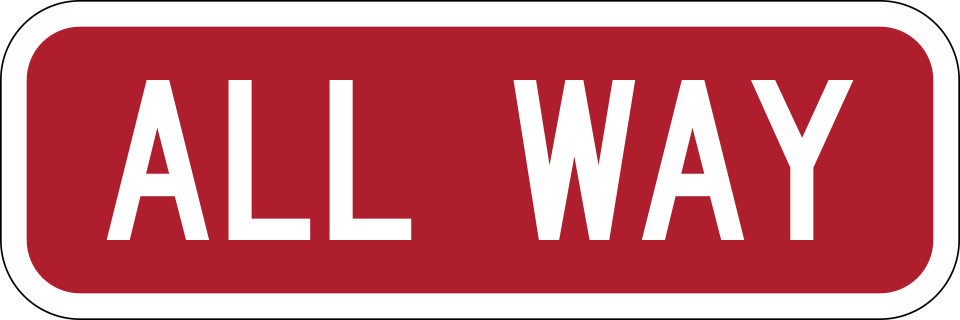
The manual gives drivers a way to check in under a second. Section 2B.04 makes the ALL-WAY (R1-3P) plaque mandatory: at intersections where every approach is stop-controlled, the plaque “shall be mounted below each STOP sign.” That same section bans the alternatives outright, so 2-WAY, 3-WAY, and 4-WAY plaques “shall not be used.” One legend, one rule. It either exists on the post in front of you or it does not.
Section 2B.04 also directs agencies to post a CROSS TRAFFIC DOES NOT STOP plaque, or the TRAFFIC FROM LEFT (RIGHT) DOES NOT STOP variant, at intersections where stop signs control all but one approach. Those plaques are guidance rather than a hard requirement, so they are not always there. The ALL-WAY plaque is a Standard, so its absence is information a driver can rely on. Andre’s error is one of the most common right-of-way misses turning up in the DMV Ready data, and it is the reason the Illinois practice set and the rest of the state decks drill intersection control rather than sign trivia.
When a regulatory sign stops working
Placement rules decide whether a sign is doing its job. Section 2B.18 requires the STOP or YIELD sign on the near side of the intersection, on the right-hand approach, and adds that they “shall not be mounted on the same post.” Guidance puts them within 50 feet of the edge of the intersected pavement. Where visibility is restricted, a Stop Ahead or Yield Ahead warning sign becomes mandatory in advance.
Temporary control has its own hard limit. Portable or part-time STOP and YIELD signs “shall not be used except for emergency and temporary traffic control zone purposes,” which is why the folding sign a flagger holds at a work zone is legitimate and a homemade one at the end of a driveway is not. Other DMV Ready guides to crossbuck signs at railroad crossings and the pennant-shaped no-passing sign cover two more places where the device you see is not the device carrying the legal weight. A third example: the school zone sign. The fluorescent pentagon warns; the rectangular assembly behind it sets the enforceable limit.
Consequences of ignoring regulatory control are measurable. The Insurance Institute for Highway Safety reports that 1,119 people were killed in red light running crashes in 2024 and more than 141,000 were injured, and about half of those killed were pedestrians, cyclists, or people in other vehicles. Signal control and sign control fail the same way, one driver at a time. Want the full taxonomy? The DMV Ready road sign guides break down every class, and yellow warning signs make a useful contrast: those describe what to expect, never what a driver must do.
Frequently asked questions
Below are the questions people search for alongside “regulatory signs,” answered against the 11th edition of the MUTCD and the state codes cited above. Where a rule varies by state, the answer says so rather than picking one state and calling it the national answer, and the state-by-state detail lives on the state permit test pages.
Regulatory signs are the small, unglamorous half of the sign system, and they are the half that writes tickets. Learn the shape-and-color rule, then learn the two exceptions and the reason they exist. Check for the ALL-WAY plaque before pulling out of a stop. Remember that the sign is a messenger and your state’s vehicle code is the message. Ready to test yourself? Practice with your own state’s question set on DMV Ready, where every regulatory sign question ties back to the handbook section it came from.


 Scan to get the app